Antoniac Iulian, Negrusoiu Mihai, Mardare Mihai, Socoliuc Claudiu, Zazgyva Ancuţa, Niculescu Marius
Biomaterials Group, Materials Science and Engineering Faculty, University Politehnica of Bucharest Colentina Clinical Hospital, Clinic of Orthopaedics and Traumatology I, Bucharest Victor Babeş University of Medicine and Pharmacy, Timişoara Department of Pathology, Colentina Clinical Hospital Department of Anatomical Pathology, Faculty of Dental Medicine, Carol Davila University of Medicine and Pharmacy, Bucharest Department of Cell and Molecular Biology, University of Medicine and Pharmacy Tîrgu Mureş, Tîrgu Mureş Department of Orthopaedics and Traumatology, Faculty of Medicine, Titu Maiorescu University, Bucharest, Romania.
Medicine (Baltimore). 2017 May;96(19):e6687. doi: 10.1097/MD.0000000000006687.
In younger patients, ceramic-on-ceramic (CoC) bearing surfaces are usually recommended for total hip replacement (THR) because of their low wear rate and longer expected functional life. Although technical advancements have reduced the risk of ceramic bearings fracture, this complication remains a major concern.
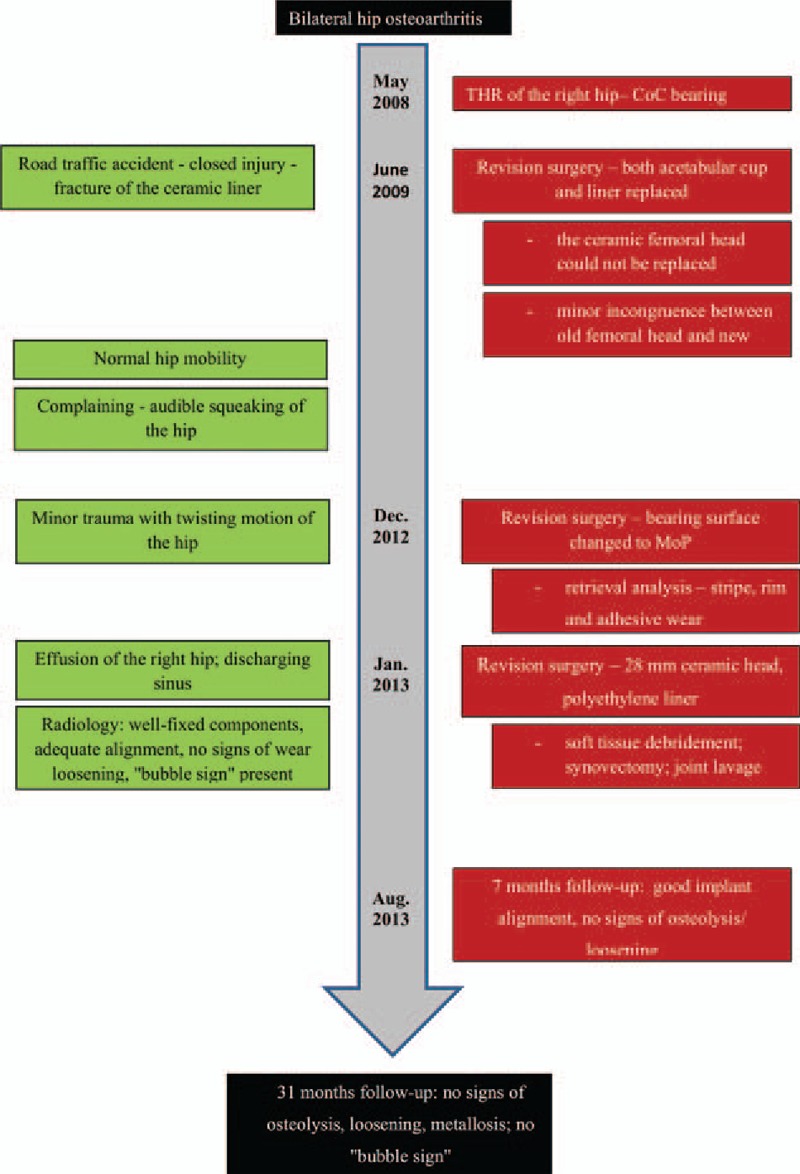
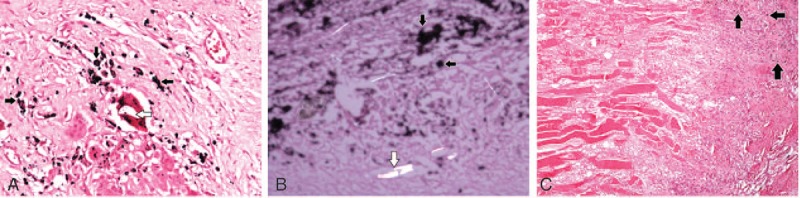
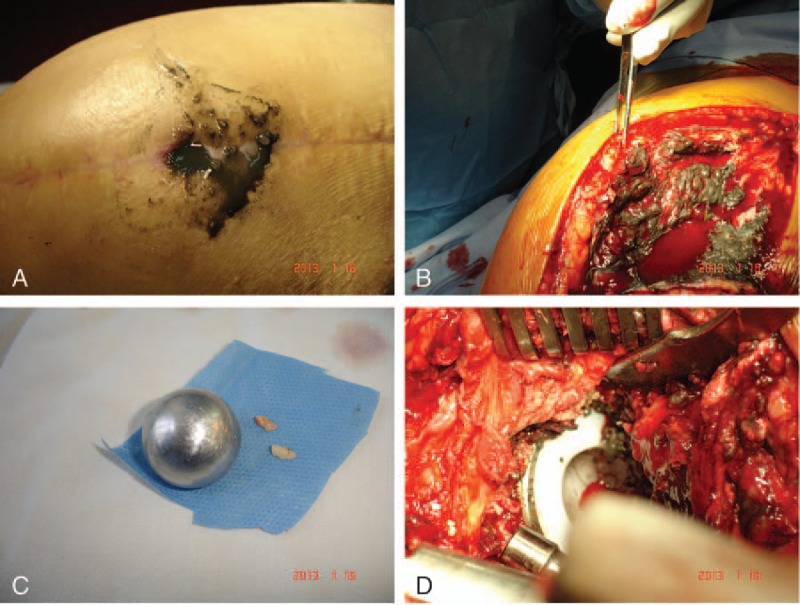
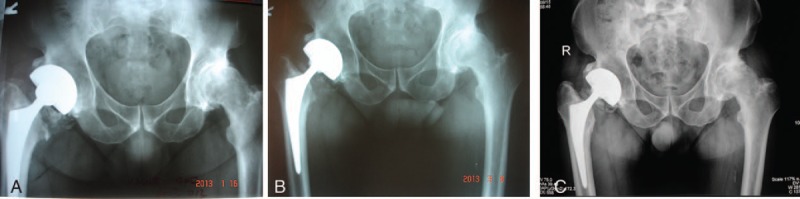
We present the case of a 56-year-old patient undergoing 3 revision hip arthroplasties of the right hip due to ceramic liner fractures. Initial THR (2008) was performed with a CoC bearing, followed by liner fracture due to trauma a year later. The acetabular component and liner were replaced, with a minor incongruence between the old head and new insert. The 2nd ceramic insert fractured 3.5 years later, following minor trauma. Upon revision, the bearing surface was changed to metal-on-polyethylene (MoP). The performed retrieval analysis demonstrated stripe and rim wear, and evidence of adhesive wear. The patient was referred to us a month later, with a fistula on the lateral side of the hip, discharging black, petroleum-like liquid. Radiology showed well-fixed implants, no dislocation and no apparent polyethylene wear. Microbiological assessment of the discharge showed no infection. Intraoperatively massive metallosis was noticed, with stable acetabular and femoral components. The metal femoral head was heavily abraded, with almost 1% volumetric wear. Hematoxylin and eosin stained frozen tissue samples showed muscular and adipose tissue necrosis, while polarized light microscopy highlighted metal, polyethylene, and ceramic particles.
The present case is yet another report showing the adverse outcomes of using MoP bearings for revision after ceramic liner fracture in THR.
在年轻患者中,由于其低磨损率和更长的预期功能寿命,通常推荐在全髋关节置换术(THR)中使用陶瓷对陶瓷(CoC)关节面。尽管技术进步降低了陶瓷关节面骨折的风险,但这种并发症仍然是一个主要问题。
我们报告一例56岁患者,因陶瓷内衬骨折接受了3次右髋关节翻修置换术。初次全髋关节置换术(2008年)采用CoC关节面,一年后因外伤导致内衬骨折。髋臼组件和内衬被更换,旧股骨头与新内衬之间存在轻微不匹配。3.5年后,第二次陶瓷内衬在轻微外伤后骨折。翻修时,关节面改为金属对聚乙烯(MoP)。进行的取出分析显示有条状和边缘磨损以及粘着磨损的证据。一个月后患者被转诊至我们这里,髋关节外侧有一个瘘管,流出黑色的、类似石油的液体。放射学检查显示植入物固定良好,无脱位且无明显的聚乙烯磨损。对流出物的微生物学评估显示无感染。术中发现大量金属沉着病,髋臼和股骨组件稳定。金属股骨头严重磨损,体积磨损近1%。苏木精和伊红染色的冷冻组织样本显示肌肉和脂肪组织坏死,而偏振光显微镜检查突出显示了金属、聚乙烯和陶瓷颗粒。
本病例是另一例显示在全髋关节置换术中陶瓷内衬骨折后使用MoP关节面进行翻修的不良后果的报告。