Shaashua Lee, Shabat-Simon Maytal, Haldar Rita, Matzner Pini, Zmora Oded, Shabtai Moshe, Sharon Eran, Allweis Tanir, Barshack Iris, Hayman Lucile, Arevalo Jesusa, Ma Jeffrey, Horowitz Maya, Cole Steven, Ben-Eliyahu Shamgar
Sagol School of Neuroscience and School of Psychological Sciences, Tel Aviv University, Tel Aviv, Israel.
Department of Surgery and Transplantation, Sheba Medical Center, Ramat Gan, Israel.
Clin Cancer Res. 2017 Aug 15;23(16):4651-4661. doi: 10.1158/1078-0432.CCR-17-0152. Epub 2017 May 10.
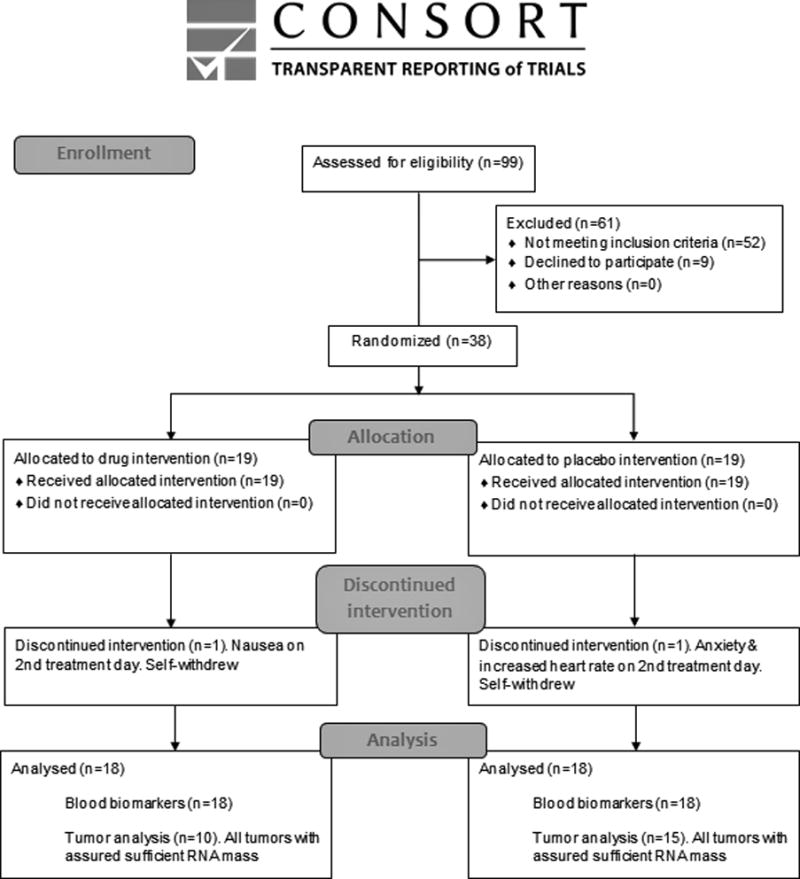
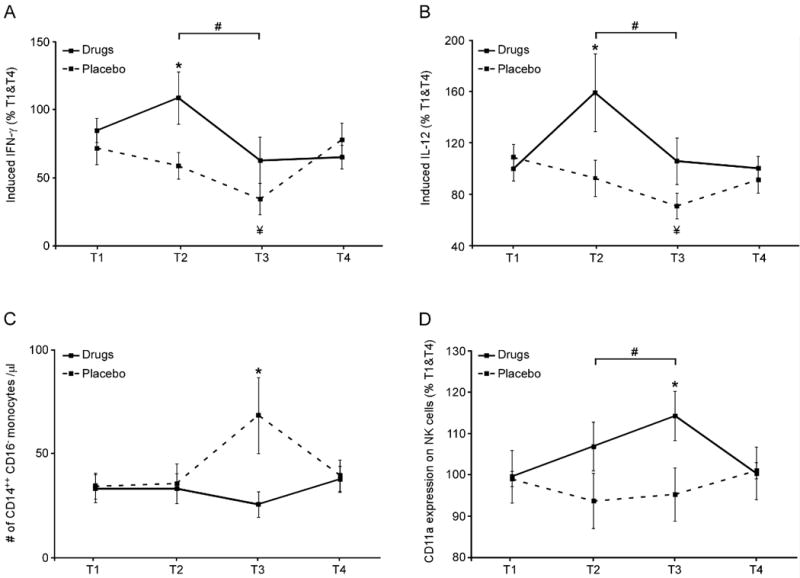
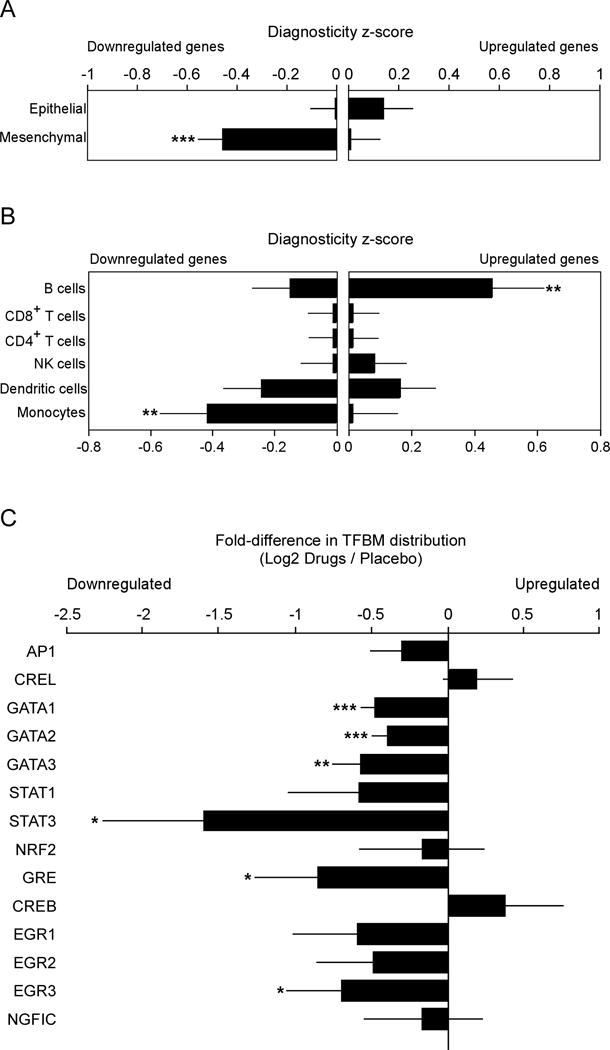
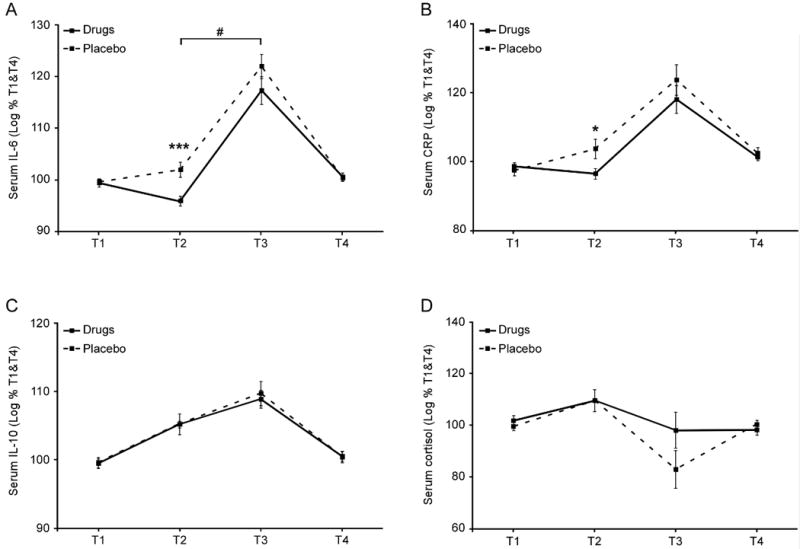
Translational studies suggest that excess perioperative release of catecholamines and prostaglandins may facilitate metastasis and reduce disease-free survival. This trial tested the combined perioperative blockade of these pathways in breast cancer patients. In a randomized placebo-controlled biomarker trial, 38 early-stage breast cancer patients received 11 days of perioperative treatment with a β-adrenergic antagonist (propranolol) and a COX-2 inhibitor (etodolac), beginning 5 days before surgery. Excised tumors and sequential blood samples were assessed for prometastatic biomarkers. Drugs were well tolerated with adverse event rates comparable with placebo. Transcriptome profiling of the primary tumor tested hypotheses and indicated that drug treatment significantly (i) decreased epithelial-to-mesenchymal transition, (ii) reduced activity of prometastatic/proinflammatory transcription factors (GATA-1, GATA-2, early-growth-response-3/EGR3, signal transducer and activator of transcription-3/STAT-3), and (iii) decreased tumor-infiltrating monocytes while increasing tumor-infiltrating B cells. Drug treatment also significantly abrogated presurgical increases in serum IL6 and C-reactive protein levels, abrogated perioperative declines in stimulated IL12 and IFNγ production, abrogated postoperative mobilization of CD16 "classical" monocytes, and enhanced expression of CD11a on circulating natural killer cells. Perioperative inhibition of COX-2 and β-adrenergic signaling provides a safe and effective strategy for inhibiting multiple cellular and molecular pathways related to metastasis and disease recurrence in early-stage breast cancer. .
转化研究表明,围手术期儿茶酚胺和前列腺素的过度释放可能会促进转移并降低无病生存期。本试验测试了对乳腺癌患者围手术期这些信号通路的联合阻断作用。在一项随机安慰剂对照生物标志物试验中,38例早期乳腺癌患者在手术前5天开始接受为期11天的围手术期治疗,使用β-肾上腺素能拮抗剂(普萘洛尔)和COX-2抑制剂(依托度酸)。对切除的肿瘤和连续采集的血样进行促转移生物标志物评估。药物耐受性良好,不良事件发生率与安慰剂相当。对原发性肿瘤的转录组分析验证了假设,并表明药物治疗显著:(i)减少上皮-间质转化;(ii)降低促转移/促炎转录因子(GATA-1、GATA-2、早期生长反应因子-3/EGR3、信号转导和转录激活因子-3/STAT-3)的活性;(iii)减少肿瘤浸润单核细胞,同时增加肿瘤浸润B细胞。药物治疗还显著消除了术前血清IL6和C反应蛋白水平的升高,消除了围手术期刺激的IL12和IFNγ产生的下降,消除了术后CD16“经典”单核细胞的动员,并增强了循环自然杀伤细胞上CD11a的表达。围手术期抑制COX-2和β-肾上腺素能信号传导为抑制早期乳腺癌中与转移和疾病复发相关的多种细胞和分子途径提供了一种安全有效的策略。