Houwing Danielle J, Buwalda Bauke, van der Zee Eddy A, de Boer Sietse F, Olivier Jocelien D A
Unit Behavioral Neuroscience, Department of Neurobiology, Groningen Institute for Evolutionary Life Sciences (GELIFES), University of GroningenGroningen, Netherlands.
Unit Molecular Neurobiology, Department of Neurobiology, Groningen Institute for Evolutionary Life Sciences (GELIFES), University of GroningenGroningen, Netherlands.
Front Cell Neurosci. 2017 Apr 26;11:117. doi: 10.3389/fncel.2017.00117. eCollection 2017.
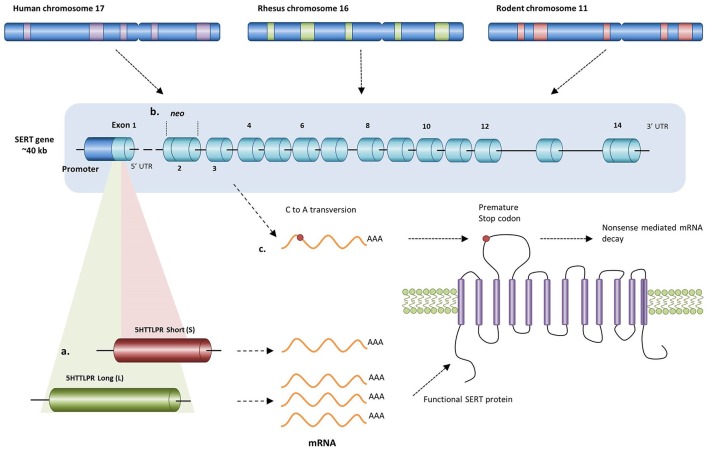
The interaction between the serotonin transporter (SERT) linked polymorphic region (5-HTTLPR) and adverse early life stressing (ELS) events is associated with enhanced stress susceptibility and risk to develop mental disorders like major depression, anxiety, and aggressiveness. In particular, human short allele carriers are at increased risk. This 5-HTTLPR polymorphism is absent in the rodent SERT gene, but heterozygous SERT knockout rodents (SERT) show several similarities to the human S-allele carrier, therefore creating an animal model of the human situation. Many rodent studies investigated ELS interactions in SERT knockout rodents combined with ELS. However, underlying neuromolecular mechanisms of the (mal)adaptive responses to adversity displayed by SERT rodents remain to be elucidated. Here, we provide a comprehensive review including studies describing mechanisms underlying variation × ELS interactions in rodents. Alterations at the level of translation and transcription but also epigenetic alterations considerably contribute to underlying mechanisms of variation × ELS interactions. In particular, SERT rodents exposed to adverse early rearing environment may be of high translational and predictive value to the more stress sensitive human short-allele carrier, considering the similarity in neurochemical alterations. Therefore, SERT rodents are highly relevant in research that aims to unravel the complex psychopathology of mental disorders. So far, most studies fail to show solid evidence for increased vulnerability to develop affective-like behavior after ELS in SERT rodents. Several reasons may underlie these failures, e.g., (1) stressors used might not be optimal or severe enough to induce maladaptations, (2) effects in females are not sufficiently studied, and (3) few studies include both behavioral manifestations and molecular correlates of ELS-induced effects in SERT rodents. Of course, one should not exclude the (although unlikely) possibility of SERT rodents not being sensitive to ELS. In conclusion, future studies addressing ELS-induced effects in the SERT rodents should extensively study both long-term behavioral and (epi)genetic aspects in both sexes. Finally, further research is warranted using more severe stressors in animal models. From there on, we should be able to draw solid conclusions whether the SERT exposed to ELS is a suitable translational animal model for studying 5-HTTLPR polymorphism and stress interactions.
血清素转运体(SERT)连锁多态性区域(5-HTTLPR)与早期不良生活应激(ELS)事件之间的相互作用,与应激易感性增强以及患重度抑郁症、焦虑症和攻击性等精神障碍的风险相关。特别是,人类短等位基因携带者的风险增加。啮齿动物的SERT基因中不存在这种5-HTTLPR多态性,但杂合子SERT基因敲除啮齿动物(SERT)表现出与人类S等位基因携带者的一些相似之处,因此创建了一种人类情况的动物模型。许多啮齿动物研究调查了SERT基因敲除啮齿动物与ELS相结合时的ELS相互作用。然而,SERT啮齿动物对逆境的(不)适应性反应的潜在神经分子机制仍有待阐明。在此,我们提供一篇全面综述,包括描述啮齿动物中变异×ELS相互作用潜在机制的研究。翻译和转录水平的改变以及表观遗传改变在很大程度上促成了变异×ELS相互作用的潜在机制。特别是,考虑到神经化学改变的相似性,暴露于不良早期饲养环境的SERT啮齿动物对于更易受应激影响的人类短等位基因携带者可能具有很高的转化和预测价值。因此,SERT啮齿动物在旨在揭示精神障碍复杂精神病理学的研究中具有高度相关性。到目前为止,大多数研究未能为SERT啮齿动物在ELS后出现类似情感行为的易感性增加提供确凿证据。这些失败可能有几个原因,例如,(1)所使用的应激源可能不是最佳的或不够严重,不足以诱导适应不良,(2)对雌性的影响研究不足,以及(3)很少有研究包括SERT啮齿动物中ELS诱导效应的行为表现和分子相关性。当然,人们不应排除(尽管不太可能)SERT啮齿动物对ELS不敏感的可能性。总之,未来针对SERT啮齿动物中ELS诱导效应的研究应广泛研究两性的长期行为和(表观)遗传方面。最后,有必要在动物模型中使用更严重的应激源进行进一步研究。从那时起,我们应该能够得出确凿结论,即暴露于ELS的SERT是否是研究5-HTTLPR多态性和应激相互作用的合适转化动物模型。