Spring Bonnie, Pellegrini Christine A, Pfammatter Angela, Duncan Jennifer M, Pictor Alex, McFadden H Gene, Siddique Juned, Hedeker Donald
Department of Preventive Medicine, Northwestern University Feinberg School of Medicine, Chicago, Illinois, USA.
Department of Public Health Sciences, University of Chicago, Chicago, Illinois.
Obesity (Silver Spring). 2017 Jul;25(7):1191-1198. doi: 10.1002/oby.21842. Epub 2017 May 11.
To determine the effects on weight loss of three abbreviated behavioral weight loss interventions with and without coaching and mobile technology.
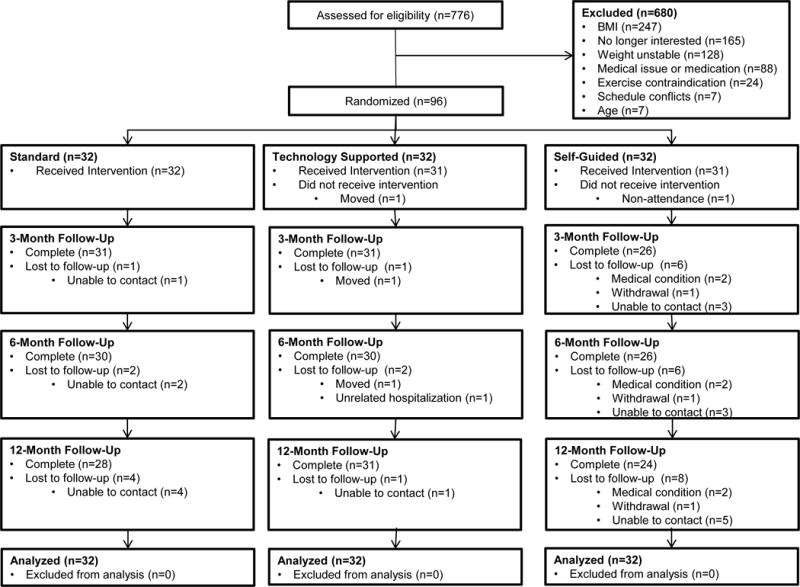
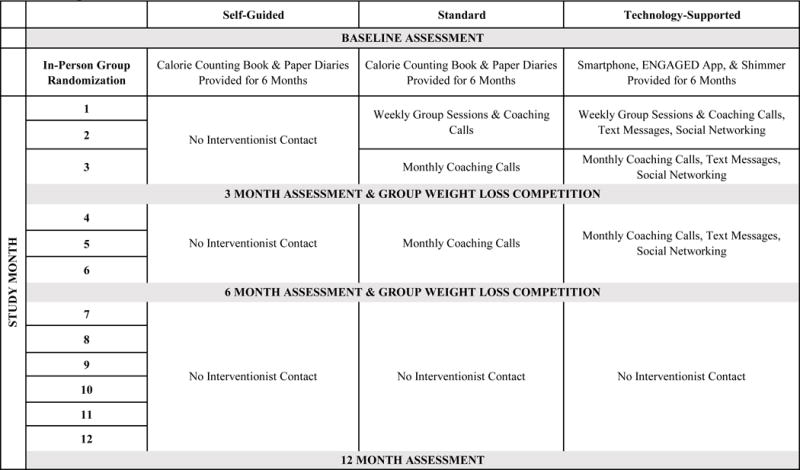
A randomized controlled efficacy study of three 6-month weight loss treatments was conducted in 96 adults with obesity: 1) self-guided (SELF), 2) standard (STND), or 3) technology-supported (TECH). STND and TECH received eight in-person group treatment sessions. SELF and STND used paper diaries to self-monitor diet, activity, and weight; TECH used a smartphone application with social networking features and wireless accelerometer.
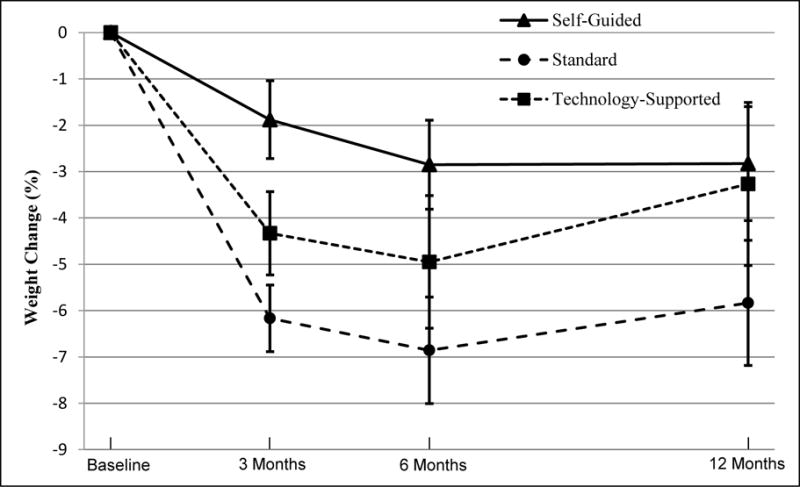
Weight loss was greater for TECH and STND than SELF at 6 months (-5.7 kg [95% confidence interval: -7.2 to -4.1] vs. -2.7 kg [95% confidence interval: -5.1 to -0.3], P < 0.05) but not 12 months. TECH and STND did not differ except that more STND (59%) than TECH (34%) achieved ≥ 5% weight loss at 6 months (P < 0.05). Self-monitoring adherence was greater in TECH than STND (P < 0.001), greater in both interventions than SELF (P < 0.001), and covaried with weight loss (r(84) = 0.36-0.51, P < 0.001).
Abbreviated behavioral counseling can produce clinically meaningful weight loss regardless of whether self-monitoring is performed on paper or smartphone, but long-term superiority over standard of care self-guided treatment is challenging to maintain.
确定三种简化的行为减肥干预措施在有无指导及移动技术辅助下对体重减轻的影响。
对96名肥胖成年人进行了一项为期6个月的三种减肥治疗的随机对照疗效研究:1)自我指导组(SELF),2)标准组(STND),或3)技术支持组(TECH)。STND组和TECH组接受了八次面对面的小组治疗课程。SELF组和STND组使用纸质日记自我监测饮食、活动和体重;TECH组使用具有社交网络功能的智能手机应用程序和无线加速度计。
6个月时,TECH组和STND组的体重减轻幅度大于SELF组(-5.7千克[95%置信区间:-7.2至-4.1] vs. -2.7千克[95%置信区间:-5.1至-0.3],P<0.05),但12个月时并非如此。TECH组和STND组之间没有差异,只是6个月时达到≥5%体重减轻的STND组(59%)多于TECH组(34%)(P<0.05)。TECH组的自我监测依从性高于STND组(P<0.001),两种干预措施的自我监测依从性均高于SELF组(P<0.001),且与体重减轻相关(r(84)=0.36 - 0.51,P<0.001)。
简化的行为咨询无论自我监测是通过纸质还是智能手机进行,都能产生具有临床意义的体重减轻,但要长期保持优于标准护理自我指导治疗的效果具有挑战性。