Svetkey Laura P, Batch Bryan C, Lin Pao-Hwa, Intille Stephen S, Corsino Leonor, Tyson Crystal C, Bosworth Hayden B, Grambow Steven C, Voils Corrine, Loria Catherine, Gallis John A, Schwager Jenifer, Bennett Gary G
Division of Nephrology, Department of Medicine, Duke University Medical Center, Durham, North Carolina, USA.
Sarah W. Stedman Nutrition and Metabolism Center, Duke Molecular Physiology Institute, Durham, North Carolina, USA.
Obesity (Silver Spring). 2015 Nov;23(11):2133-41. doi: 10.1002/oby.21226.
To determine the effect on weight of two mobile technology-based (mHealth) behavioral weight loss interventions in young adults.
Randomized, controlled comparative effectiveness trial in 18- to 35-year-olds with BMI ≥ 25 kg/m(2) (overweight/obese), with participants randomized to 24 months of mHealth intervention delivered by interactive smartphone application on a cell phone (CP); personal coaching enhanced by smartphone self-monitoring (PC); or Control.
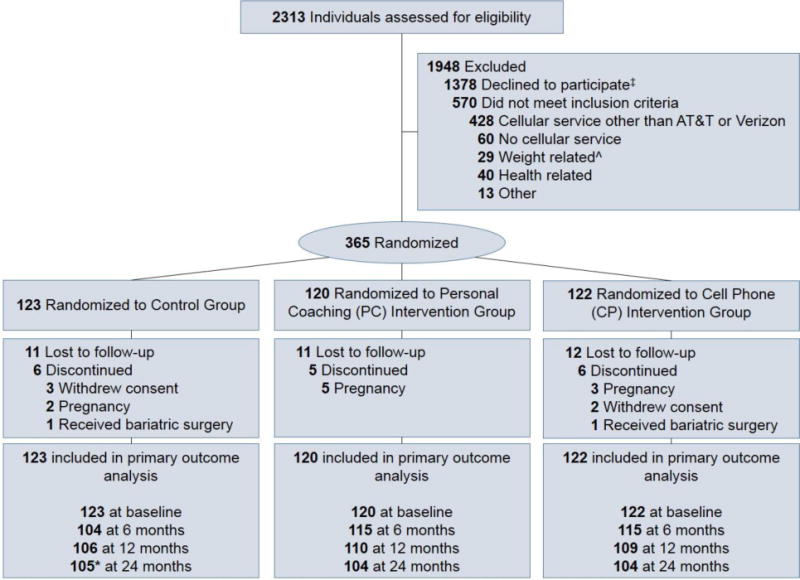
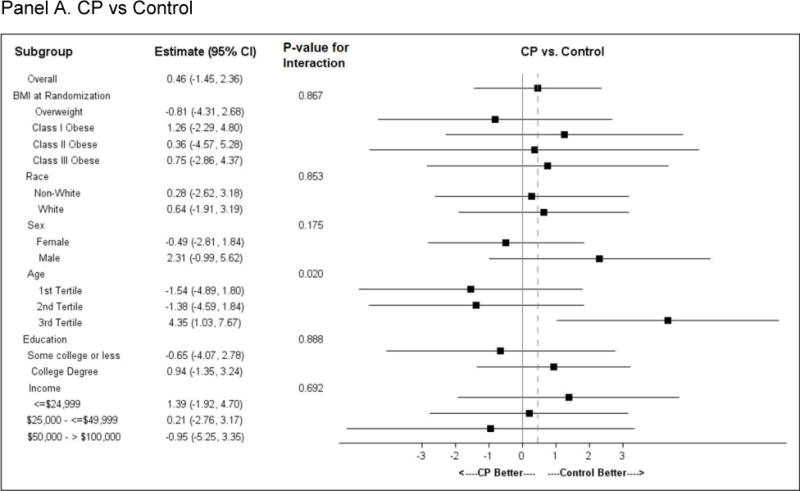
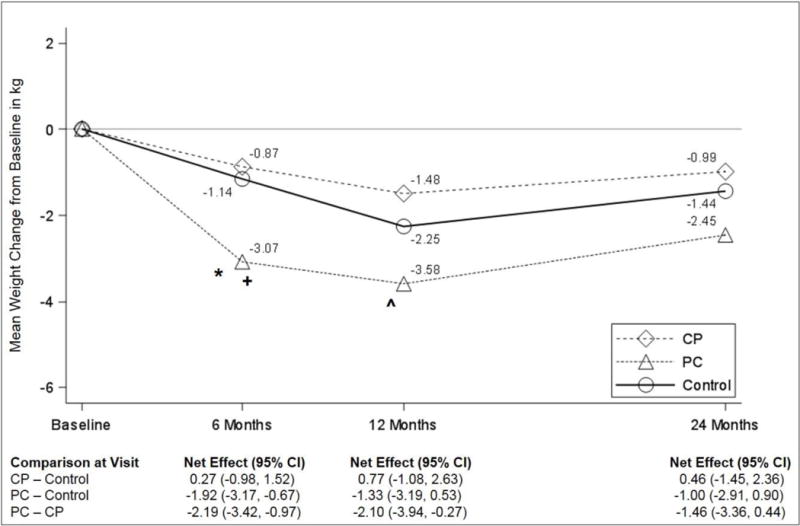
The 365 randomized participants had mean baseline BMI of 35 kg/m(2) . Final weight was measured in 86% of participants. CP was not superior to Control at any measurement point. PC participants lost significantly more weight than Controls at 6 months (net effect -1.92 kg [CI -3.17, -0.67], P = 0.003), but not at 12 and 24 months.
Despite high intervention engagement and study retention, the inclusion of behavioral principles and tools in both interventions, and weight loss in all treatment groups, CP did not lead to weight loss, and PC did not lead to sustained weight loss relative to Control. Although mHealth solutions offer broad dissemination and scalability, the CITY results sound a cautionary note concerning intervention delivery by mobile applications. Effective intervention may require the efficiency of mobile technology, the social support and human interaction of personal coaching, and an adaptive approach to intervention design.
确定两种基于移动技术(移动健康)的行为减肥干预措施对年轻人体重的影响。
对18至35岁、体重指数(BMI)≥25 kg/m²(超重/肥胖)的人群进行随机对照比较有效性试验,参与者被随机分为三组,分别接受为期24个月的以下干预措施:通过手机上的交互式智能手机应用程序进行移动健康干预(CP);通过智能手机自我监测增强的个人指导(PC);或对照组。
365名随机参与者的基线平均BMI为35 kg/m²。86%的参与者测量了最终体重。在任何测量点,CP均不优于对照组。PC组参与者在6个月时体重减轻明显多于对照组(净效应-1.92 kg [CI -3.17, -0.67],P = 0.003),但在12个月和24个月时并非如此。
尽管干预参与度和研究保留率较高,两种干预措施均纳入了行为原则和工具,且所有治疗组均有体重减轻,但CP并未导致体重减轻,PC相对于对照组也未导致持续体重减轻。尽管移动健康解决方案具有广泛传播和可扩展性,但CITY研究结果对通过移动应用程序进行干预发出了警示。有效的干预可能需要移动技术的效率、个人指导的社会支持和人际互动,以及适应性的干预设计方法。