Burks Jack, Marshall Thomas S, Ye Xiaolan
Nova Southeastern University, Davie, FL.
AbbVie Inc, Chicago, IL, USA.
Clinicoecon Outcomes Res. 2017 Apr 28;9:251-260. doi: 10.2147/CEOR.S130334. eCollection 2017.
To evaluate adherence to disease-modifying therapies (DMTs) among patients with multiple sclerosis (MS) initiating oral and injectable DMTs, and to estimate the impact of adherence on relapse, health resource utilization, and medical costs.
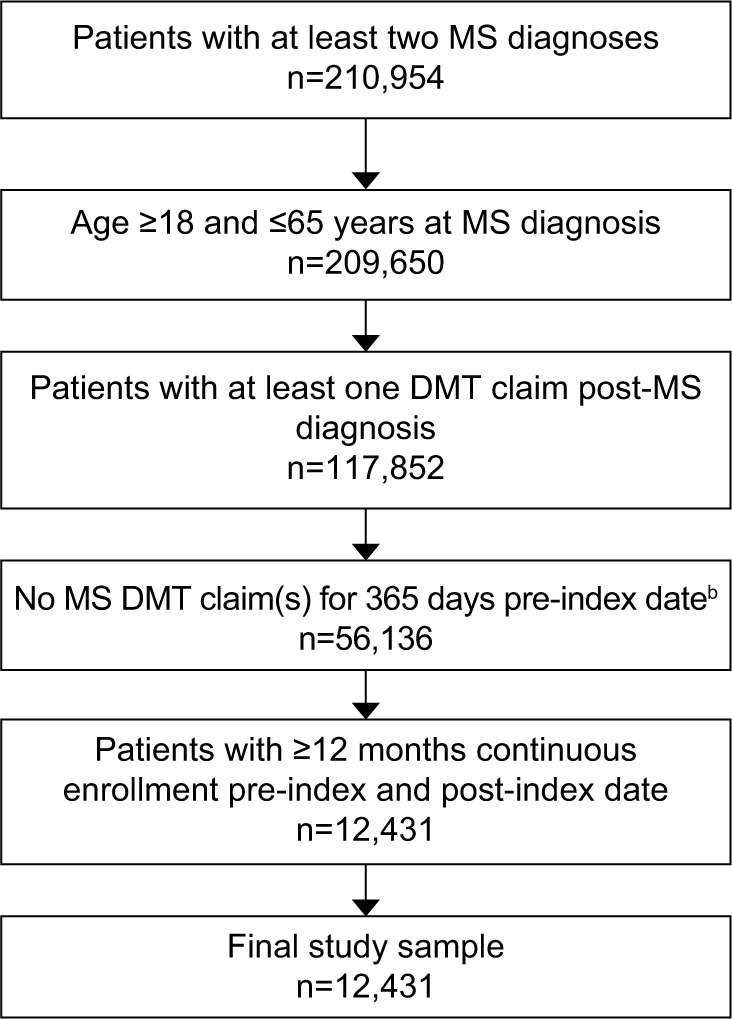
Commercially insured MS patients (aged 18-65 years, two or more MS diagnoses, one or more DMT claims) with continuous eligibility 12 months before and after the first DMT claim date (index date) and no DMT claim during the pre-index period were identified from a large commerical claims database for the period from January 1, 2008, to September 30, 2015. Adherence to the index DMT was measured by the 12-month post-index proportion of days covered (PDC) and compared between oral and injectable DMT initiators. After adjustment for sex, age at index DMT, and comorbidities, regression models examined the relationship between adherence and relapse risk, MS-related health resource utilization, and non-drug medical costs (2015 US$).
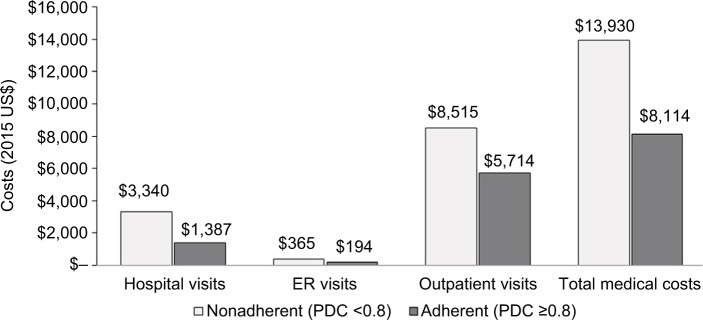
The study covered 12,431 patients and nine DMTs. Adherence to the index DMT did not differ significantly between oral (n=1,018) and injectable (n=11,413) DMTs when assessed by mean PDC (0.7257±0.2934 vs 0.7259±0.2869, respectively; =0.0787), or percentages achieving PDC ≥0.8 (61.4% vs 58.6%, respectively; =0.0806). Compared to non-adherence, adherence to DMT significantly reduced the likelihood of relapse in the post-index 12 months by 42%, hospitalization by 52%, and emergency visits by 38% (all, <0.0001). Adherent patients would be expected to have on average 0.7 fewer outpatient visits annually versus non-adherent patients (<0.0001). Based on the differences in predicted mean costs, adherence (vs non-adherence) would decrease the total annual medical care costs by $5,816 per patient, including hospitalization costs by $1,953, emergency visits by $171, and outpatient visits by $2,802.
Adherence remains suboptimal but comparable between oral and injectable DMTs. Potential health and economic benefits underscore the importance of improving adherence in MS.
评估开始使用口服和注射用疾病修饰疗法(DMT)的多发性硬化症(MS)患者对DMT的依从性,并估计依从性对复发、卫生资源利用和医疗费用的影响。
从一个大型商业索赔数据库中识别出2008年1月1日至2015年9月30日期间具有商业保险的MS患者(年龄18 - 65岁,有两次或更多次MS诊断,有一次或更多次DMT索赔),这些患者在首次DMT索赔日期(索引日期)前后连续12个月符合资格,且在索引前期无DMT索赔。通过索引后12个月的覆盖天数比例(PDC)来衡量对索引DMT的依从性,并在口服和注射用DMT起始者之间进行比较。在对性别、索引DMT时的年龄和合并症进行调整后,回归模型研究了依从性与复发风险、MS相关卫生资源利用和非药物医疗费用(2015年美元)之间的关系。
该研究涵盖了12431名患者和9种DMT。当通过平均PDC评估时,口服DMT(n = 1018)和注射用DMT(n = 11413)对索引DMT的依从性无显著差异(分别为0.7257±0.2934和0.7259±0.2869;P = 0.0787),达到PDC≥0.8的百分比也无显著差异(分别为61.4%和58.6%;P = 0.0806)。与不依从相比,依从DMT可使索引后12个月内的复发可能性显著降低42%,住院可能性降低52%,急诊就诊可能性降低38%(均P<0.0001)。预计依从患者每年的门诊就诊次数比不依从患者平均少0.7次(P<0.0001)。根据预测平均成本的差异,依从(与不依从相比)将使每位患者每年的医疗总费用降低5816美元,包括住院费用降低1953美元、急诊就诊费用降低171美元和门诊就诊费用降低2802美元。
依从性仍不理想,但口服和注射用DMT之间具有可比性。潜在的健康和经济效益凸显了改善MS患者依从性的重要性。