Freeman Leorah, Kee Arianna, Tian Marc, Mehta Rina
Dell Medical School, The University of Texas at Austin, TX, USA.
Bristol Myers Squibb, Princeton, NJ, USA.
Clinicoecon Outcomes Res. 2021 Jan 22;13:65-75. doi: 10.2147/CEOR.S288296. eCollection 2021.
Early diagnosis and treatment of multiple sclerosis (MS) with disease-modifying therapy (DMT) can reduce relapse number and severity, which has cost implications. We describe treatment patterns, healthcare utilization, and cost among MS patients newly initiating DMTs (index).
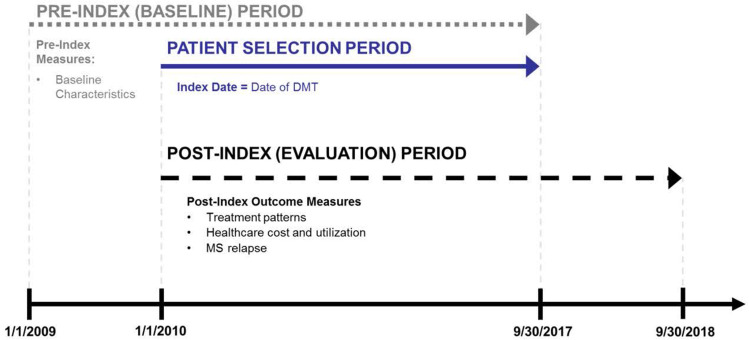
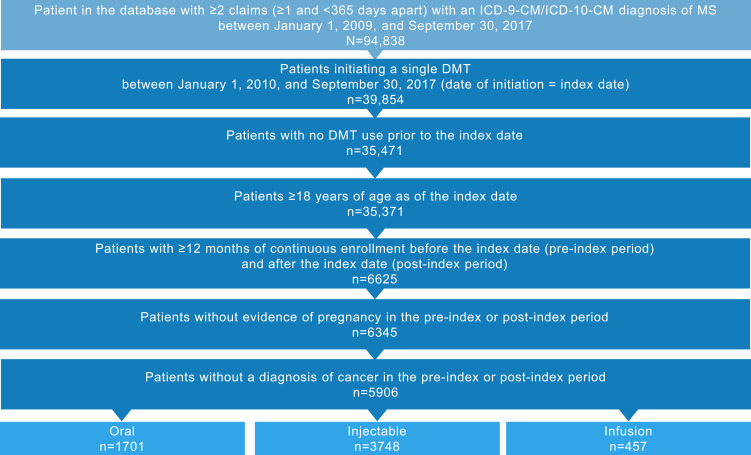
DMT-naïve adults with 12 months' continuous enrollment pre- and post-index and ≥2 MS claims (2009‒2018) were identified from the Optum Clinformatics Data Mart database. Treatment adherence and persistence were measured as time on index DMT. Relapses were identified using a validated claims-based algorithm. All-cause and MS-related healthcare expenditures and utilization were captured pre- and post-index. Outcomes were stratified by route of administration. Multivariate analyses assessed differences in outcomes and costs.
The analysis included 5906 MS patients (mean age, 46.6 years). The majority initiated injectable (63.5%) followed by oral (28.8%) and infusion (7.7%) DMTs. Post-index, 45.3% of patients were nonadherent and 39.4% were nonpersistent. Relapse rates decreased from pre- to post-index (oral: 24.3%‒16.1%; injectable: 25.0%‒17.1%; infusion: 29.3%‒15.5%). Post-index mean (SD) all-cause total costs were lowest with oral ($70,970 [$36,681]) vs injectable ($82,521 [$58,569]) and infusion ($80,871 [$49,627]) DMTs. MS-related total costs were lowest with oral ($65,149 [$65,133]) vs injectable ($76,197 [$60,204]) and infusion ($72,703 [$47,287]) DMTs. Multivariate analysis showed no differences between oral and injectable DMTs in adherence, persistence, or relapse rate; however, oral DMTs had significantly lower all-cause and MS-related costs.
With similar outcomes across DMT administration routes, initiating the least costly DMT may be warranted for many patients. In newly treated MS patients, the need exists to improve adherence and persistence.
采用疾病修正疗法(DMT)对多发性硬化症(MS)进行早期诊断和治疗可减少复发次数和严重程度,这涉及成本问题。我们描述了新开始使用DMT(索引)的MS患者的治疗模式、医疗保健利用情况和成本。
从Optum临床信息学数据集市数据库中识别出在索引前后连续登记12个月且有≥2次MS索赔记录(2009 - 2018年)的未使用过DMT的成年人。治疗依从性和持续性以使用索引DMT的时间来衡量。复发情况通过经过验证的基于索赔的算法来识别。在索引前后记录所有原因和与MS相关的医疗保健支出及利用情况。结果按给药途径分层。多变量分析评估结果和成本的差异。
分析纳入了5906例MS患者(平均年龄46.6岁)。大多数患者开始使用注射用DMT(63.5%),其次是口服DMT(28.8%)和输液用DMT(7.7%)。索引后,45.3%的患者不依从,39.4%的患者未持续治疗。复发率从索引前到索引后有所下降(口服:24.3% - 16.1%;注射:25.0% - 17.1%;输液:29.3% - 15.5%)。索引后平均(标准差)所有原因的总成本,口服DMT(70,970美元[36,681美元])最低,其次是注射用DMT(82,521美元[58,569美元])和输液用DMT(80,871美元[49,627美元])。与MS相关的总成本,口服DMT(65,149美元[65,133美元])最低,其次是注射用DMT(76,197美元[60,204美元])和输液用DMT(72,703美元[47,287美元])。多变量分析显示,口服和注射用DMT在依从性、持续性或复发率方面没有差异;然而,口服DMT的所有原因和与MS相关的成本显著更低。
在不同给药途径的DMT治疗效果相似的情况下,对于许多患者而言,启动成本最低的DMT治疗可能是合理的。在新接受治疗的MS患者中,需要提高依从性和持续性。