Ghazvini Hamed, Shabani Mohammad, Asadi-Shekaari Majid, Khalifeh Solmaz, Esmaeilpour Khadijeh, Khodamoradi Mehdi, Sheibani Vahid
PhD Candidate, Neuroscience Research Center, Institute of Neuropharmacology, Kerman University of Medical Sciences, Kerman, Iran.
Associate Professor, Neuroscience Research Center, Institute of Neuropharmacology, Kerman University of Medical Sciences, Kerman, Iran.
Addict Health. 2016 Jul;8(3):145-156.
Methamphetamine (METH) is one of the most popular psychostimulants which produce long lasting learning and memory impairment. Previous studies have indicated that estrogen and progesterone replacement therapy attenuate cognitive impairment against a wide array of neurodegenerative diseases. Present study was designed to figure out the effects of estrogen, progesterone alone or in combination, on early long-term potentiation (E-LTP) at the cornu ammonis (CA1) area of the hippocampus in METH-exposed ovariectomized (OVX) rat.
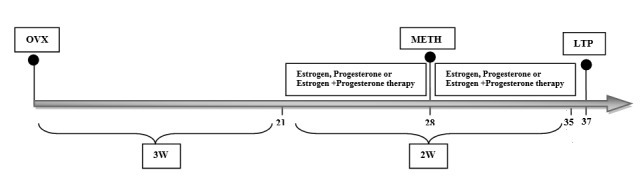
Twenty-one days after ovariectomy, the OVX rats received vehicle, estrogen [1 mg/kg, intraperitoneal (IP)] or progesterone (8 mg/kg, IP) and co-administration of estrogen plus progesterone during 14 consecutive days. On the 28th day, animals were exposed to neurotoxic METH regimens [four injections 6 mg/kg, subcutaneous (SC), 2 h intervals] 30 min after the hormones replacement. Finally, we investigated the effect of those ovarian hormones on synaptic plasticity using in vivo extracellular recording in the CA1 area of the hippocampus 2 days after last treatment.
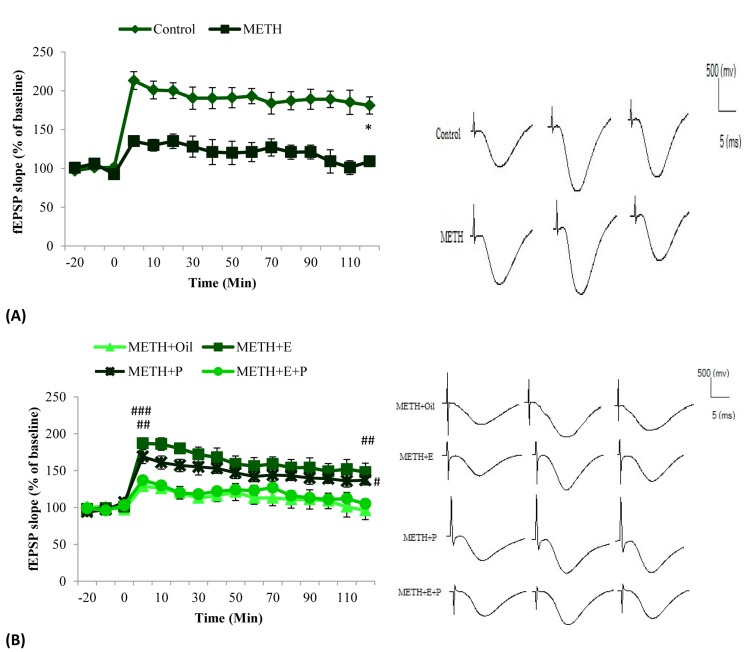
The findings showed that the induction and maintenance phase of E-LTP was impaired in the METH exposed animals compared to the saline group. Data from this study demonstrated that treatment with estrogen and progesterone showed a significant facilitation for induction and enhancement of the maintenance of LTP in animals that received METH. In addition, co-administration of estrogen plus progesterone did not significantly affect the hippocampal synaptic plasticity in METH-exposed OVX rats in comparison with METH-exposed animals that received vehicle injections.
The present findings provide new insight about treatment with ovarian hormones on synaptic plasticity deficits induced by METH.
甲基苯丙胺(METH)是最流行的精神兴奋剂之一,会导致长期的学习和记忆障碍。先前的研究表明,雌激素和孕激素替代疗法可减轻多种神经退行性疾病的认知障碍。本研究旨在探讨雌激素、孕激素单独或联合使用对甲基苯丙胺暴露的去卵巢(OVX)大鼠海马齿状回(CA1)区域早期长时程增强(E-LTP)的影响。
去卵巢21天后,OVX大鼠连续14天接受溶剂、雌激素[1 mg/kg,腹腔注射(IP)]或孕激素(8 mg/kg,IP)以及雌激素加孕激素的联合给药。在第28天,动物在激素替代后30分钟接受神经毒性METH方案[4次注射,6 mg/kg,皮下注射(SC),间隔2小时]。最后,在最后一次治疗2天后,我们使用海马CA1区域的体内细胞外记录来研究这些卵巢激素对突触可塑性的影响。
结果表明,与生理盐水组相比,暴露于METH的动物中E-LTP的诱导和维持阶段受损。本研究数据表明,雌激素和孕激素治疗对接受METH的动物的LTP诱导和维持增强具有显著促进作用。此外,与接受溶剂注射的暴露于METH的动物相比,雌激素加孕激素的联合给药对暴露于METH的OVX大鼠的海马突触可塑性没有显著影响。
本研究结果为卵巢激素治疗甲基苯丙胺诱导的突触可塑性缺陷提供了新的见解。