Materials Physics and Applications Division, Center for Integrated Nanotechnologies, Los Alamos National Laboratory, PO Box 1663, MS-K771, Los Alamos, New Mexico 87545, USA.
Department of Physics, The University of Texas at Dallas, Richardson, Texas 75080, USA.
Nat Commun. 2017 May 12;8:15083. doi: 10.1038/ncomms15083.
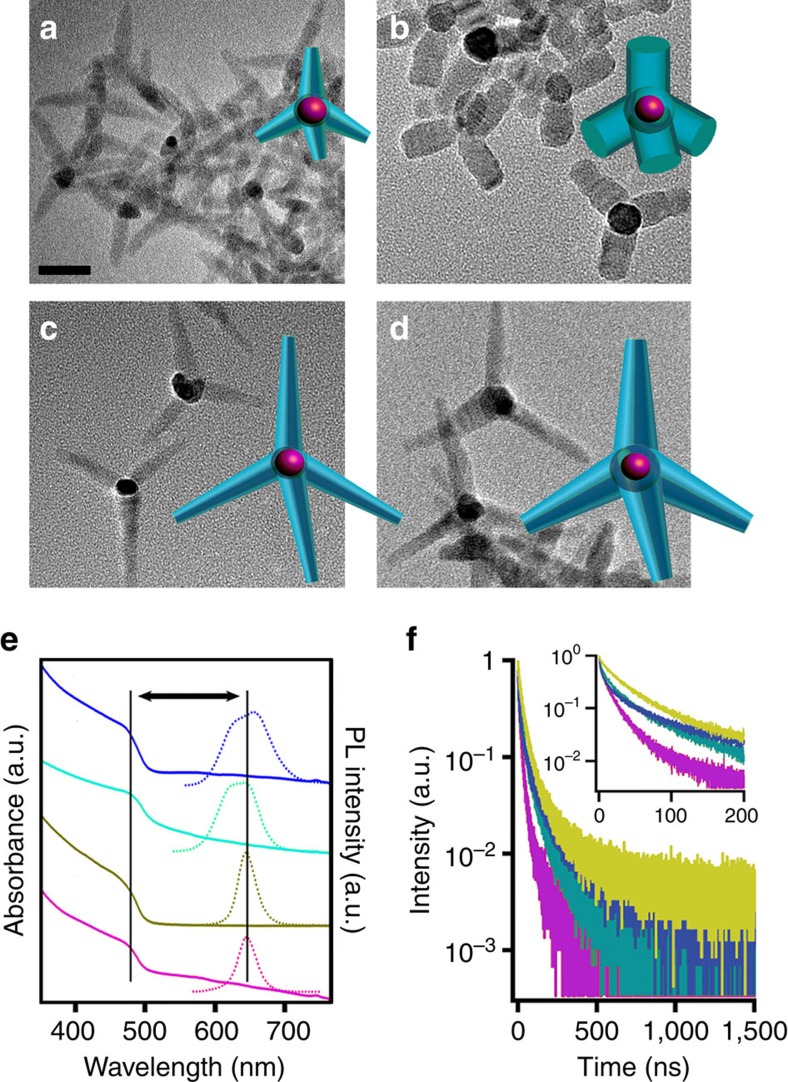
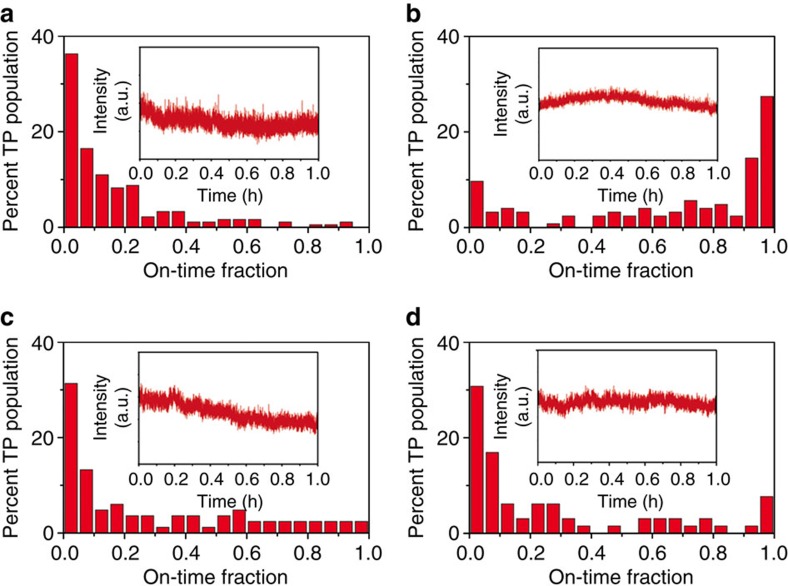
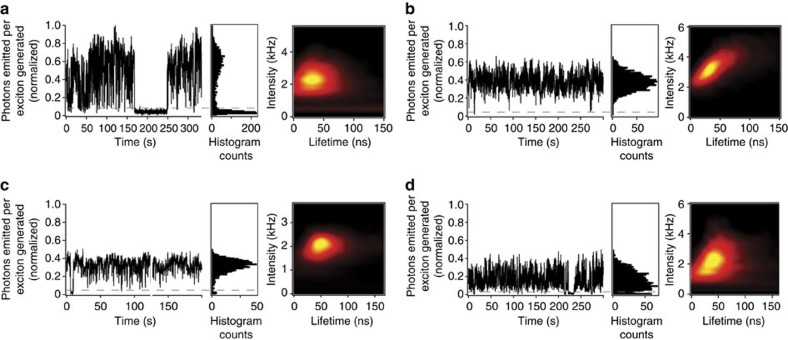
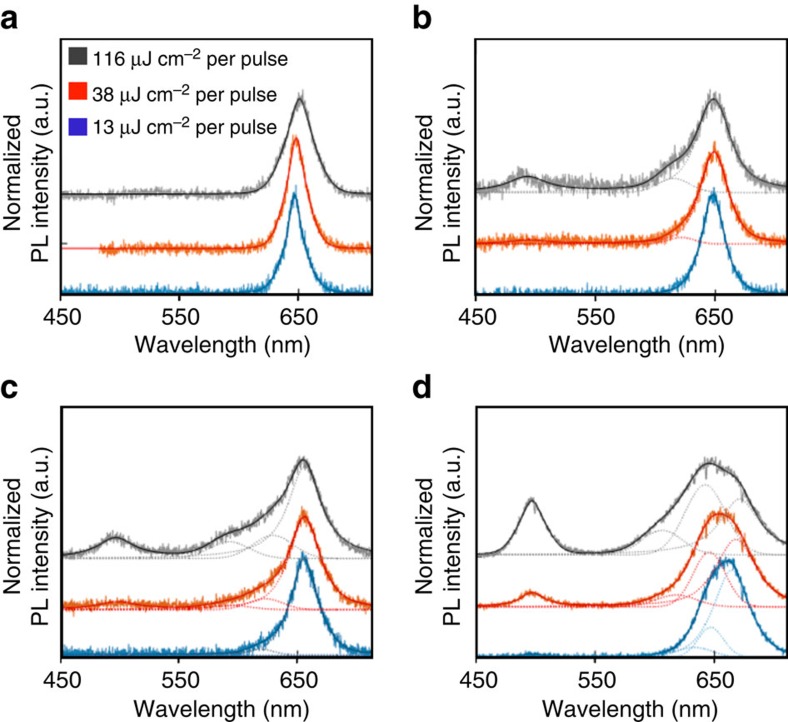
Semiconductor nanostructures capable of emitting from two excited states and thereby of producing two photoluminescence colours are of fundamental and potential technological significance. In this limited class of nanocrystals, CdSe/CdS core/arm tetrapods exhibit the unusual trait of two-colour (red and green) multiexcitonic emission, with green emission from the CdS arms emerging only at high excitation fluences. Here we show that by synthetic shape-tuning, both this multi-colour emission process, and blinking and photobleaching behaviours of single tetrapods can be controlled. Specifically, we find that the properties of dual emission and single-nanostructure photostability depend on different structural parameters-arm length and arm diameter, respectively-but that both properties can be realized in the same nanostructure. Furthermore, based on results of correlated photoluminescence and transient absorption measurements, we conclude that hole-trap filling in the arms and partial state-filling in the core are necessary preconditions for the observation of multiexciton multi-colour emission.
能够从两个激发态发射并因此产生两种光致发光颜色的半导体纳米结构具有基础和潜在的技术意义。在这有限的纳米晶体类中,CdSe/CdS 核/臂四角形纳米柱表现出双色(红和绿)多激子发射的不寻常特性,只有在高激发强度下才会从 CdS 臂中出现绿色发射。在这里,我们表明通过合成形状调谐,可以控制多色发射过程以及单个四角形纳米柱的闪烁和光漂白行为。具体来说,我们发现双发射和单纳米结构光稳定性的性质取决于不同的结构参数臂长和臂直径,但这两种性质可以在同一纳米结构中实现。此外,基于相关光致发光和瞬态吸收测量的结果,我们得出结论,在观察多激子多色发射时,必须满足空穴陷阱填充在臂中和核心部分状态填充这两个条件。