Houehanou Yessito Corine, Mizéhoun-Adissoda Carmelle, Amidou Salimanou, Désormais Iléana, Houénassi Martin, Preux Pierre-Marie, Marin Benoit, Houinato Dismand, Lacroix Philippe
a U1094, Tropical Neuroepidemiology , INSERM , Limoges , France.
b UMR-S 1094, Tropical Neuroepidemiology, Institute of Neuroepidemiology and Tropical Neurology , University Limoges , Limoges , France.
Glob Health Action. 2017;10(1):1270528. doi: 10.1080/16549716.2017.1270528.
Faced with the growing burden of cardiovascular disease (CVD) including atherosclerotic in Sub-Saharan Africa (SSA), the development of appropriate prediction tools, based on large cohorts, appears useful for prevention.
The objective of the pilot project TAHES (Tanvè Health Study) was to explore the feasibility of a large cohort study focused on CVD and risk factors in Benin.
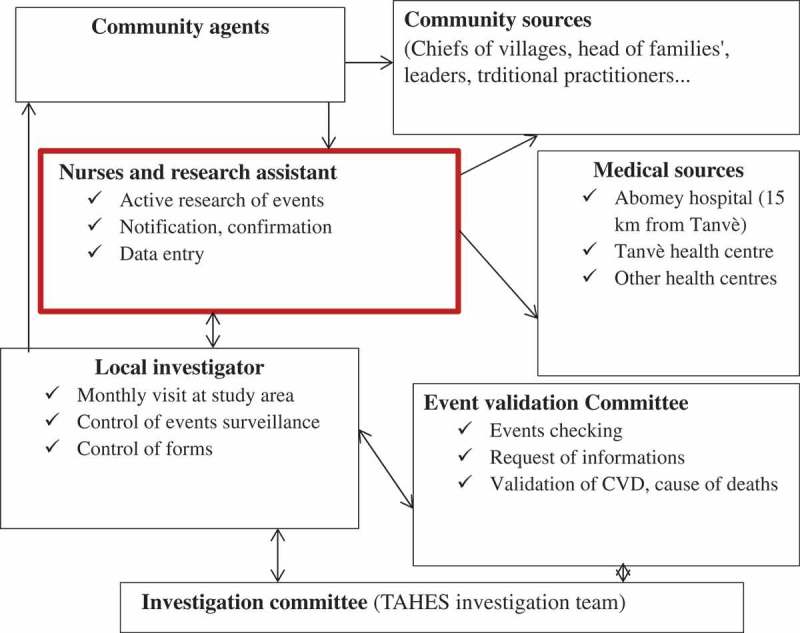
We implemented a prospective cohort over 2 years. The sample consisted of all people aged 25 years or older who had lived for at least the previous 6 months in the villages of Tanvè or Dékanmè. At baseline in February 2015, behaviours and medical histories were recorded using a standardized questionnaire adapted from the WHO Steps instrument; screening questionnaires for angina, claudication, congestive heart failure, and stroke were applied; anthropometric measures and fasting capillary blood glucose were taken. All participants were included in the follow-up phase. Surveillance of target CVD and deaths was implemented through a medical and a community network.
A total of 1,195 participants were enrolled at baseline; women represented 65.5% and the median age was 39 years. The high participation rate (91.4%), the quality of baseline data, and the functionality of the events surveillance network over 8 months indicated good perspective for the feasibility of a large cohort. We recorded a 3.8% prevalence of daily smoking, 3.6% of harmful use of alcohol, 10.7% of obesity, 25.5% of high blood pressure, and 3.5% of diabetes. Prevalence of angina pectoris (2.7%), intermittent claudication (2.0%), congestive heart failure (0.9%), and stroke survival with motor impairment (3‰) were also recorded. Ten deaths occurred during the first 8 months, all within households; a cardiovascular cause was suspected in four cases.
These preliminary results support the feasibility of establishing a cohort in Benin. It would require technical and resource support.
面对包括动脉粥样硬化在内的心血管疾病(CVD)在撒哈拉以南非洲(SSA)日益加重的负担,基于大规模队列开发合适的预测工具似乎对预防工作很有用。
试点项目TAHES(坦韦健康研究)的目的是探讨在贝宁开展一项关注心血管疾病及其危险因素的大规模队列研究的可行性。
我们进行了一项为期2年的前瞻性队列研究。样本包括所有年龄在25岁及以上、此前至少在坦韦或德坎梅村居住6个月的人。2015年2月基线期,使用从世界卫生组织(WHO)的“STEPS”工具改编而来的标准化问卷记录行为和病史;应用心绞痛、间歇性跛行、充血性心力衰竭和中风的筛查问卷;进行人体测量和空腹毛细血管血糖检测。所有参与者均纳入随访阶段。通过医疗和社区网络对目标心血管疾病及死亡情况进行监测。
基线期共招募了1195名参与者;女性占65.5%,中位年龄为39岁。较高的参与率(91.4%)、基线数据质量以及事件监测网络在8个月内的功能表明大规模队列研究具有良好的可行性前景。我们记录到每日吸烟率为3.8%,有害饮酒率为3.6%,肥胖率为10.7%,高血压患病率为25.5%,糖尿病患病率为3.5%。还记录到心绞痛患病率为2.7%,间歇性跛行患病率为2.0%,充血性心力衰竭患病率为0.9%,中风伴运动障碍幸存者患病率为3‰。在最初的8个月内发生了10例死亡,均发生在家庭中;4例怀疑死于心血管疾病。
这些初步结果支持在贝宁建立队列研究的可行性。这将需要技术和资源支持。