State Key Laboratory of Tree Genetics and Breeding, The Research Institute of Forestry, Chinese Academy of Forestry, Beijing, China.
CSIRO Agriculture and Food, Canberra, ACT, Australia.
Plant Biotechnol J. 2018 Jan;16(1):124-136. doi: 10.1111/pbi.12754. Epub 2017 Jul 25.
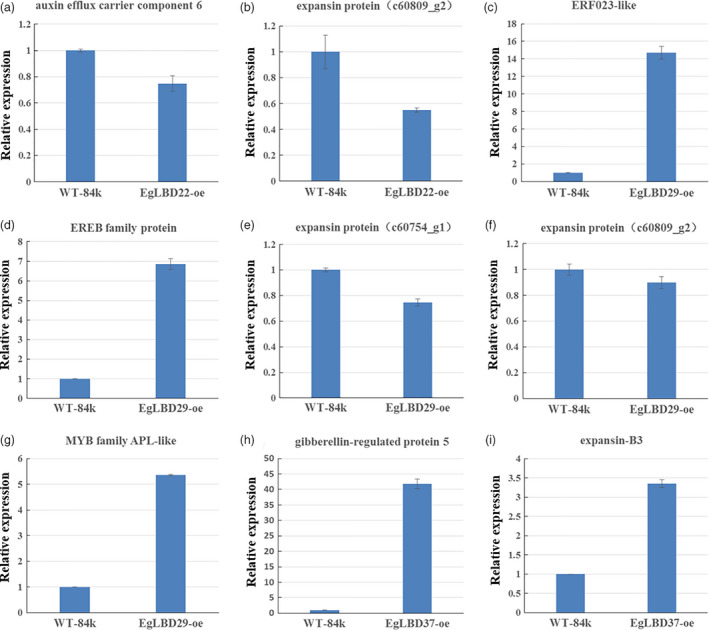
Lateral Organ Boundaries Domain (LBD) proteins are plant-specific transcription factors playing crucial roles in growth and development. However, the function of LBD proteins in Eucalyptus grandis remains largely unexplored. In this study, LBD genes in E. grandis were identified and characterized using bioinformatics approaches. Gene expression patterns in various tissues and the transcriptional responses of EgLBDs to exogenous hormones were determined by qRT-PCR. Functions of the selected EgLBDs were studied by ectopically overexpressing in a hybrid poplar (Populus alba × Populus glandulosa). Expression levels of genes in the transgenic plants were investigated by RNA-seq. Our results showed that there were forty-six EgLBD members in the E. grandis genome and three EgLBDs displayed xylem- (EgLBD29) or phloem-preferential expression (EgLBD22 and EgLBD37). Confocal microscopy indicated that EgLBD22, EgLBD29 and EgLBD37 were localized to the nucleus. Furthermore, we found that EgLBD22, EgLBD29 and EgLBD37 were responsive to the treatments of indol-3-acetic acid and gibberellic acid. More importantly, we demonstrated EgLBDs exerted different influences on secondary growth. Namely, 35S::EgLBD37 led to significantly increased secondary xylem, 35S::EgLBD29 led to greatly increased phloem fibre production, and 35S::EgLBD22 showed no obvious effects. We revealed that key genes related to gibberellin, ethylene and auxin signalling pathway as well as cell expansion were significantly up- or down-regulated in transgenic plants. Our new findings suggest that LBD genes in E. grandis play important roles in secondary growth. This provides new mechanisms to increase wood or fibre production.
侧生器官边界域(LBD)蛋白是植物特有的转录因子,在生长和发育中发挥着关键作用。然而,LBD 蛋白在桉树中的功能在很大程度上仍未被探索。在本研究中,我们使用生物信息学方法鉴定和表征了桉树中的 LBD 基因。通过 qRT-PCR 测定了各种组织中的基因表达模式以及 EgLBDs 对外源激素的转录响应。通过在杂种杨树(白杨×腺柳)中异位过表达选定的 EgLBDs 研究了它们的功能。通过 RNA-seq 研究了转基因植物中基因的表达水平。我们的结果表明,桉树基因组中有 46 个 EgLBD 成员,其中 3 个 EgLBD 表现出木质部(EgLBD29)或韧皮部偏好表达(EgLBD22 和 EgLBD37)。共聚焦显微镜表明 EgLBD22、EgLBD29 和 EgLBD37 定位于细胞核。此外,我们发现 EgLBD22、EgLBD29 和 EgLBD37 对吲哚-3-乙酸和赤霉素的处理有反应。更重要的是,我们证明 EgLBDs 对次生生长有不同的影响。即,35S::EgLBD37 导致次生木质部显著增加,35S::EgLBD29 导致韧皮纤维大量产生,而 35S::EgLBD22 则没有明显影响。我们发现,与赤霉素、乙烯和生长素信号通路以及细胞扩展相关的关键基因在转基因植物中显著上调或下调。我们的新发现表明,桉树中的 LBD 基因在次生生长中发挥重要作用。这为增加木材或纤维产量提供了新的机制。