Dugas Lara R, Forrester Terrence E, Plange-Rhule Jacob, Bovet Pascal, Lambert Estelle V, Durazo-Arvizu Ramon A, Cao Guichan, Cooper Richard S, Khatib Rasha, Tonino Laura, Riesen Walter, Korte Wolfgang, Kliethermes Stephanie, Luke Amy
Public Health Sciences, Stritch School of Medicine, Maywood, IL, USA.
Solutions for Developing Countries, University of the West Indies, Mona, Kingston, Jamaica.
BMC Public Health. 2017 May 12;17(1):438. doi: 10.1186/s12889-017-4318-4.
Cardiovascular risk factors are increasing in most developing countries. To date, however, very little standardized data has been collected on the primary risk factors across the spectrum of economic development. Data are particularly sparse from Africa.
In the Modeling the Epidemiologic Transition Study (METS) we examined population-based samples of men and women, ages 25-45 of African ancestry in metropolitan Chicago, Kingston, Jamaica, rural Ghana, Cape Town, South Africa, and the Seychelles. Key measures of cardiovascular disease risk are described.
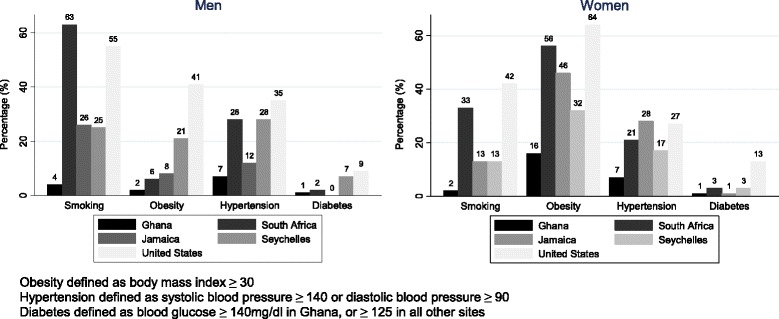
The risk factor profile varied widely in both total summary estimates of cardiovascular risk and in the magnitude of component factors. Hypertension ranged from 7% in women from Ghana to 35% in US men. Total cholesterol was well under 200 mg/dl for all groups, with a mean of 155 mg/dl among men in Ghana, South Africa and Jamaica. Among women total cholesterol values varied relatively little by country, following between 160 and 178 mg/dl for all 5 groups. Levels of HDL-C were virtually identical in men and women from all study sites. Obesity ranged from 64% among women in the US to 2% among Ghanaian men, with a roughly corresponding trend in diabetes. Based on the Framingham risk score a clear trend toward higher total risk in association with socioeconomic development was observed among men, while among women there was considerable overlap, with the US participants having only a modestly higher risk score.
These data provide a comprehensive estimate of cardiovascular risk across a range of countries at differing stages of social and economic development and demonstrate the heterogeneity in the character and degree of emerging cardiovascular risk. Severe hypercholesterolemia, as characteristic in the US and much of Western Europe at the onset of the coronary epidemic, is unlikely to be a feature of the cardiovascular risk profile in these countries in the foreseeable future, suggesting that stroke may remain the dominant cardiovascular event.
在大多数发展中国家,心血管危险因素正在增加。然而,迄今为止,关于经济发展各阶段主要危险因素的标准化数据收集得很少。非洲的数据尤其匮乏。
在“模拟流行病学转变研究”(METS)中,我们对芝加哥大都市、牙买加金斯敦、加纳农村、南非开普敦和塞舌尔25至45岁非洲裔男女的人群样本进行了研究。描述了心血管疾病风险的关键指标。
心血管风险的总体汇总估计值以及各组成因素的大小方面,危险因素概况差异很大。高血压患病率从加纳女性的7%到美国男性的35%不等。所有组的总胆固醇均远低于200mg/dl,加纳、南非和牙买加男性的平均总胆固醇为155mg/dl。在女性中,各国总胆固醇值差异相对较小,所有5组均在160至178mg/dl之间。所有研究地点的男性和女性高密度脂蛋白胆固醇(HDL-C)水平几乎相同。肥胖率从美国女性的64%到加纳男性的2%不等,糖尿病情况也有大致相应的趋势。根据弗雷明汉风险评分,男性中观察到与社会经济发展相关的总风险明显升高的趋势,而女性中存在相当大的重叠,美国参与者的风险评分仅略高。
这些数据全面估计了处于不同社会和经济发展阶段的一系列国家的心血管风险,并表明新兴心血管风险的特征和程度存在异质性。在美国和西欧大部分地区冠心病流行初期所特有的严重高胆固醇血症,在可预见的未来不太可能成为这些国家心血管风险概况的特征,这表明中风可能仍然是主要的心血管事件。