Budu-Aggrey Ashley, Bowes John, Stuart Philip E, Zawistowski Matthew, Tsoi Lam C, Nair Rajan, Jadon Deepak Rohit, McHugh Neil, Korendowych Eleanor, Elder James T, Barton Anne, Raychaudhuri Soumya
Arthritis Research UK Centre for Genetics and Genomics, Centre for Musculoskeletal Research, University of Manchester, Manchester, UK.
NIHR Manchester Musculoskeletal Biomedical Research Unit, Central Manchester Foundation Trust and University of Manchester, Manchester Academy of Health Sciences, Manchester, UK.
Ann Rheum Dis. 2017 Jul;76(7):1321-1324. doi: 10.1136/annrheumdis-2016-210592. Epub 2017 May 13.
Psoriatic arthritis (PsA) is an inflammatory arthritis associated with psoriasis. While many common risk alleles have been reported for association with PsA as well as psoriasis, few rare coding alleles have yet been identified.
To identify rare coding variation associated with PsA risk or protection, we genotyped 41 267 variants with the exome chip and investigated association within an initial cohort of 1980 PsA cases and 5913 controls. Genotype data for an independent cohort of 2234 PsA cases and 5708 controls was also made available, allowing for a meta-analysis to be performed with the discovery dataset.
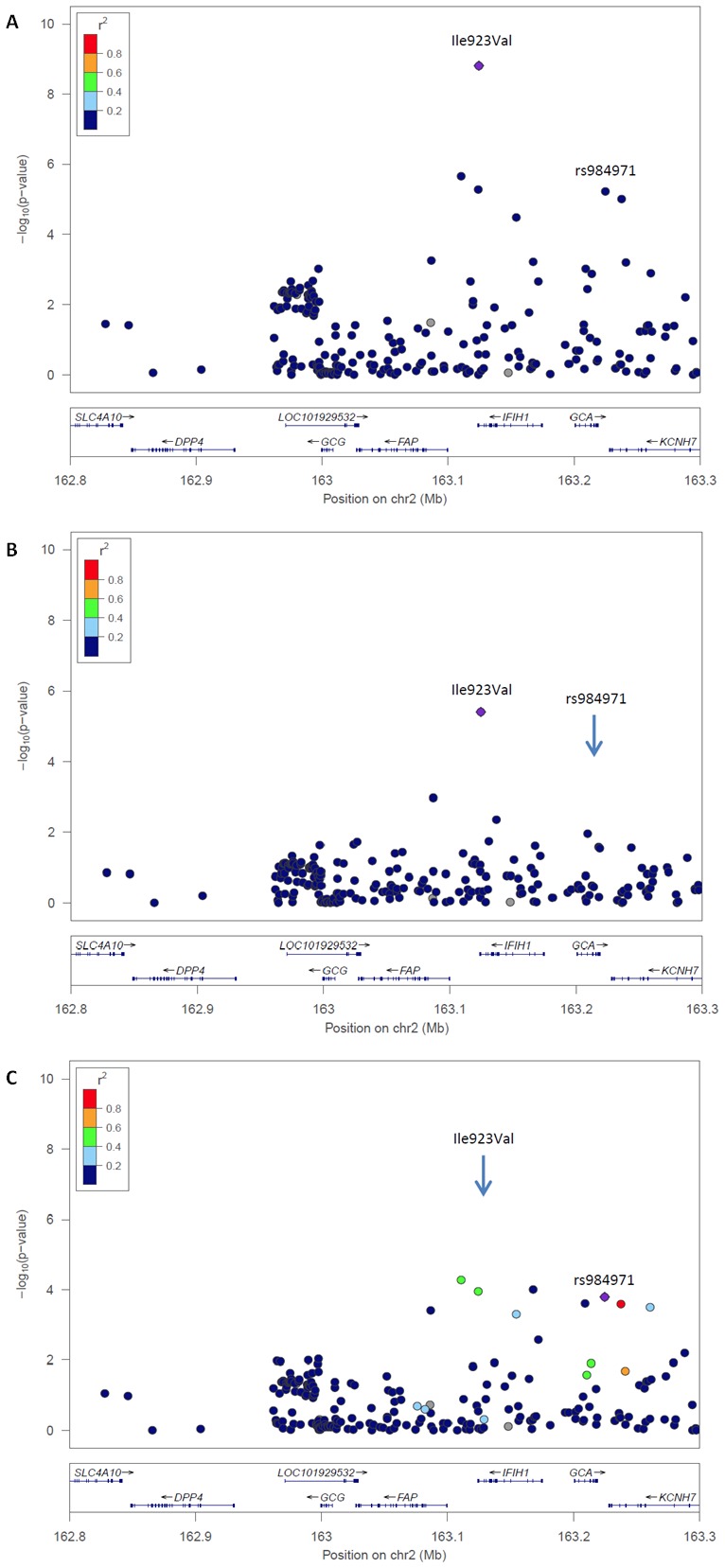
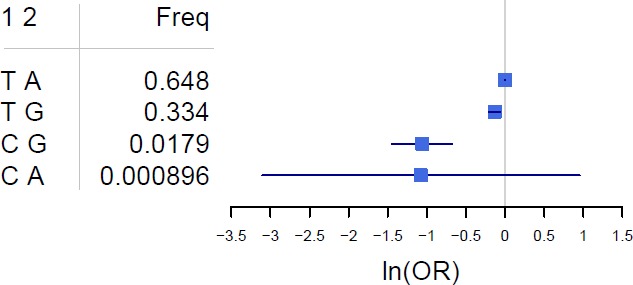
We identified an association with the rare variant rs35667974 (p=2.39x10, OR=0.47), encoding an Ile923Val amino acid change in the gene protein product. The association was reproduced in our independent cohort, which reached a high level of significance on meta-analysis with the discovery and replication datasets (p=4.67x10). We identified a strong association with when performing multiple-variant analysis (p=6.77x10), and found evidence of independent effects between the rare allele and the common PsA variant at the same locus.
For the first time, we report a rare coding allele in to be protective for PsA. This rare allele has also been identified to have the same direction of effect on type I diabetes and psoriasis. While this association further supports existing evidence for as a causal gene for PsA, mechanistic studies will need to be pursued to confirm that is indeed causal.
银屑病关节炎(PsA)是一种与银屑病相关的炎性关节炎。虽然已经报道了许多与PsA以及银屑病相关的常见风险等位基因,但尚未鉴定出罕见的编码等位基因。
为了鉴定与PsA风险或保护相关的罕见编码变异,我们使用外显子芯片对41267个变异进行了基因分型,并在1980例PsA病例和5913例对照的初始队列中研究了关联性。还提供了2234例PsA病例和5708例对照的独立队列的基因型数据,从而能够与发现数据集进行荟萃分析。
我们鉴定出与罕见变异rs35667974存在关联(p = 2.39×10,比值比= 0.47),该变异在基因蛋白产物中编码Ile923Val氨基酸变化。这种关联在我们的独立队列中得到了重现,在与发现和复制数据集进行荟萃分析时达到了高度显著性(p = 4.67×10)。在进行多变异分析时,我们鉴定出与存在强关联(p = 6.77×10),并发现了该罕见等位基因与同一基因座上常见的PsA变异之间存在独立效应的证据。
我们首次报告基因中的一种罕见编码等位基因对PsA具有保护作用。还已鉴定出这种罕见等位基因对1型糖尿病和银屑病具有相同的效应方向。虽然这种关联进一步支持了作为PsA致病基因的现有证据,但仍需要进行机制研究以确认确实是致病的。