Unterrainer Human-Friedrich, Hiebler-Ragger Michaela, Koschutnig Karl, Fuchshuber Jürgen, Tscheschner Sebastian, Url Maria, Wagner-Skacel Jolana, Reininghaus Eva Z, Papousek Ilona, Weiss Elisabeth M, Fink Andreas
Institute of Psychology, University of GrazGraz, Austria.
Center for Integrative Addiction Research, Grüner Kreis SocietyVienna, Austria.
Front Hum Neurosci. 2017 Apr 28;11:208. doi: 10.3389/fnhum.2017.00208. eCollection 2017.
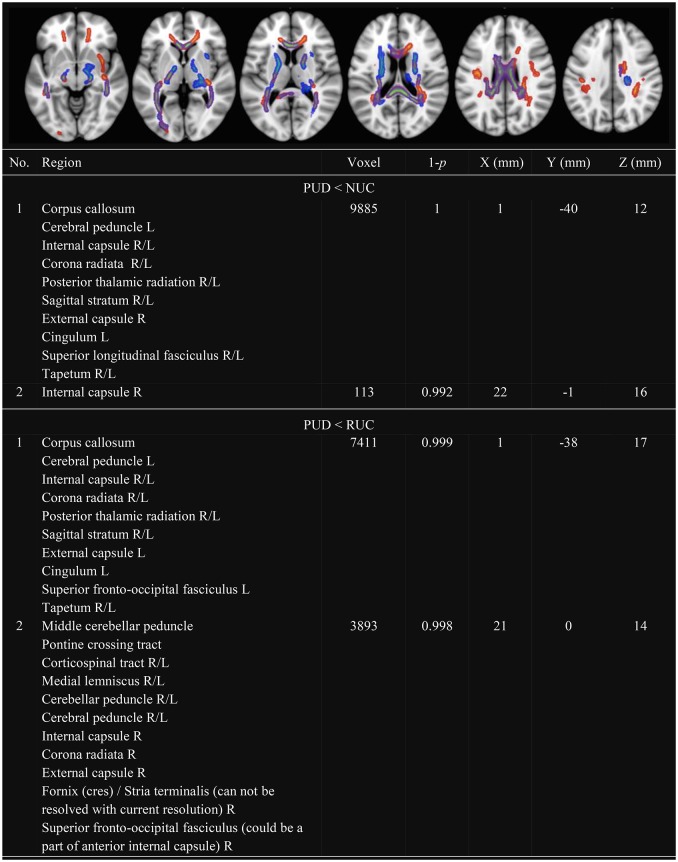
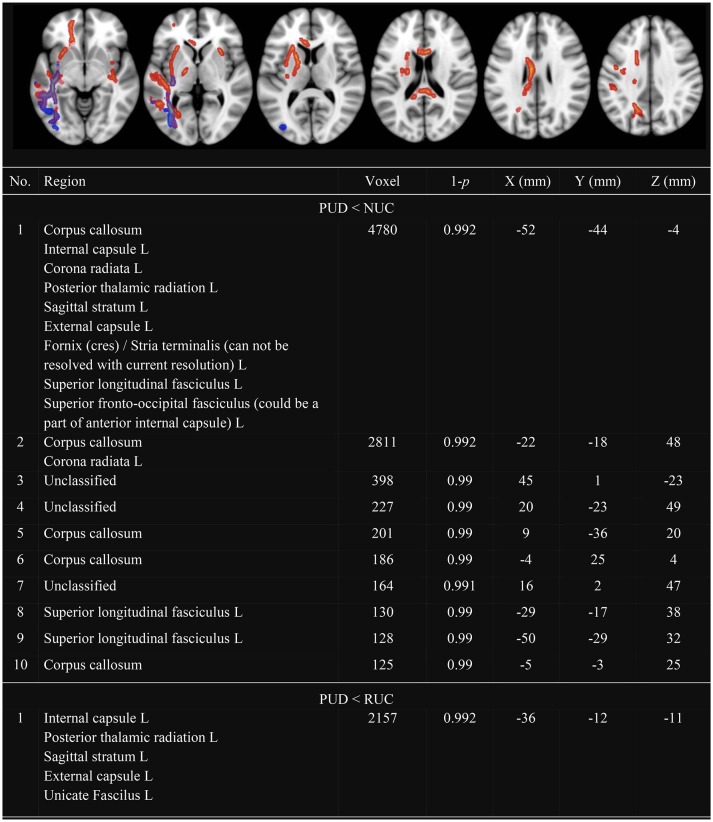
Substance use disorders (SUD) have been shown to be linked to various neuronal and behavioral impairments. In this study, we investigate whether there is a connection between the integrity of white matter (WM) and attachment styles as well as different affective states including spirituality in a group of patients diagnosed for poly-drug use disorder (PUD) in comparison to non-clinical controls. A total sample of 59 right-handed men, comprising the groups of patients with PUD ( = 19), recreational drug-using individuals (RUC; = 20) as well as non-drug using controls were recruited (NUC; = 20). For the behavioral assessment, we applied the Adult Attachment-Scale, the Affective Neuroscience Personality-Scale (short version) and the Multidimensional Inventory for Religious/Spiritual Well-Being. Diffusion Tensor Imaging was used to investigate differences in WM neural connectivity. Analyses revealed decreased Fractional Anisotropy and decreased Mean Diffusivity in PUD patients as compared to RUC and NUC. No differences were found between RUC and NUC. Additional ROI analyses suggested that WM impairment in the superior longitudinal fasciculus (SLF) and the superior corona radiata (SCR) was linked to more insecure attachment as well as to more negative affectivity. No substantial correlation was observed with spirituality. These findings are mainly limited by the cross-sectional design of the study. However, our preliminary results support the idea of addiction as an attachment disorder, both at neuronal and behavioral levels. Further research might be focused on the changes of insecure attachment patterns in SUD treatment and their correlation with changes in the brain.
物质使用障碍(SUD)已被证明与各种神经元和行为损伤有关。在本研究中,我们调查了一组被诊断为多药使用障碍(PUD)的患者与非临床对照相比,白质(WM)完整性与依恋风格以及包括精神性在内的不同情感状态之间是否存在联系。共招募了59名右利手男性,包括PUD患者组(n = 19)、娱乐性药物使用个体(RUC;n = 20)以及非药物使用对照组(NUC;n = 20)。对于行为评估,我们应用了成人依恋量表、情感神经科学人格量表(简版)和宗教/精神幸福感多维量表。采用扩散张量成像来研究WM神经连接性的差异。分析显示,与RUC和NUC相比,PUD患者的分数各向异性降低,平均扩散率降低。RUC和NUC之间未发现差异。额外的感兴趣区域分析表明,上纵束(SLF)和放射冠上部(SCR)的WM损伤与更不安全的依恋以及更消极的情感有关。未观察到与精神性有显著相关性。这些发现主要受限于研究的横断面设计。然而,我们的初步结果支持成瘾是一种依恋障碍的观点,无论是在神经元水平还是行为水平。进一步的研究可能集中在SUD治疗中不安全依恋模式的变化及其与大脑变化的相关性上。