Yenkie Kirti M, Wu Wenzhao, Maravelias Christos T
Department of Chemical and Biological Engineering, University of Wisconsin-Madison, 1415 Engineering Drive, Madison, WI 53706-1691 USA.
DOE Great Lakes Bioenergy Research Center, University of Wisconsin-Madison, 1552 University Ave, Madison, WI 53726 USA.
Biotechnol Biofuels. 2017 May 8;10:119. doi: 10.1186/s13068-017-0804-2. eCollection 2017.
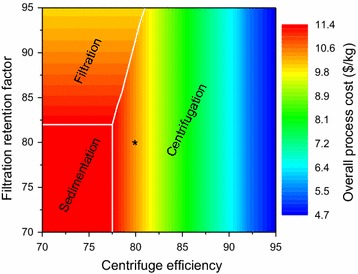
Bioseparations can contribute to more than 70% in the total production cost of a bio-based chemical, and if the desired chemical is localized intracellularly, there can be additional challenges associated with its recovery. Based on the properties of the desired chemical and other components in the stream, there can be multiple feasible options for product recovery. These options are composed of several alternative technologies, performing similar tasks. The suitability of a technology for a particular chemical depends on (1) its performance parameters, such as separation efficiency; (2) cost or amount of added separating agent; (3) properties of the bioreactor effluent (e.g., biomass titer, product content); and (4) final product specifications. Our goal is to first synthesize alternative separation options and then analyze how technology selection affects the overall process economics. To achieve this, we propose an optimization-based framework that helps in identifying the critical technologies and parameters.
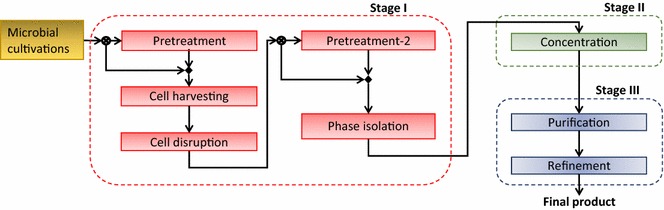
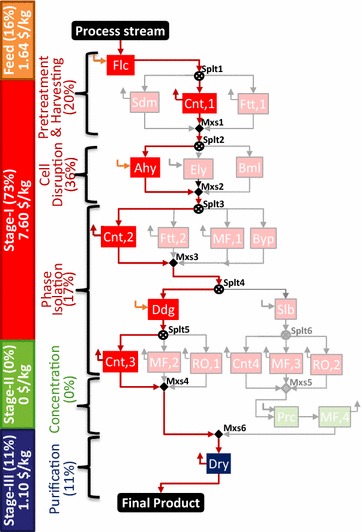
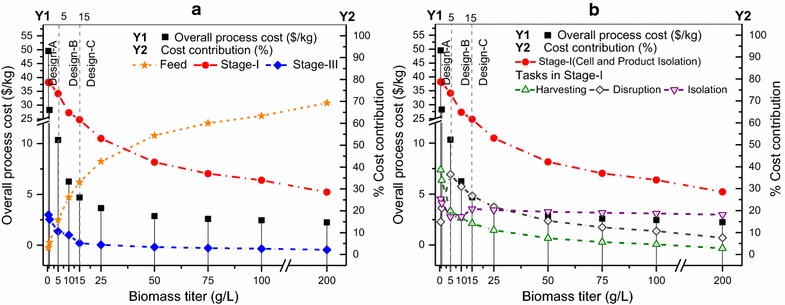
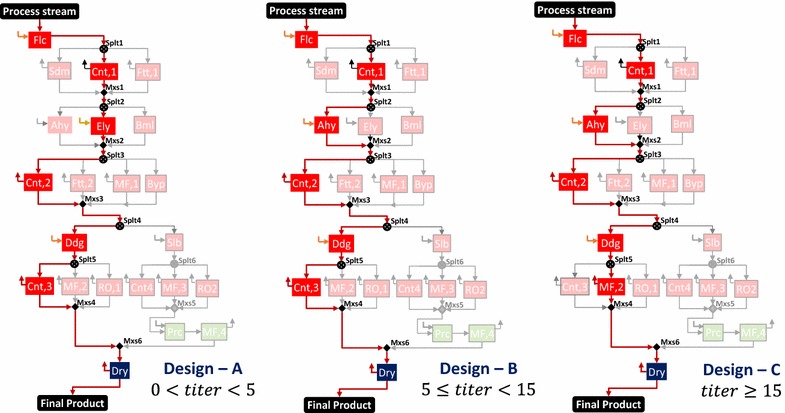
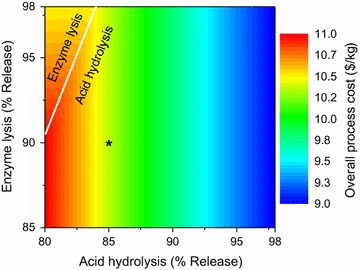
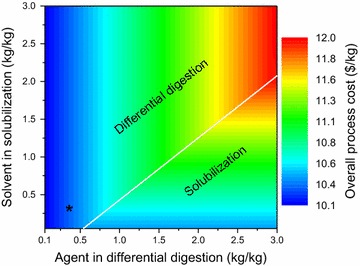
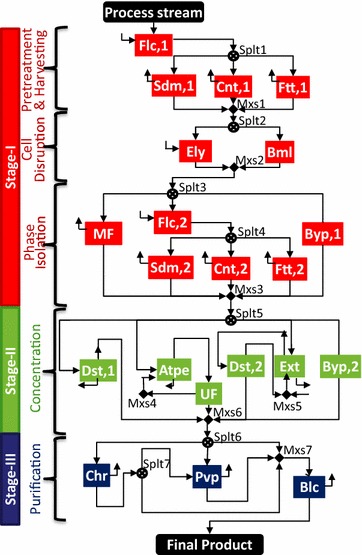
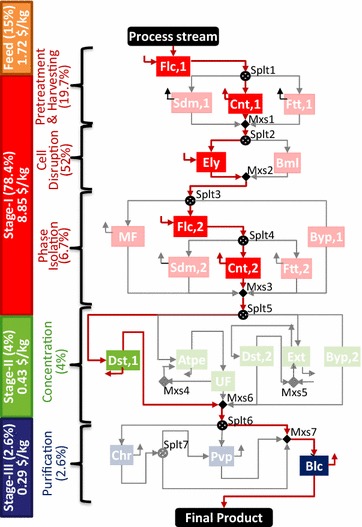
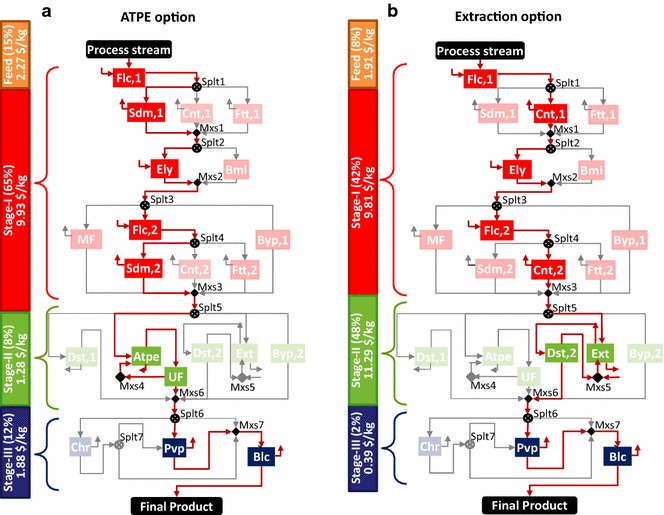
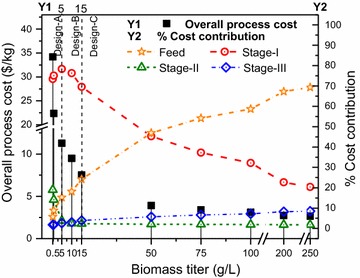
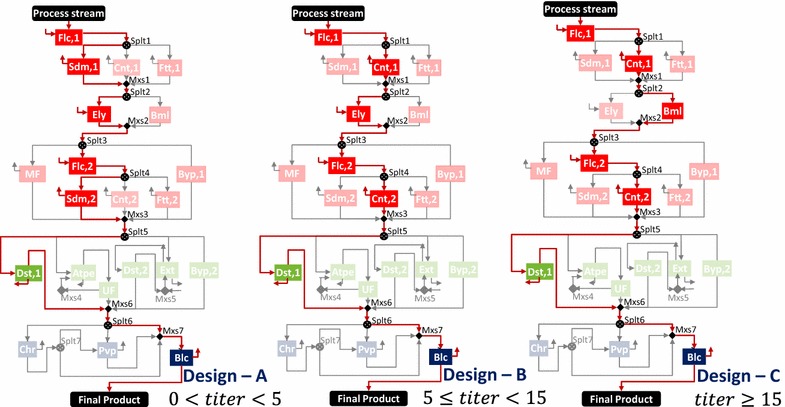
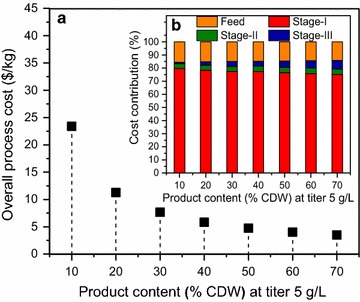
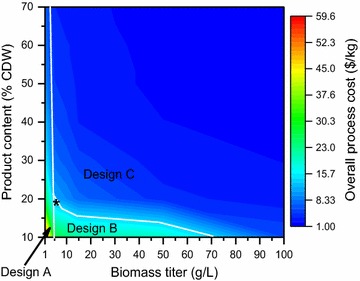
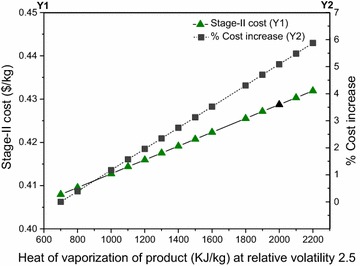
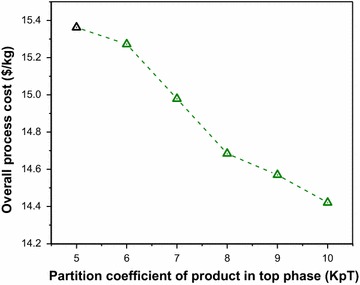
We study the separation networks for two representative classes of chemicals based on their properties. The separation network is divided into three stages: cell and product isolation (stage I), product concentration (II), and product purification and refining (III). Each stage exploits differences in specific product properties for achieving the desired product quality. The cost contribution analysis for the two cases (intracellular insoluble and intracellular soluble) reveals that stage I is the key cost contributor (>70% of the overall cost). Further analysis suggests that changes in input conditions and technology performance parameters lead to new designs primarily in stage I.
The proposed framework provides significant insights for technology selection and assists in making informed decisions regarding technologies that should be used in combination for a given set of stream/product properties and final output specifications. Additionally, the parametric sensitivity provides an opportunity to make crucial design and selection decisions in a comprehensive and rational manner. This will prove valuable in the selection of chemicals to be produced using bioconversions (bioproducts) as well as in creating better bioseparation flow sheets for detailed economic assessment and process implementation on the commercial scale.
生物分离在生物基化学品的总生产成本中所占比例可能超过70%,如果所需化学品存在于细胞内,其回收还会面临其他挑战。根据物流中所需化学品和其他成分的性质,产品回收可能有多种可行方案。这些方案由几种执行类似任务的替代技术组成。一种技术对特定化学品的适用性取决于:(1)其性能参数,如分离效率;(2)添加分离剂的成本或用量;(3)生物反应器流出物的性质(如生物质浓度、产品含量);以及(4)最终产品规格。我们的目标是首先合成替代分离方案,然后分析技术选择如何影响整体工艺经济性。为实现这一目标,我们提出了一个基于优化的框架,有助于识别关键技术和参数。
我们根据两种具有代表性的化学品的性质研究了分离网络。分离网络分为三个阶段:细胞与产品分离(阶段I)、产品浓缩(阶段II)以及产品纯化与精制(阶段III)。每个阶段利用特定产品性质的差异来实现所需的产品质量。对两种情况(细胞内不溶性和细胞内可溶性)的成本贡献分析表明,阶段I是主要的成本贡献者(超过总成本的70%)。进一步分析表明,输入条件和技术性能参数的变化主要在阶段I产生新的设计。
所提出的框架为技术选择提供了重要见解,并有助于就给定的物流/产品性质和最终产出规格组合使用的技术做出明智决策。此外,参数敏感性为以全面和合理的方式做出关键的设计和选择决策提供了机会。这在选择使用生物转化生产的化学品(生物产品)以及创建更好的生物分离流程图以进行详细经济评估和商业规模的工艺实施方面将证明是有价值的。