Adibi Atoosa, Maleki Shahab, Adibi Peyman, Etminani Reza, Hovsepian Silva
Department of Radiology, Research Institute for Primordial Prevention of Non-communicable Disease, Isfahan Endocrine and Metabolism Research Center, Isfahan University of Medical Sciences, Isfahan, Iran.
Department of Gastroenterology, Research Institute for Primordial Prevention of Non-communicable Disease, Isfahan Endocrine and Metabolism Research Center, Isfahan University of Medical Sciences, Isfahan, Iran.
Adv Biomed Res. 2017 Apr 17;6:47. doi: 10.4103/2277-9175.204590. eCollection 2017.
This study aimed to determine the prevalence of nonalcoholic fatty liver disease (NAFLD) and its related risk factors among the general population of Isfahan city located in the central part of Iran.
In this cross-sectional study, the prevalence of NAFLD among 483 general adult populations was determined using ultrasonography. Anthropometric and biochemical variables were compared in groups with and without NAFLD and their predictive value for occurrence of NAFLD was investigated also.
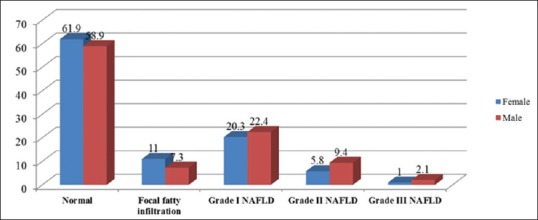
Prevalence of NAFLD was 39.3%. Frequency of focal fatty infiltration (FFI), Grade I, Grade II, and Grade III of NAFLD was 9.5%, 21.1%, 7.2%, 1.4%, respectively. Prevalence of different types of NAFLD and FFI, was not different between female and male participants ( = 0.238). Ordinal regression was determined that all of the studied variables have significant predictive value for NAFLD ( < 0.001, = 0.615). Spearman correlation indicated that there was a significant relationship between NAFLD and BMI ( = 0.37, < 0.001), age ( = 0.15, = 0.001), FBS ( = 0.20, < 0.001), cholesterol ( = 0.19, < 0.001), triglyceride ( = 0.20, < 0.001), LDL ( = 0.16, < 0.001), AST ( = 0.17, < 0.001), and ALT ( = 0.31, < 0.001).
Considering the high prevalence of NAFLD specially its lower grades among Isfahani adult general population and their association with studied variables, it seems that interventional studies which target-related mentioned risk factors could reduce the overall occurrence of NAFLD.
本研究旨在确定位于伊朗中部的伊斯法罕市普通人群中非酒精性脂肪性肝病(NAFLD)的患病率及其相关危险因素。
在这项横断面研究中,通过超声检查确定了483名普通成年人群中NAFLD的患病率。比较了有和没有NAFLD的人群的人体测量和生化变量,并研究了它们对NAFLD发生的预测价值。
NAFLD的患病率为39.3%。局灶性脂肪浸润(FFI)、NAFLD的I级、II级和III级的发生率分别为9.5%、21.1%、7.2%、1.4%。不同类型的NAFLD和FFI的患病率在女性和男性参与者之间没有差异(P = 0.238)。有序回归确定所有研究变量对NAFLD均具有显著的预测价值(P < 0.001,OR = 0.615)。Spearman相关性表明,NAFLD与BMI(r = 0.37,P < 0.001)、年龄(r = 0.15,P = 0.001)、空腹血糖(r = 0.20,P < 0.001)、胆固醇(r = 0.19,P < 0.001)、甘油三酯(r = 0.20,P < 0.001)、低密度脂蛋白(r = 0.16,P < 0.001)、谷草转氨酶(r = 0.17,P < 0.001)和谷丙转氨酶(r = 0.31,P < 0.001)之间存在显著关系。
考虑到NAFLD在伊斯法罕成年普通人群中的高患病率,特别是其较低级别患病率以及它们与研究变量的关联,针对上述相关危险因素的干预性研究似乎可以降低NAFLD的总体发生率。