Perkins Kenneth A, Karelitz Joshua L, Boldry Margaret C
Western Psychiatric Institute and Clinic, University of Pittsburgh School of Medicine, Pittsburgh, PA, USA.
Front Psychiatry. 2017 May 1;8:65. doi: 10.3389/fpsyt.2017.00065. eCollection 2017.
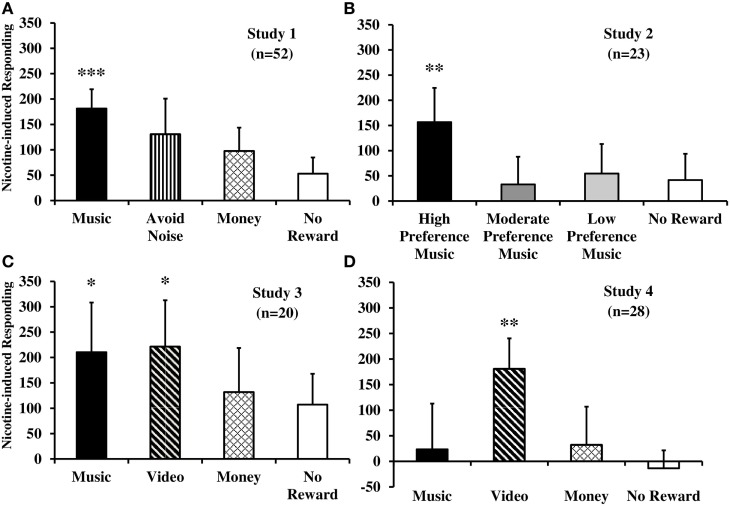
Preclinical research documents that, aside from the primary and secondary reinforcing effects of nicotine intake itself, nicotine also acutely enhances the reinforcing efficacy of non-drug reinforcers ("rewards"). Study of these effects in humans has largely been overlooked, but very recent findings suggest they may have clinical implications for more fully understanding the persistence of tobacco dependence. This overview first outlines the topic and notes some recent human studies indirectly addressing nicotine effects on related responses (e.g., subjective ratings), explaining why those findings do not confirm enhancement of behavioral reinforcement due to nicotine. Then, the methodology used in the subsequently presented studies is described, demonstrating how those studies specifically did demonstrate enhancement of reinforced responding for non-drug rewards. The main section focuses on the limited controlled research to date directly assessing nicotine's acute reinforcement-enhancing effects in humans, particularly as it relates to reinforced behavioral responding for non-drug rewards in non-human animal models. After detailing those few existing human studies, we address potential consequences of these effects for dependence and tobacco cessation efforts and then suggest directions for future research. This research indicates that nicotine increases responding in humans that is reinforced by some rewards (auditory stimuli music, visual stimuli video), but perhaps not by others (e.g., money). These reinforcement-enhancing effects in smokers are not due to dependence or withdrawal relief and can be restored by a small amount of nicotine (similar to a smoking lapse), including from e-cigarettes, a non-tobacco nicotine product. Future clinical research should examine factors determining which types of rewards are (or are not) enhanced by nicotine, consequences of the loss of these nicotine effects after quitting smoking, potential individual differences in these effects, and the possibility that nicotine nicotine replacement therapy and non-nicotine quit medications may attenuate loss of these effects upon quitting. Further study with humans of nicotine's reinforcement-enhancing effects may provide a more complete understanding of smoking persistence and added mechanisms of cessation medication efficacy.
临床前研究表明,除了尼古丁摄入本身的主要和次要强化作用外,尼古丁还能急性增强非药物强化物(“奖励”)的强化效力。对这些效应在人类中的研究在很大程度上被忽视了,但最近的研究结果表明,它们可能对更全面地理解烟草依赖的持续性具有临床意义。本综述首先概述了该主题,并指出了一些最近间接探讨尼古丁对相关反应(如主观评分)影响的人体研究,解释了为什么这些研究结果没有证实尼古丁会增强行为强化。然后,描述了后续研究所使用的方法,展示了这些研究如何具体证明了对非药物奖励的强化反应增强。主要部分聚焦于迄今为止直接评估尼古丁在人类中急性强化增强效应的有限对照研究,特别是与非人类动物模型中对非药物奖励的强化行为反应相关的研究。在详细介绍了那几项现有的人体研究后,我们探讨了这些效应对依赖和戒烟努力的潜在后果,然后提出了未来研究的方向。这项研究表明,尼古丁会增加人类对某些奖励(听觉刺激——音乐、视觉刺激——视频)强化的反应,但可能不会增加对其他奖励(如金钱)强化的反应。吸烟者中的这些强化增强效应并非由于依赖或戒断缓解,并且可以通过少量尼古丁(类似于吸烟复吸)恢复,包括来自电子烟这种非烟草尼古丁产品。未来的临床研究应该研究决定哪些类型的奖励会(或不会)被尼古丁增强的因素、戒烟后这些尼古丁效应丧失的后果、这些效应中潜在的个体差异,以及尼古丁、尼古丁替代疗法和非尼古丁戒烟药物可能减轻戒烟后这些效应丧失的可能性。对尼古丁强化增强效应进行更多的人体研究可能会更全面地理解吸烟的持续性以及戒烟药物疗效的附加机制。