Brose Leonie S, Hitchman Sara C, Brown Jamie, West Robert, McNeill Ann
Department of Addictions, UK Centre for Tobacco and Alcohol Studies (UKCTAS), Institute of Psychiatry, Psychology and Neuroscience, King's College London, London, UK.
Health Behaviour Research Centre, University College London, London, UK.
Addiction. 2015 Jul;110(7):1160-8. doi: 10.1111/add.12917. Epub 2015 Apr 23.
To use a unique longitudinal data set to assess the association between e-cigarette use while smoking with smoking cessation attempts, cessation and substantial reduction, taking into account frequency of use and key potential confounders.
Web-based survey, baseline November/December 2012, 1-year follow-up in December 2013.
Great Britain.
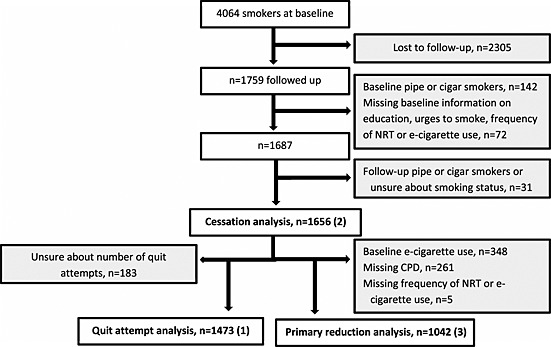
National general population sample of 4064 adult smokers, with 1759 (43%) followed-up.
Main outcome measures were cessation attempt, cessation and substantial reduction (≥50% from baseline to follow-up) of cigarettes per day (CPD). In logistic regression models, cessation attempt in the last year (analysis n = 1473) and smoking status (n = 1656) at follow-up were regressed on to baseline e-cigarette use (none, non-daily, daily) while adjusting for baseline socio-demographics, dependence and nicotine replacement (NRT) use. Substantial reduction (n = 1042) was regressed on to follow-up e-cigarette use while adjusting for baseline socio-demographics and dependence and follow-up NRT use.
Compared with non-use, daily e-cigarette use at baseline was associated with increased cessation attempts [odds ratio (OR) = 2.11, 95% confidence interval (CI) = 1.24-3.58, P = 0.006], but not with cessation at follow-up (OR = 0.62, 95% CI = 0.28-1.37, P = 0.24). Non-daily use was not associated with cessation attempts or cessation. Daily e-cigarette use at follow-up was associated with increased odds of substantial reduction (OR = 2.49, 95% CI = 1.14-5.45, P = 0.02), non-daily use was not.
Daily use of e-cigarettes while smoking appears to be associated with subsequent increases in rates of attempting to stop smoking and reducing smoking, but not with smoking cessation. Non-daily use of e-cigarettes while smoking does not appear to be associated with cessation attempts, cessation or reduced smoking.
利用独特的纵向数据集,在考虑使用频率和关键潜在混杂因素的情况下,评估吸烟时使用电子烟与戒烟尝试、戒烟及大幅减少吸烟量之间的关联。
基于网络的调查,2012年11月/12月为基线,2013年12月进行1年随访。
英国。
4064名成年吸烟者的全国普通人群样本,1759人(43%)接受了随访。
主要结局指标为戒烟尝试、戒烟以及每日吸烟量(CPD)从基线到随访时大幅减少(≥50%)。在逻辑回归模型中,将过去一年的戒烟尝试(分析样本量n = 1473)和随访时的吸烟状况(n = 1656)对基线时电子烟使用情况(无、非每日、每日)进行回归分析,同时对基线社会人口统计学、烟瘾程度和尼古丁替代疗法(NRT)使用情况进行调整。将大幅减少吸烟量(n = 1042)对随访时电子烟使用情况进行回归分析,同时对基线社会人口统计学、烟瘾程度和随访时NRT使用情况进行调整。
与不使用电子烟相比,基线时每日使用电子烟与戒烟尝试增加相关[比值比(OR)= 2.11,95%置信区间(CI)= 1.24 - 3.58,P = 0.006],但与随访时戒烟无关(OR = 0.62,95% CI = 0.28 - 1.37,P = 0.24)。非每日使用电子烟与戒烟尝试或戒烟无关。随访时每日使用电子烟与大幅减少吸烟量的几率增加相关(OR = 2.49,95% CI = 1.14 - 5.45,P = 0.02),非每日使用则无此关联。
吸烟时每日使用电子烟似乎与随后尝试戒烟和减少吸烟率的增加相关,但与戒烟无关。吸烟时非每日使用电子烟似乎与戒烟尝试、戒烟或减少吸烟无关。