Fang Yan, Du Yanlei, Wang Jun, Wu Aijiao, Qiao Sheng, Xu Bingcheng, Zhang Suiqi, Siddique Kadambot H M, Chen Yinglong
State Key Laboratory of Soil Erosion and Dryland Farming on the Loess Plateau, Northwest A&F UniversityYangling, China.
Institute of Soil and Water Conservation, Chinese Academy of Sciences and Ministry of Water ResourcesYangling, China.
Front Plant Sci. 2017 May 1;8:672. doi: 10.3389/fpls.2017.00672. eCollection 2017.
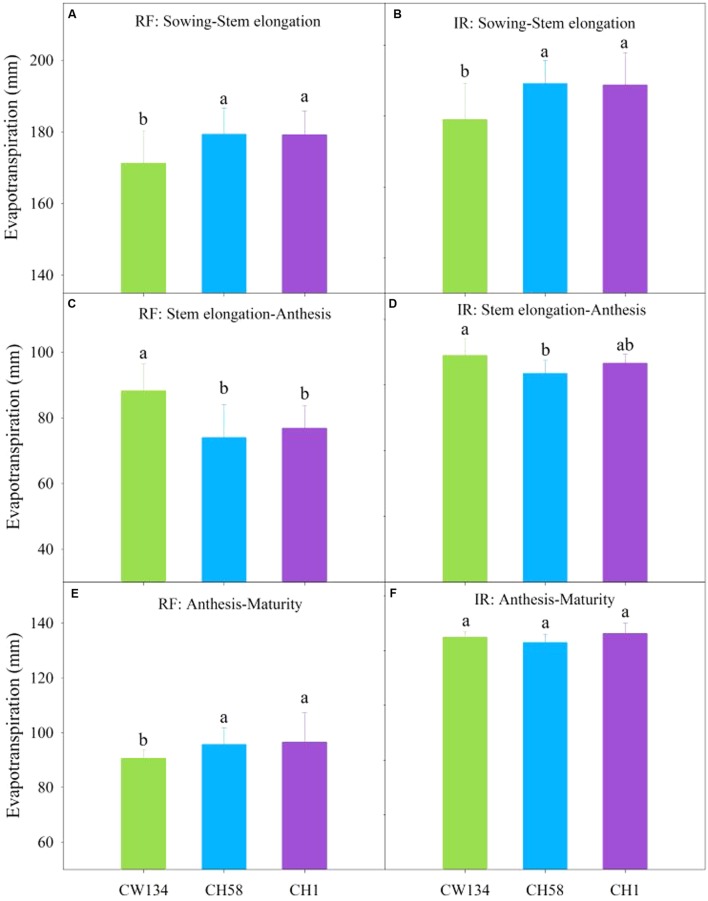
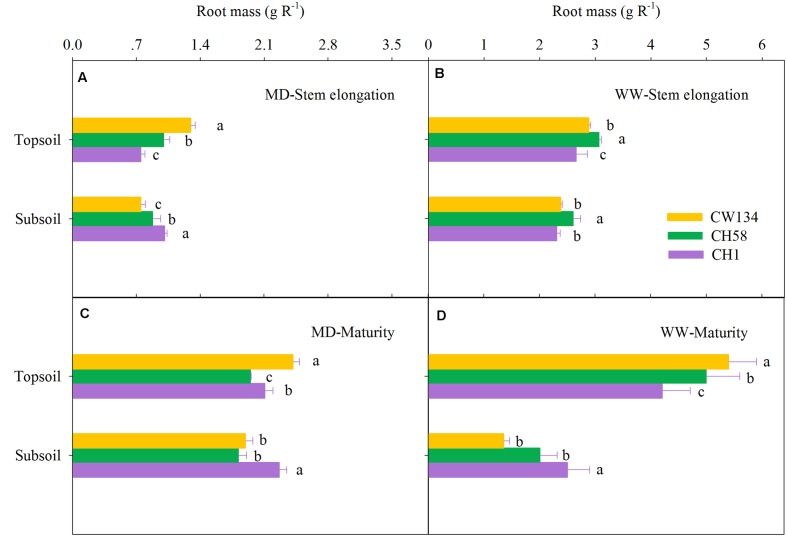
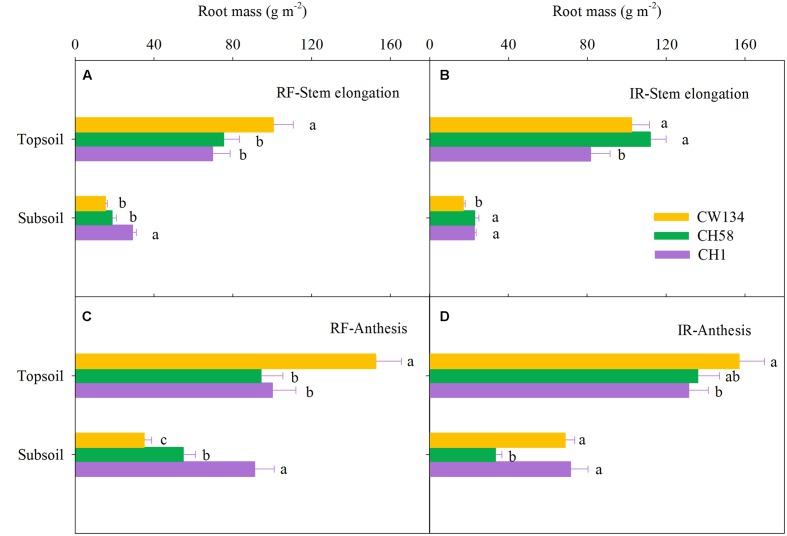
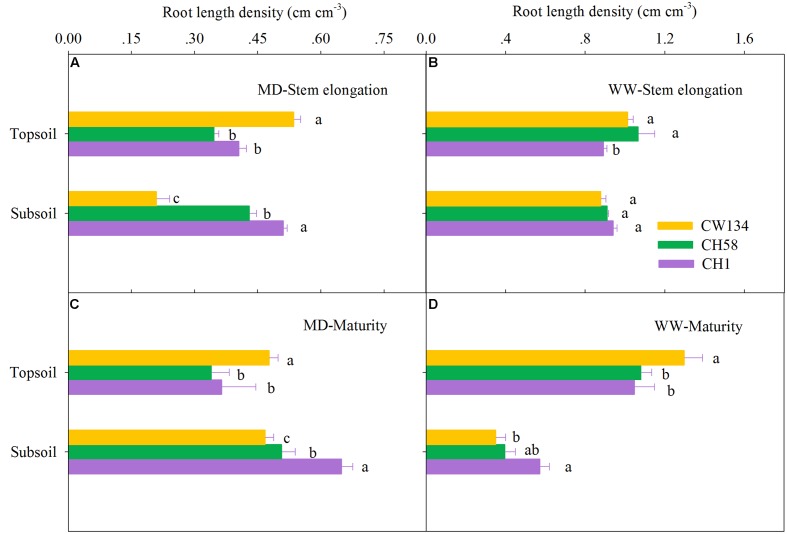
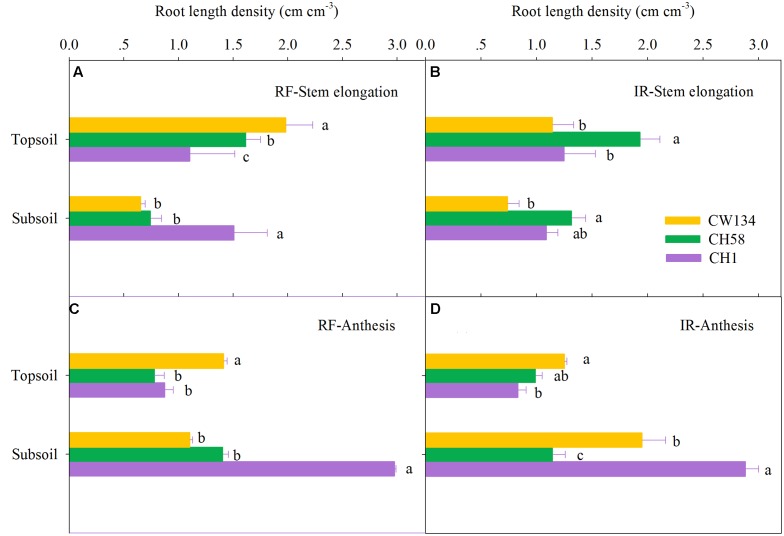
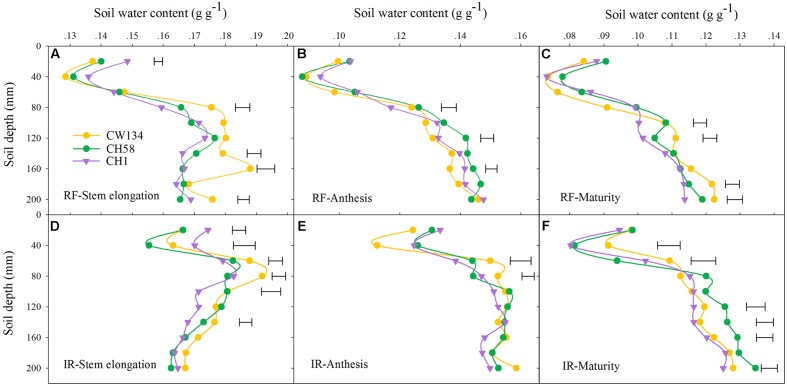
To determine root growth and grain yield of winter wheat ( L) under moderate drought stress, a nursery experiment and a field trial were conducted with or without water stress using three representative cultivars released in different years: CW134 (old landrace), CH58 (modern cultivar) and CH1 (new release). In the nursery experiment, plants were grown in soil-filled rhizoboxes under moderate drought (MD, 55% of field capacity) or well-watered (WW, 85% of field capacity) conditions. In the field trial, plots were either rainfed (moderate drought stress) or irrigated with 30 mm of water at each of stem elongation, booting and anthesis stages (irrigated). Compared to drought stress, grain yields increased under sufficient water supply in all cultivars, particular the newly released cultivar CH1 with 70% increase in the nursery and 23% in the field. When well-watered (nursery) or irrigated (field), CH1 had the highest grain yields compared to the other two cultivars, but produced similar yield to the modern cultivar (CH58) under water-stressed (nursery) or rainfed (field) conditions. When exposed to drought stress, CW134 had the highest topsoil root dry mass in topsoil but lowest in subsoil among the cultivars at stem elongation, anthesis, and maturity, respectively; while CH1 had the lowest topsoil and highest subsoil root dry mass at respective sampling times. Topsoil root mass and root length density were negatively correlated with grain yield for the two water treatments in nursery experiment. When water was limited, subsoil root mass was positively correlated with thousand kernel weight (TKW). In the field trial, CH1 and CH58 used less water during vegetative growth than CW134, but after anthesis stage, CH1 used more water than the other two cultivars, especially in the soil profile below 100 cm, which was associated with the increased TKW. This study demonstrated that greater root mass and root length density in subsoil layers, with enhanced access to subsoil water after anthesis, contribute to high grain yield when soil water is scarce.
为了确定中度干旱胁迫下冬小麦(L)的根系生长和籽粒产量,使用三个不同年份发布的代表性品种进行了苗圃试验和田间试验,试验设置了有水胁迫和无水胁迫两种情况:CW134(古老地方品种)、CH58(现代品种)和CH1(新发布品种)。在苗圃试验中,植株种植在装有土壤的根箱中,处于中度干旱(MD,田间持水量的55%)或充分浇水(WW,田间持水量的85%)条件下。在田间试验中,小区要么靠雨水灌溉(中度干旱胁迫),要么在拔节期、孕穗期和开花期各灌溉30毫米水(灌溉)。与干旱胁迫相比,所有品种在充足供水条件下籽粒产量均增加,特别是新发布品种CH1,在苗圃中增加了70%,在田间增加了23%。当充分浇水(苗圃)或灌溉(田间)时,CH1的籽粒产量高于其他两个品种,但在水分胁迫(苗圃)或靠雨水灌溉(田间)条件下,其产量与现代品种(CH58)相似。在干旱胁迫下,CW134在拔节期、开花期和成熟期时,其表土根系干质量在品种中分别最高,但在底土中最低;而CH1在各个采样时间的表土根系干质量最低,底土根系干质量最高。在苗圃试验的两种水分处理中,表土根系质量和根长密度与籽粒产量呈负相关。当水分有限时,底土根系质量与千粒重(TKW)呈正相关。在田间试验中,CH1和CH58在营养生长阶段比CW134耗水量少,但在开花期后,CH1比其他两个品种耗水量多,特别是在100厘米以下的土壤剖面中,这与TKW的增加有关。本研究表明,在土壤水分稀缺时,底土层中更大的根系质量和根长密度,以及开花期后对底土水分获取的增强,有助于提高籽粒产量。