State Key Laboratory of Earth Surface Processes and Resource Ecology and Ministry of Education Key Laboratory for Biodiversity Science and Ecological Engineering, Beijing Normal University, Beijing, China.
PLoS One. 2013 Jul 25;8(7):e70006. doi: 10.1371/journal.pone.0070006. Print 2013.
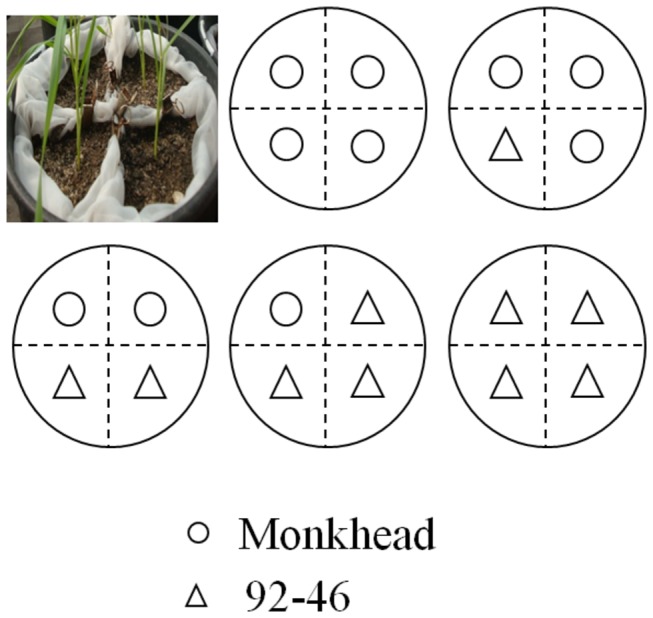
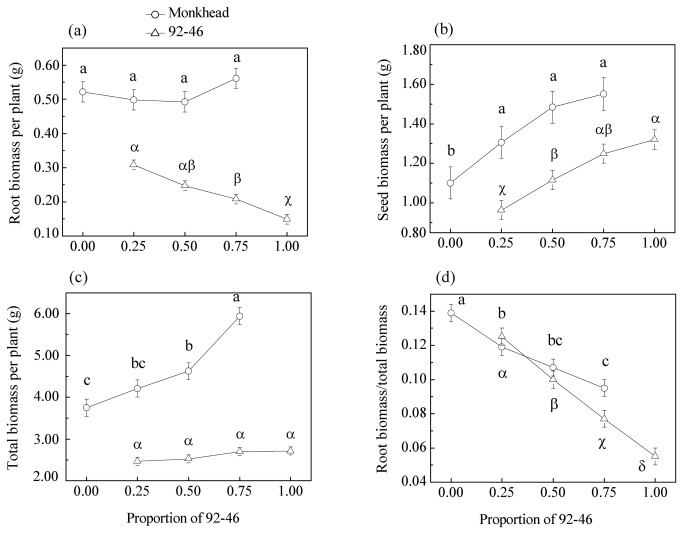
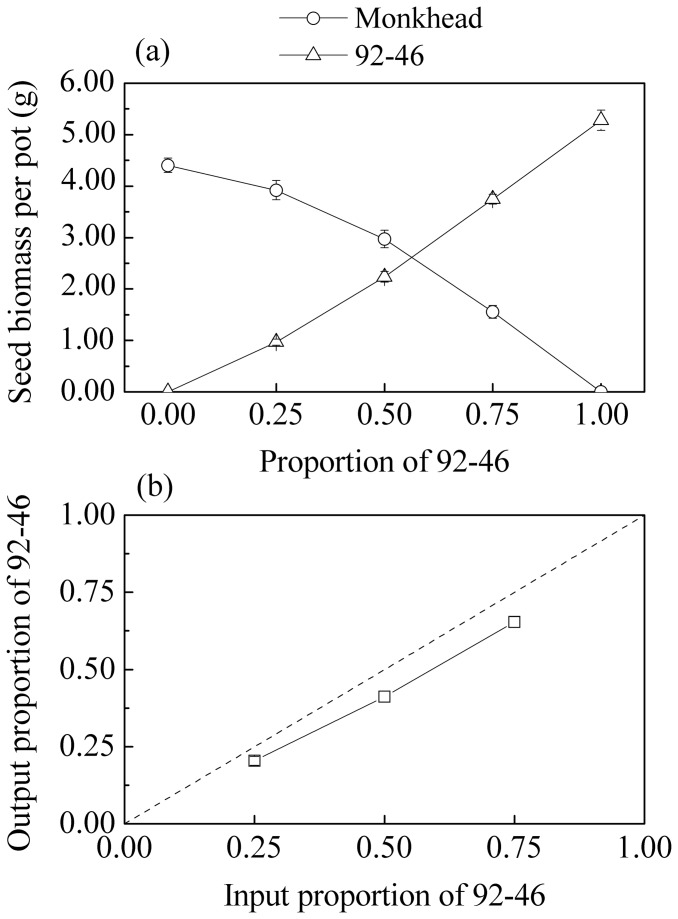
Human selection for high crop yield under water-limited conditions should have led modern cereal cultivars to invest less in root biomass, be it unconsciously. To test this hypothesis we conducted a pot experiment with two spring wheat cultivars, one old and one modern, both widely grown in the semi-arid regions of China. Using the replacement series method introduced by de Wit, we showed that the older landrace (Monkhead) was significantly more competitive than the more-modern cultivar (92-46). However, when grown in pure stand, old Monkhead had grown root biomass 3.5 times modern 92-46, whereas modern 92-46 gained a 20% higher grain yield. We also found modern 92-46 significantly increased root biomass per plant and root allocation (i.e., root biomass/total individual biomass) as its frequency in mixtures decreased, whereas old Monkhead did not respond in a similar way. This result suggests that the roots of modern cultivars may have gained an ability to recognize neighboring root systems and show more plastic self-restraining response to intra-cultivar competition.
在水资源有限的条件下,人类对高作物产量的选择可能导致现代谷类品种无意识地减少对根生物量的投入。为了验证这一假设,我们进行了一项盆栽实验,使用了两种春小麦品种,一种是古老的品种,另一种是现代的品种,这两种品种在中国半干旱地区都广泛种植。我们采用 de Wit 引入的替代系列方法表明,较老的地方品种(Monkhead)比更现代的品种(92-46)具有更强的竞争力。然而,当单独种植时,古老的 Monkhead 的根生物量是现代 92-46 的 3.5 倍,而现代 92-46 的谷物产量却高出 20%。我们还发现,现代 92-46 的每株植物的根生物量和根分配(即根生物量/总个体生物量)随着其在混合物中的频率降低而显著增加,而古老的 Monkhead 则没有以类似的方式作出反应。这一结果表明,现代品种的根系可能已经获得了一种识别邻近根系系统的能力,并对种内竞争表现出更具弹性的自我抑制反应。