Suresh Krithika, Taylor Jeremy M G, Spratt Daniel E, Daignault Stephanie, Tsodikov Alexander
Department of Biostatistics, School of Public Health, University of Michigan, Ann Arbor, MI, 48109, USA.
Department of Radiation Oncology, University of Michigan, Ann Arbor, MI, 48109, USA.
Biom J. 2017 Nov;59(6):1277-1300. doi: 10.1002/bimj.201600235. Epub 2017 May 16.
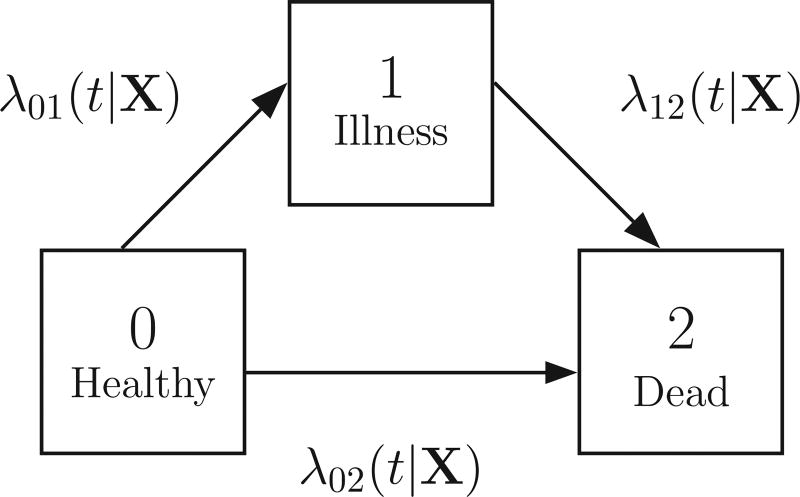
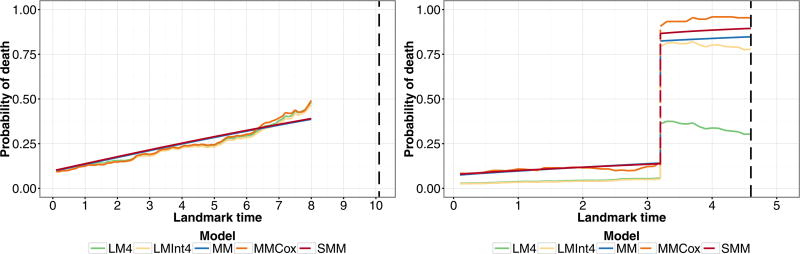
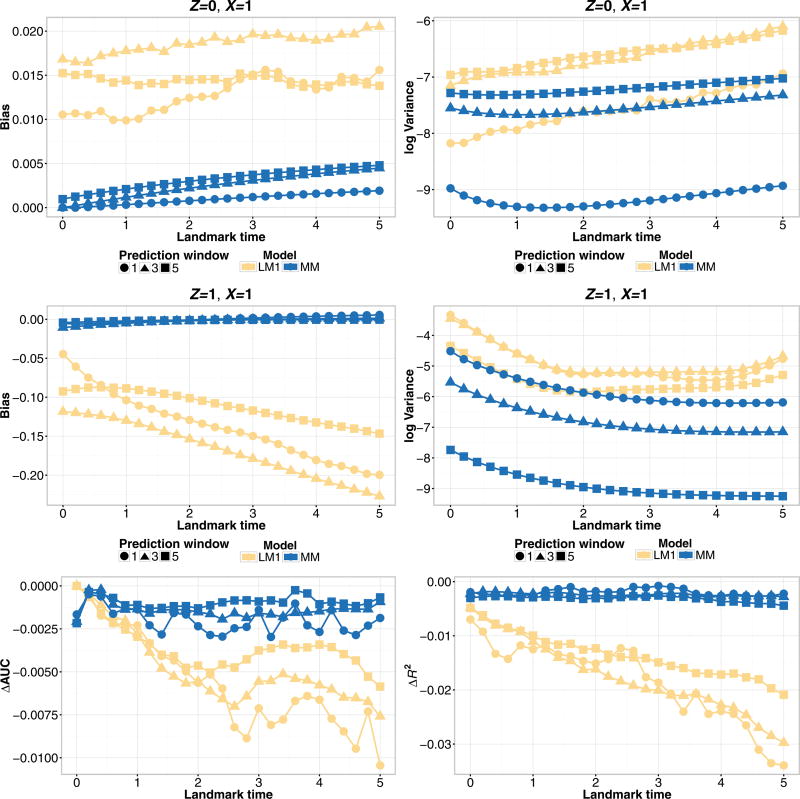
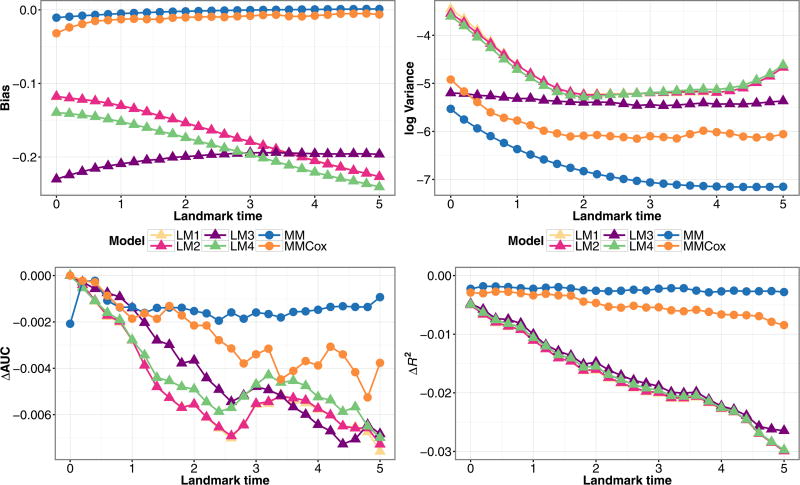
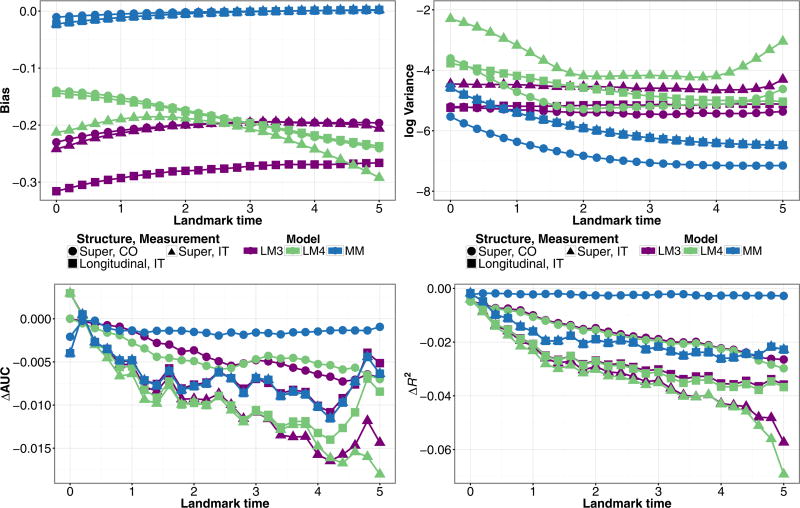
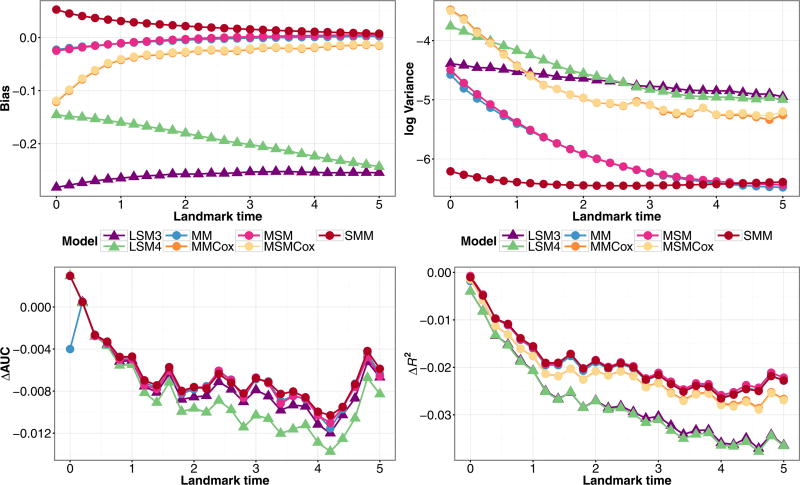
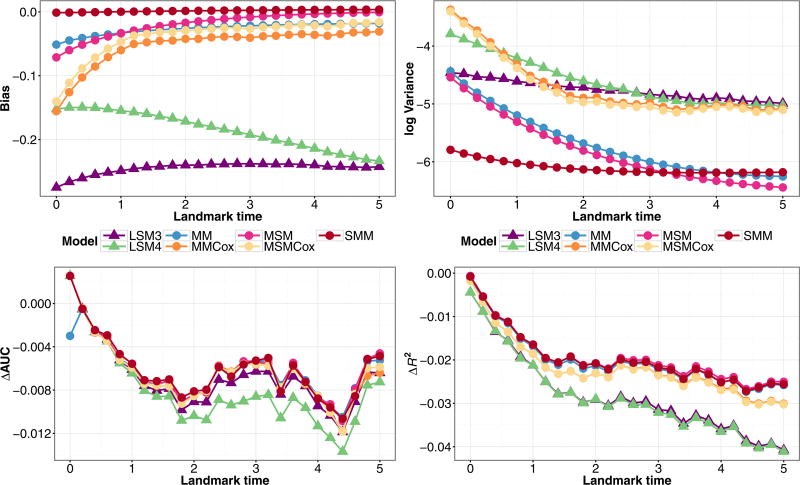
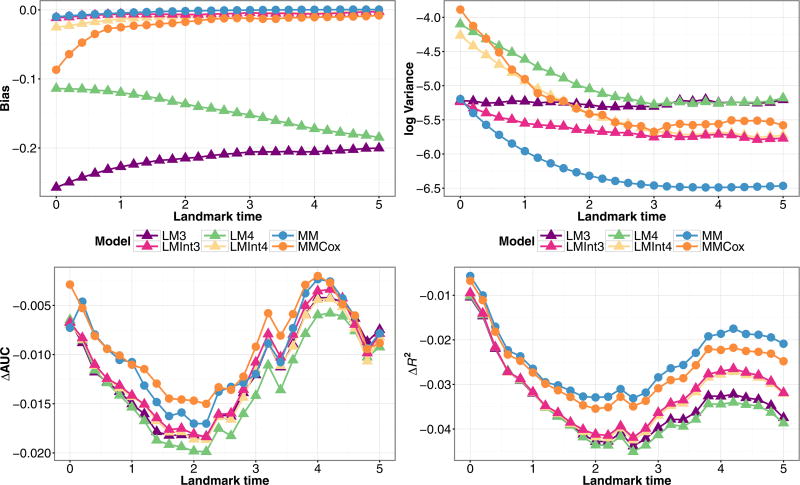
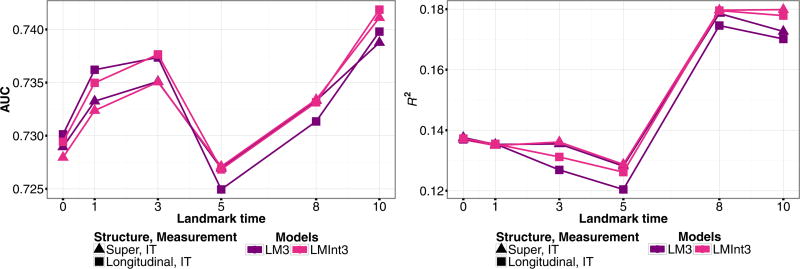
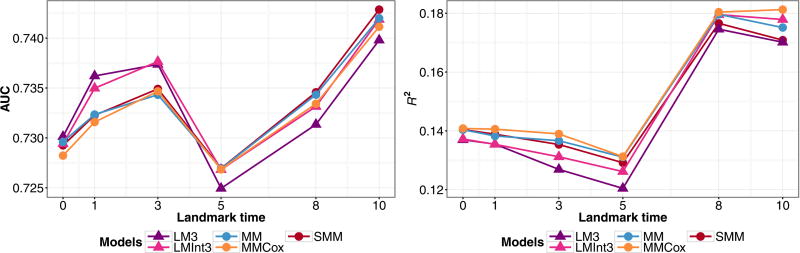
Dynamic prediction incorporates time-dependent marker information accrued during follow-up to improve personalized survival prediction probabilities. At any follow-up, or "landmark", time, the residual time distribution for an individual, conditional on their updated marker values, can be used to produce a dynamic prediction. To satisfy a consistency condition that links dynamic predictions at different time points, the residual time distribution must follow from a prediction function that models the joint distribution of the marker process and time to failure, such as a joint model. To circumvent the assumptions and computational burden associated with a joint model, approximate methods for dynamic prediction have been proposed. One such method is landmarking, which fits a Cox model at a sequence of landmark times, and thus is not a comprehensive probability model of the marker process and the event time. Considering an illness-death model, we derive the residual time distribution and demonstrate that the structure of the Cox model baseline hazard and covariate effects under the landmarking approach do not have simple form. We suggest some extensions of the landmark Cox model that should provide a better approximation. We compare the performance of the landmark models with joint models using simulation studies and cognitive aging data from the PAQUID study. We examine the predicted probabilities produced under both methods using data from a prostate cancer study, where metastatic clinical failure is a time-dependent covariate for predicting death following radiation therapy.
动态预测纳入了随访期间积累的随时间变化的标志物信息,以提高个性化生存预测概率。在任何随访或“地标”时间,个体的剩余时间分布(以其更新后的标志物值为条件)可用于进行动态预测。为满足连接不同时间点动态预测的一致性条件,剩余时间分布必须源自一个对标志物过程和失效时间的联合分布进行建模的预测函数,比如联合模型。为规避与联合模型相关的假设和计算负担,已提出动态预测的近似方法。其中一种方法是地标法,它在一系列地标时间拟合Cox模型,因此不是标志物过程和事件时间的全面概率模型。考虑疾病-死亡模型,我们推导了剩余时间分布,并证明在地标法下Cox模型基线风险和协变量效应的结构没有简单形式。我们提出了地标Cox模型的一些扩展,应该能提供更好的近似。我们使用模拟研究以及来自PAQUID研究的认知老化数据,比较了地标模型与联合模型的性能。我们使用前列腺癌研究的数据检查了两种方法下产生的预测概率,其中转移性临床失败是预测放疗后死亡的随时间变化的协变量。