Yu Liping, Zhao Zhiyuan, Steck Andrea K
Barbara Davis Center for Childhood Diabetes, University of Colorado School of Medicine, Aurora, Colorado, USA.
Curr Opin Endocrinol Diabetes Obes. 2017 Aug;24(4):285-291. doi: 10.1097/MED.0000000000000348.
Type 1 diabetes (T1D) is now predictable by measuring major islet autoantibodies (IAbs) against insulin and other pancreatic β cells proteins including GAD65 (GADA), islet antigen 2 (IA-2A), and zinc transporter 8 (ZnT8A). The assay technology for IAbs has made great progress; however, several important aspects still need to be addressed and improved.
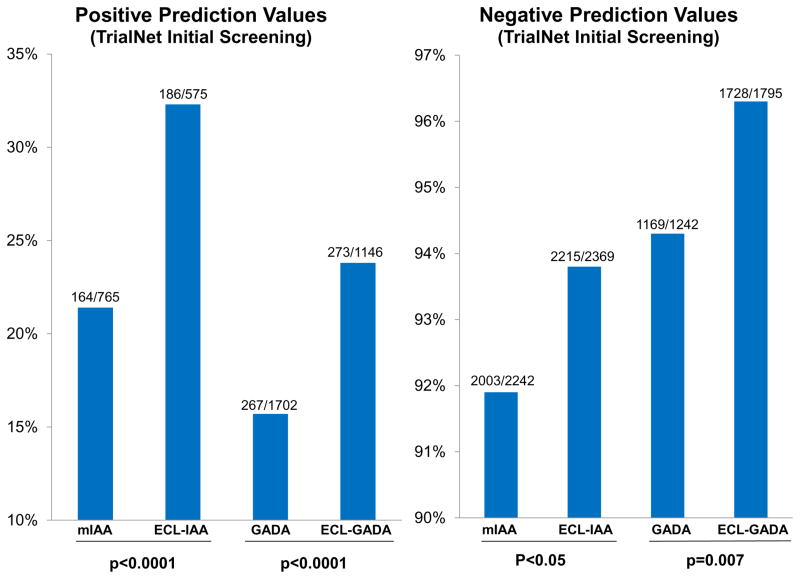
Currently a radio-binding assay has been well established as the 'gold' standard assay for all four IAbs. New generation of nonradioactive IAb assay with electrochemiluminescence technology has been shown to further improve sensitivity and disease specificity. Recently, multiplexed assays have opened the possibility of more efficient screening in large populations. Identification of potential new autoantibodies to neo-antigens or neo-epitopes posttranslational modification is a new important field to be explored.
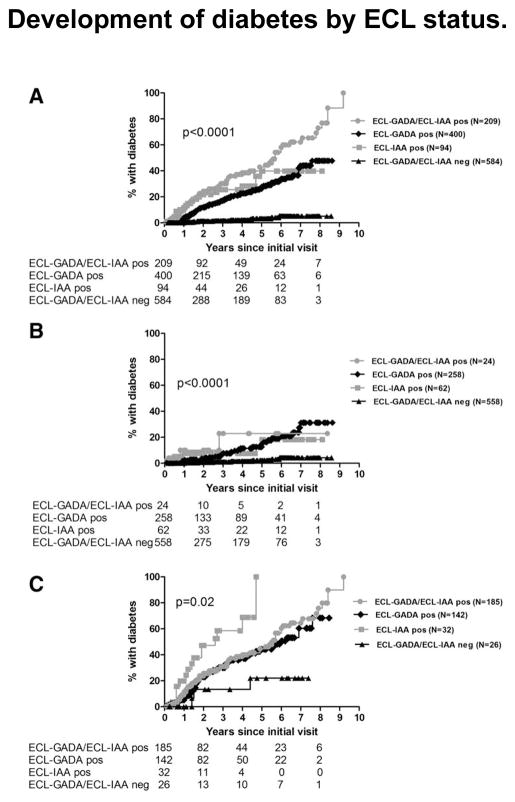
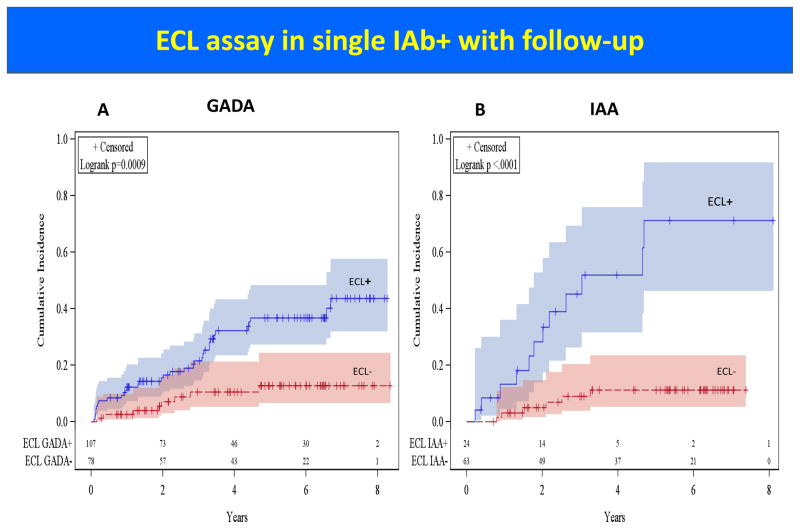
Individuals having a single positive autoantibody are at low risk for progression to T1D, whereas individuals expressing two or more positive autoantibodies, especially on multiple tests over time, have nearly 100% risk of developing clinical T1D when followed for over two decades. More efficient and cost effective IAb assays will hopefully lead to point-of-care screening in the general population.
通过检测针对胰岛素和其他胰腺β细胞蛋白(包括谷氨酸脱羧酶65抗体[GADA]、胰岛抗原2抗体[IA - 2A]和锌转运体8抗体[ZnT8A])的主要胰岛自身抗体(IAbs),1型糖尿病(T1D)现在已具有可预测性。IAbs的检测技术取得了很大进展;然而,仍有几个重要方面需要解决和改进。
目前,放射结合测定法已成为所有四种IAbs的“金标准”检测方法。新一代采用电化学发光技术的非放射性IAbs检测方法已显示出能进一步提高灵敏度和疾病特异性。最近,多重检测为在大规模人群中进行更高效的筛查提供了可能。鉴定针对新抗原或翻译后修饰新表位的潜在新自身抗体是一个有待探索的重要新领域。
单一自身抗体呈阳性的个体进展为T1D的风险较低,而表达两种或更多种阳性自身抗体的个体,尤其是随着时间推移多次检测呈阳性的个体,在随访二十多年后发生临床T1D的风险接近100%。更高效且具成本效益的IAbs检测有望在普通人群中实现即时检测筛查。