Tao Ye, Zhang Yuan-Ming, Downing Alison
Xinjiang Institute of Ecology and Geography, Key Laboratory of Biogeography and Bioresource in Arid Land, Chinese Academy of Sciences, South Beijing Road 818, Urumqi, Xinjiang, 830011, P.R. China.
University of Chinese Academy of Sciences, Yuquan Road 19 (A), Beijing, 100049, P.R. China.
Bot Stud. 2013 Dec;54(1):59. doi: 10.1186/1999-3110-54-59. Epub 2013 Dec 2.
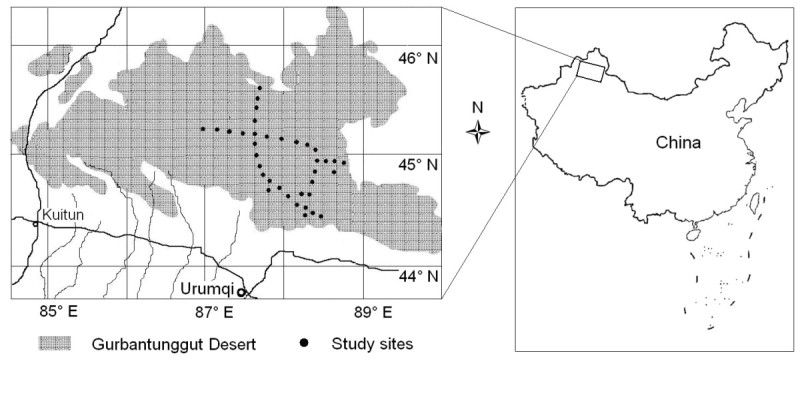
Community structure and species composition are closely related to plant diversity and ecosystem stability. To explore the similarity in vegetation structure of shrub communities under the same temperate climate but with different microhabitats, 36, 28 and 13 sampling plots in Ephedra distachya, Seriphidium terrae-albae and Artemisia songarica communities were selected respectively, during the course of three seasons (early spring, summer, autumn) in Gurbantunggut Desert, north-western China. The species composition, abundance, biomass and soil nutrients were investigated. Floristic changes were characterized by similarity and ordination methods.
Two communities, E. distachya and S. terrae-albae, were similar in terms of soil nutrients but differed from the A. songarica community. Soil organic matter, nitrogen and biological soil crusts accounted for the differences of microhabitats. In spring and summer, more plant families, genera and species were recorded in E. distachya and S. terrae-albae communities than in the A. songarica community but in each community, the number of families, genera, species, herbs and life forms showed a consistent trend summer > spring > autumn. There were significant differences in absolute biomass among the three communities, but the ratio of dead biomass to total biomass was consistently 1:4, indicating the constant turnover rate of plant biomass for nutrient cycling. In each community shrubs accounted for the most biomass. Herbaceous biomass was negligible but the herbs contributed the most richness and abundance.
The similarity in response of all three communities to seasonal changes in vegetation structure and biomass allocation demonstrate convergence although divergence is demonstrated in soil characteristics or microhabitats.
群落结构和物种组成与植物多样性及生态系统稳定性密切相关。为探究在相同温带气候但微生境不同的条件下灌木群落植被结构的相似性,在中国西北古尔班通古特沙漠,于三个季节(早春、夏季、秋季)分别在麻黄群落、白茎绢蒿群落和准噶尔艾蒿群落选取了36个、28个和13个样地,调查了物种组成、丰度、生物量和土壤养分。用相似性和排序方法表征植物区系变化。
麻黄群落和白茎绢蒿群落这两个群落在土壤养分方面相似,但与准噶尔艾蒿群落不同。土壤有机质、氮和生物土壤结皮造成了微生境差异。在春季和夏季,麻黄群落和白茎绢蒿群落记录到的植物科、属和物种比准噶尔艾蒿群落更多,但在每个群落中,科、属、物种、草本植物和生活型的数量均呈现夏季>春季>秋季的一致趋势。三个群落的绝对生物量存在显著差异,但死生物量与总生物量的比率始终为1:4,表明植物生物量为养分循环的周转率恒定。在每个群落中,灌木生物量占比最大。草本生物量可忽略不计,但草本植物的丰富度和丰度贡献最大。
尽管在土壤特征或微生境方面存在差异,但所有三个群落对植被结构和生物量分配季节变化的响应具有相似性,表明存在趋同现象。