Noda Yoshihiro, Zomorrodi Reza, Backhouse Felicity, Cash Robin F H, Barr Mera S, Rajji Tarek K, Chen Robert, Daskalakis Zafiris J, Blumberger Daniel M
Temerty Centre for Therapeutic Brain Intervention, Centre for Addiction and Mental HealthToronto, ON, Canada.
Department of Psychiatry, University of TorontoToronto, ON, Canada.
Front Aging Neurosci. 2017 May 2;9:119. doi: 10.3389/fnagi.2017.00119. eCollection 2017.
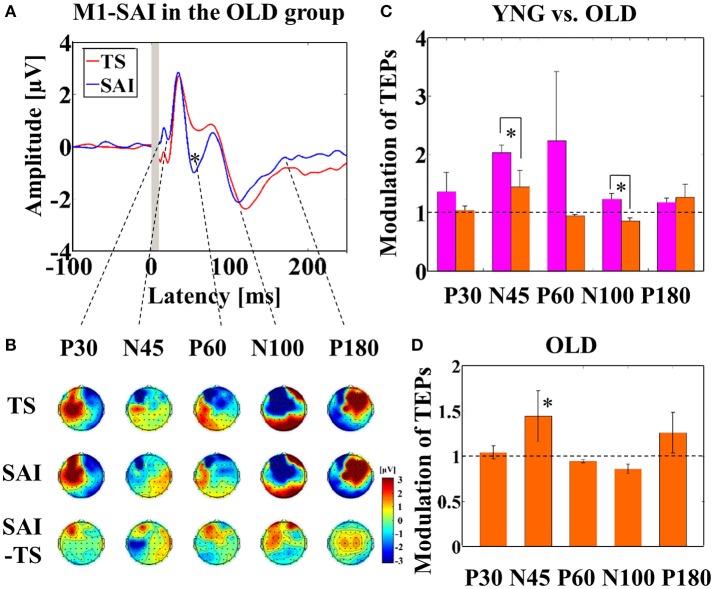
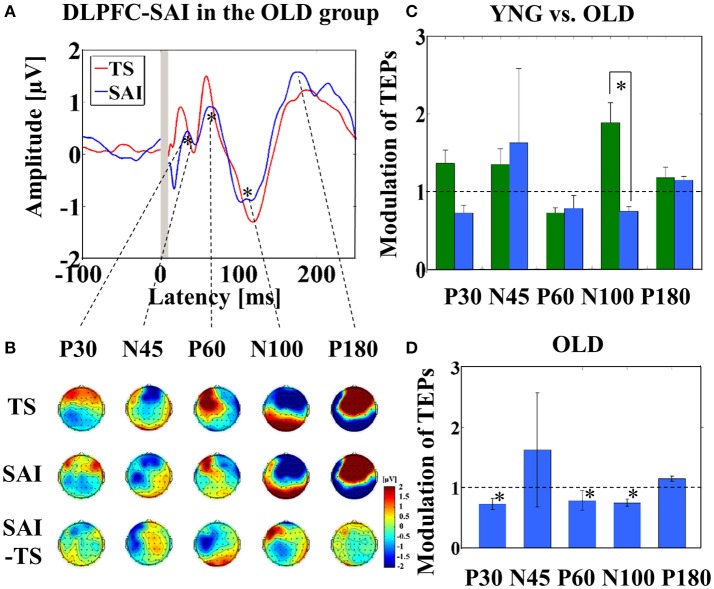
Combining transcranial magnetic stimulation (TMS) with electroencephalography (EEG) allows for the assessment of various neurophysiological processes in the human cortex. One of these paradigms, short-latency afferent inhibition (SAI), is thought to be a sensitive measure of cholinergic activity. In a previous study, we demonstrated the temporal pattern of this paradigm from both the motor (M1) and dorsolateral prefrontal cortex (DLPFC) using simultaneous TMS-EEG recording. The SAI paradigm led to marked modulations at N100. In this study, we aimed to investigate the age-related effects on TMS-evoked potentials (TEPs) with the SAI from M1 and the DLPFC in younger (18-59 years old) and older (≥60 years old) participants. Older participants showed significantly lower N100 modulation in M1-SAI as well as DLPFC-SAI compared to the younger participants. Furthermore, the modulation of N100 by DLPFC-SAI in the older participants correlated with executive function as measured with the Trail making test. This paradigm has the potential to non-invasively identify cholinergic changes in cortical regions related to cognition in older participants.
将经颅磁刺激(TMS)与脑电图(EEG)相结合,可以评估人类皮质中的各种神经生理过程。其中一种模式,即短潜伏期传入抑制(SAI),被认为是胆碱能活动的一种敏感指标。在之前的一项研究中,我们使用同步TMS-EEG记录展示了该模式在运动皮质(M1)和背外侧前额叶皮质(DLPFC)的时间模式。SAI模式导致了N100的显著调制。在本研究中,我们旨在调查年轻(18 - 59岁)和年长(≥60岁)参与者中,SAI对M1和DLPFC的TMS诱发电位(TEP)的年龄相关影响。与年轻参与者相比,年长参与者在M1-SAI以及DLPFC-SAI中表现出显著更低的N100调制。此外,年长参与者中DLPFC-SAI对N100的调制与通过连线测验测量的执行功能相关。这种模式有可能非侵入性地识别年长参与者中与认知相关的皮质区域的胆碱能变化。