Bhandari Apoorva, Radhu Natasha, Farzan Faranak, Mulsant Benoit H, Rajji Tarek K, Daskalakis Zafiris J, Blumberger Daniel M
Temerty Centre for Therapeutic Brain Intervention, Centre for Addiction and Mental Health, Toronto, Ontario M6J 1H4, Canada.
Temerty Centre for Therapeutic Brain Intervention, Centre for Addiction and Mental Health, Toronto, Ontario M6J 1H4, Canada; Department of Psychiatry, University of Toronto, Toronto, Ontario M5T 1R8, Canada; Campbell Family Mental Health Research Institute, Centre for Addiction and Mental Health, Toronto, Ontario M5T 1R8, Canada.
Clin Neurophysiol. 2016 Aug;127(8):2834-2845. doi: 10.1016/j.clinph.2016.05.363. Epub 2016 Jun 8.
Transcranial magnetic stimulation (TMS) is a non-invasive tool used for studying cortical excitability and plasticity in the human brain. This review aims to quantitatively synthesize the literature on age-related differences in cortical excitability and plasticity, examined by TMS.
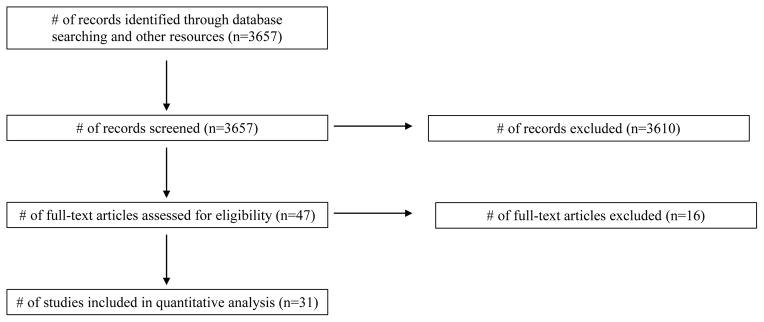
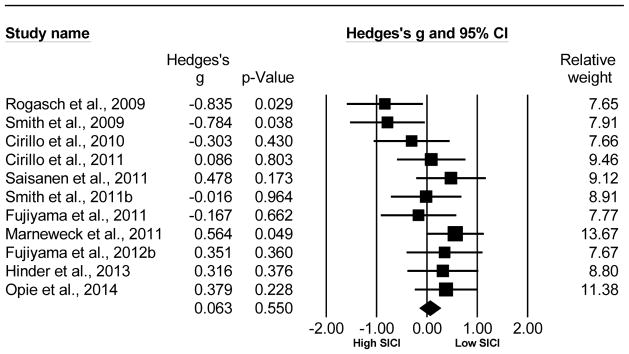
A literature search was conducted using MEDLINE, Embase, and PsycINFO from 1980 to December 2015. We extracted studies with healthy old (50-89years) versus young (16-49years) individuals that utilized the following TMS measures: resting motor threshold (RMT), short-interval cortical inhibition (SICI), short-latency afferent inhibition (SAI), cortical silent period (CSP), intracortical facilitation (ICF), and paired associative stimulation (PAS).
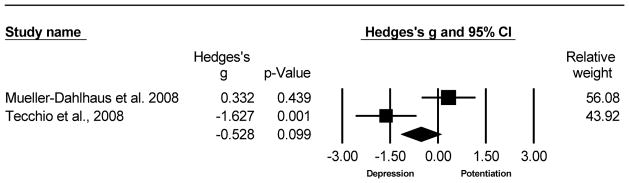
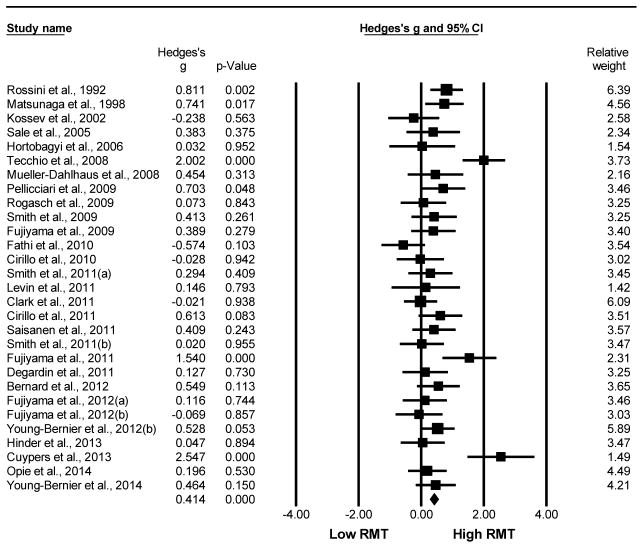
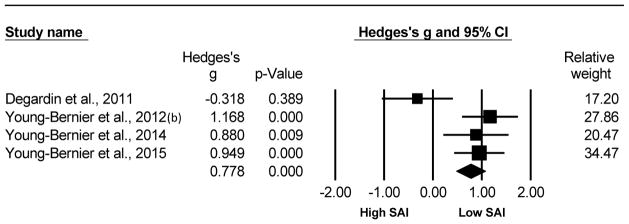
We found a significant increase in RMT (g=0.414, 95% confidence interval (CI) [0.284, 0.544], p<0.001), a significant decrease in SAI (g=0.778, 95% CI [0.478, 1.078], p<0.001), and a trending decrease in LTP-like plasticity (g=-0.528, 95% CI [-1.157, 0.100] p<0.1) with age.
Our findings suggest an age-dependent reduction in cortical excitability and sensorimotor integration within the human motor cortex.
Alterations in the ability to regulate cortical excitability, sensorimotor integration and plasticity may underlie several age-related motor deficits.
经颅磁刺激(TMS)是一种用于研究人类大脑皮质兴奋性和可塑性的非侵入性工具。本综述旨在定量综合通过TMS检测的与年龄相关的皮质兴奋性和可塑性差异的文献。
使用MEDLINE、Embase和PsycINFO对1980年至2015年12月的文献进行检索。我们提取了针对健康老年人(50 - 89岁)与年轻人(16 - 49岁),采用以下TMS测量指标的研究:静息运动阈值(RMT)、短间隔皮质抑制(SICI)、短潜伏期传入抑制(SAI)、皮质静息期(CSP)、皮质内易化(ICF)和配对联想刺激(PAS)。
我们发现,随着年龄增长,RMT显著增加(g = 0.414,95%置信区间(CI)[0.284, 0.544],p < 0.001),SAI显著降低(g = 0.778,95% CI [0.478, 1.078],p < 0.001),类长时程增强可塑性呈下降趋势(g = -0.528,95% CI [-1.157, 0.100],p < 0.1)。
我们的研究结果表明,人类运动皮质内的皮质兴奋性和感觉运动整合存在年龄依赖性降低。
调节皮质兴奋性、感觉运动整合和可塑性能力的改变可能是几种与年龄相关的运动缺陷的基础。