Gregory Anne B, Lester Kendra K, Gregory Deborah M, Twells Laurie K, Midodzi William K, Pearce Neil J
Department of Clinical Epidemiology, Faculty of Medicine, Memorial University of Newfoundland, St. John's, NL, Canada A1B 3V6.
Department of Medicine, Faculty of Medicine, Memorial University of Newfoundland, St. John's, NL, Canada A1B 3V6.
Cardiol Res Pract. 2017;2017:5481671. doi: 10.1155/2017/5481671. Epub 2017 Apr 23.
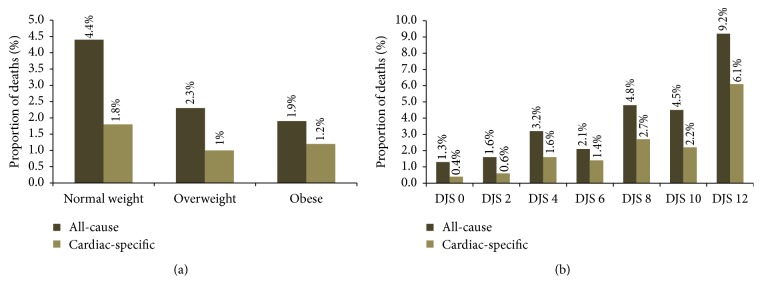
. Obesity is associated with an increased risk of cardiovascular disease and may be associated with more severe coronary artery disease (CAD); however, the relationship between body mass index [BMI (kg/m)] and CAD severity is uncertain and debatable. The aim of this study was to examine the relationship between BMI and angiographic severity of CAD. . Duke Jeopardy Score (DJS), a prognostic tool predictive of 1-year mortality in CAD, was assigned to angiographic data of patients ≥18 years of age ( = 8,079). Patients were grouped into 3 BMI categories: normal (18.5-24.9 kg/m), overweight (25.0-29.9 kg/m), and obese (≥30 kg/m); and multivariable adjusted hazard ratios for 1-year all-cause and cardiac-specific mortality were calculated. . Cardiac risk factor prevalence (e.g., diabetes, hypertension, and hyperlipidemia) significantly increased with increasing BMI. Unadjusted all-cause and cardiac-specific 1-year mortality tended to rise with incremental increases in DJS, with the exception of DJS 6 ( < 0.001). After adjusting for potential confounders, no significant association of BMI and all-cause (HR 0.70, 95% CI .48-1.02) or cardiac-specific (HR 1.11, 95% CI .64-1.92) mortality was found. . This study failed to detect an association of BMI with 1-year all-cause or cardiac-specific mortality after adjustment for potential confounding variables.
肥胖与心血管疾病风险增加相关,且可能与更严重的冠状动脉疾病(CAD)有关;然而,体重指数[BMI(kg/m²)]与CAD严重程度之间的关系尚不确定且存在争议。本研究的目的是探讨BMI与CAD血管造影严重程度之间的关系。将杜克危险评分(DJS)(一种预测CAD患者1年死亡率的预后工具)应用于年龄≥18岁患者(n = 8079)的血管造影数据。患者被分为3个BMI类别:正常(18.5 - 24.9 kg/m²)、超重(25.0 - 29.9 kg/m²)和肥胖(≥30 kg/m²);并计算了1年全因死亡率和心脏特异性死亡率的多变量调整风险比。随着BMI的增加,心脏危险因素患病率(如糖尿病、高血压和高脂血症)显著升高。未调整的1年全因死亡率和心脏特异性死亡率倾向于随着DJS的增加而上升,但DJS为6时除外(P < 0.001)。在调整潜在混杂因素后,未发现BMI与全因死亡率(HR 0.70,95%CI 0.48 - 1.02)或心脏特异性死亡率(HR 1.11,95%CI 0.64 - 1.92)之间存在显著关联。本研究在调整潜在混杂变量后未发现BMI与1年全因死亡率或心脏特异性死亡率之间存在关联。