Department of Chemistry, University of Liverpool , Crown Street, Liverpool L69 7ZD, U.K.
Surface Science Research Centre, Department of Chemistry, University of Liverpool , Abercromby Square, Liverpool L69 3BX, U.K.
Anal Chem. 2017 Jun 20;89(12):6807-6814. doi: 10.1021/acs.analchem.7b01229. Epub 2017 May 25.
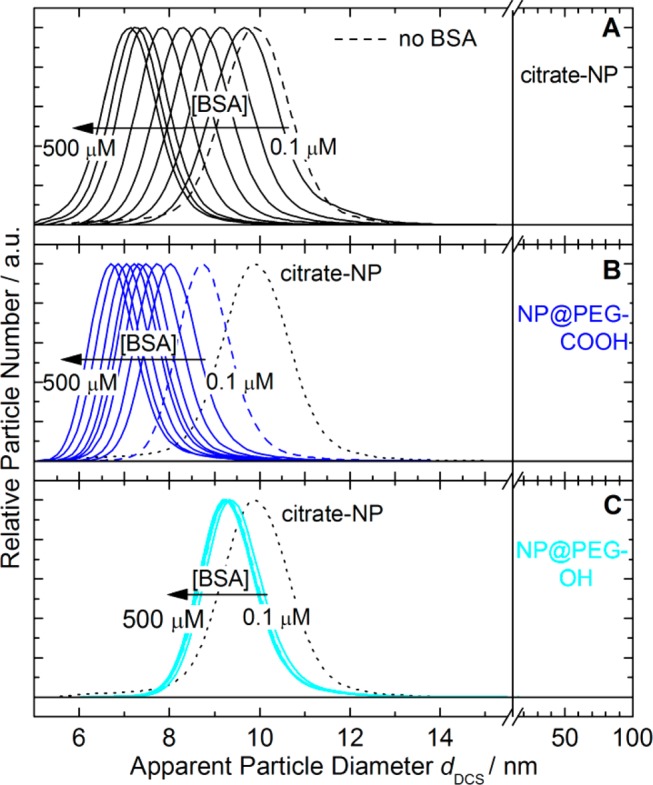
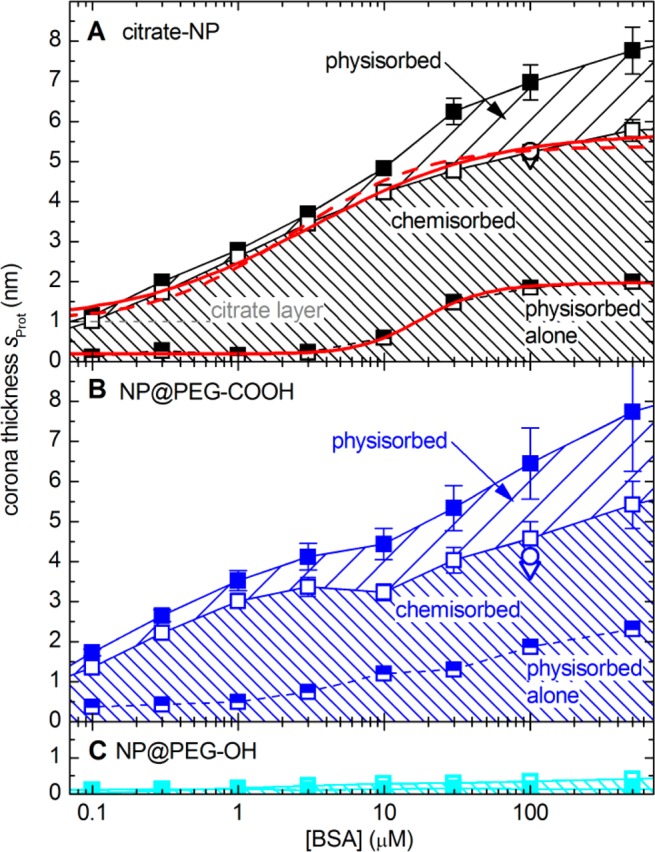
It is demonstrated that the adsorption of bovine serum albumin (BSA) to aqueous gold colloids can be quantified with molecular resolution by differential centrifugal sedimentation (DCS). This method separates colloidal particles of comparable density by mass. When proteins adsorb to the nanoparticles, both their mass and their effective density change, which strongly affects the sedimentation time. A straightforward analysis allows quantification of the adsorbed layer. Most importantly, unlike many other methods, DCS can be used to detect chemisorbed proteins ("hard corona") as well as physisorbed proteins ("soft corona"). The results for BSA on gold colloid nanoparticles can be modeled in terms of Langmuir-type adsorption isotherms (Hill model). The effects of surface modification with small thiol-PEG ligands on protein adsorption are also demonstrated.
通过差示离心沉降(DCS)可以定量地以分子分辨率研究牛血清白蛋白(BSA)在水性金纳米胶体上的吸附。该方法通过质量分离具有相似密度的胶体颗粒。当蛋白质吸附到纳米颗粒上时,它们的质量和有效密度都会发生变化,这会强烈影响沉降时间。简单的分析可以定量吸附层。最重要的是,与许多其他方法不同,DCS 可用于检测化学吸附的蛋白质(“硬壳层”)和物理吸附的蛋白质(“软壳层”)。可以根据朗缪尔型吸附等温线(Hill 模型)对金纳米胶体纳米颗粒上 BSA 的结果进行建模。还证明了用小的硫醇-PEG 配体进行表面修饰对蛋白质吸附的影响。