SynthSys - Synthetic and Systems Biology, University of Edinburgh, Edinburgh, United Kingdom.
Department of Bioengineering, Imperial College London, London, United Kingdom.
Elife. 2017 May 17;6:e21415. doi: 10.7554/eLife.21415.
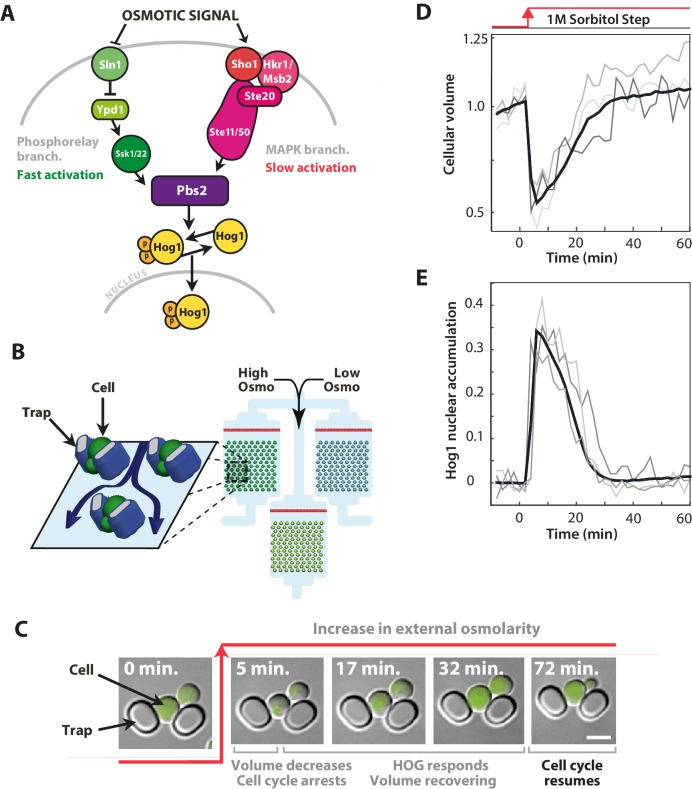
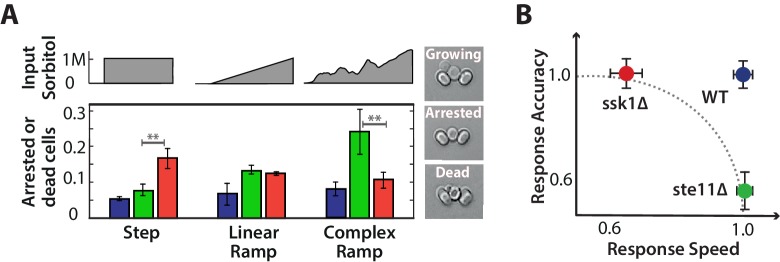
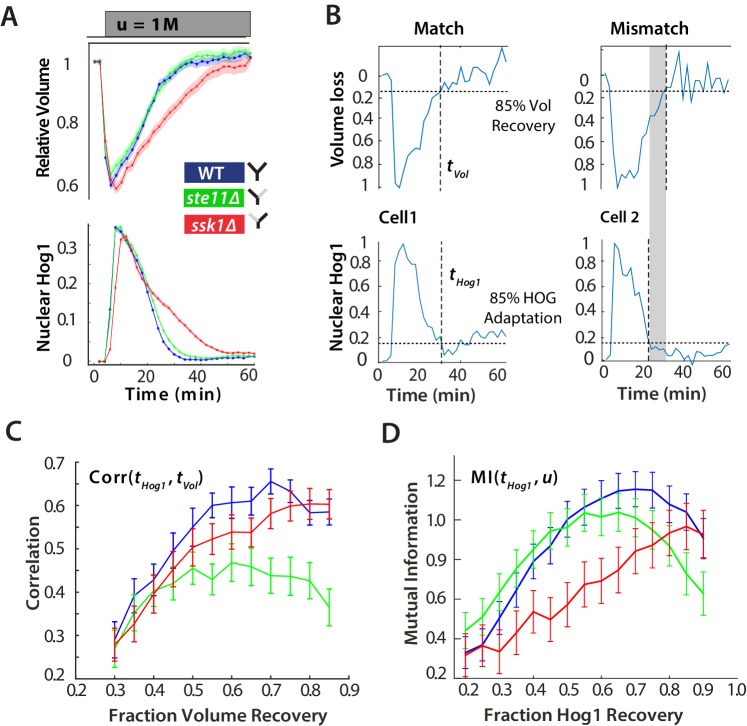
Improving in one aspect of a task can undermine performance in another, but how such opposing demands play out in single cells and impact on fitness is mostly unknown. Here we study budding yeast in dynamic environments of hyperosmotic stress and show how the corresponding signalling network increases cellular survival both by assigning the requirements of high response speed and high response accuracy to two separate input pathways and by having these pathways interact to converge on Hog1, a p38 MAP kinase. Cells with only the less accurate, reflex-like pathway are fitter in sudden stress, whereas cells with only the slow, more accurate pathway are fitter in increasing but fluctuating stress. Our results demonstrate that cellular signalling is vulnerable to trade-offs in performance, but that these trade-offs can be mitigated by assigning the opposing tasks to different signalling subnetworks. Such division of labour could function broadly within cellular signal transduction.
在任务的一个方面进行改进可能会降低另一方面的表现,但在单细胞中这种相互矛盾的需求是如何发挥作用的,以及它们如何影响适应性,在很大程度上还不得而知。在这里,我们研究了在高渗胁迫的动态环境中的出芽酵母,并展示了相应的信号网络如何通过将高速响应和高响应精度的要求分配给两个独立的输入途径,以及通过这些途径相互作用来集中到 Hog1(一种 p38 MAP 激酶),从而提高细胞存活率。只有不太准确、反射样途径的细胞在突然的压力下适应性更强,而只有缓慢、更准确途径的细胞在逐渐增加但波动的压力下适应性更强。我们的结果表明,细胞信号易受到性能权衡的影响,但通过将相反的任务分配给不同的信号子网络,可以减轻这些权衡。这种分工可能在细胞信号转导中广泛发挥作用。