Veltri Lauren W, Milton Denái R, Delgado Ruby, Shah Nina, Patel Krina, Nieto Yago, Kebriaei Partow, Popat Uday R, Parmar Simrit, Oran Betul, Ciurea Stefan, Hosing Chitra, Lee Hans C, Manasanch Elisabet, Orlowski Robert Z, Shpall Elizabeth J, Champlin Richard E, Qazilbash Muzaffar H, Bashir Qaiser
Department of Stem Cell Transplantation and Cellular Therapy, The University of Texas MD Anderson Cancer Center, Houston, Texas.
Department of Biostatistics, The University of Texas MD Anderson Cancer Center, Houston, Texas.
Cancer. 2017 Sep 15;123(18):3568-3575. doi: 10.1002/cncr.30770. Epub 2017 May 17.
Despite the introduction of effective, novel agents, the outcome of patients with refractory multiple myeloma remains poor, particularly those who are refractory to both proteasome inhibitors (PIs) and immunomodulatory agents (IMiDs). Limited data are available on the role of autologous hematopoietic stem cell transplantation in this population.
Patients with refractory myeloma who underwent first autologous hematopoietic stem cell transplantation (auto-HCT) between March 2000 and October 2015 were retrospectively analyzed. Those who had primary refractory disease and those with relapsed and refractory disease were included. Disease that was refractory to at least 1 PI and at least 1 IMiD was classified as double-refractory multiple myeloma (DR-MM).
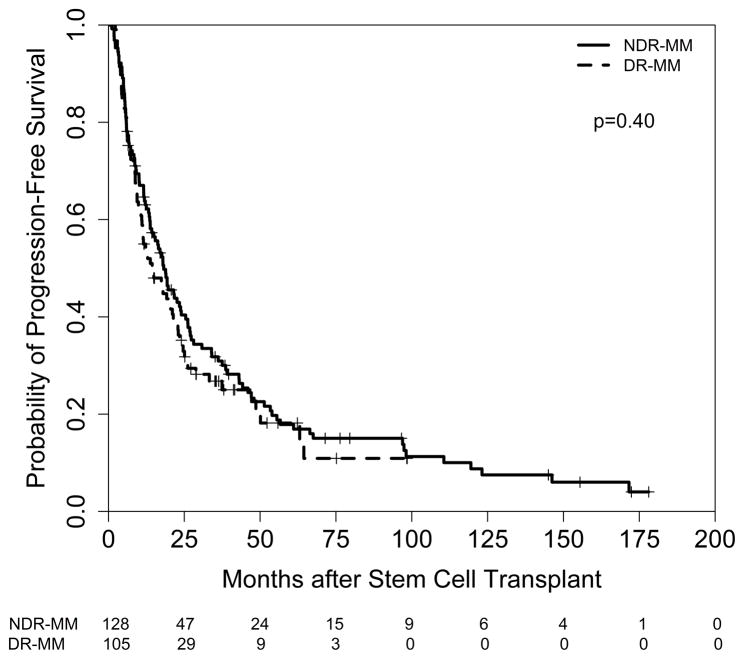
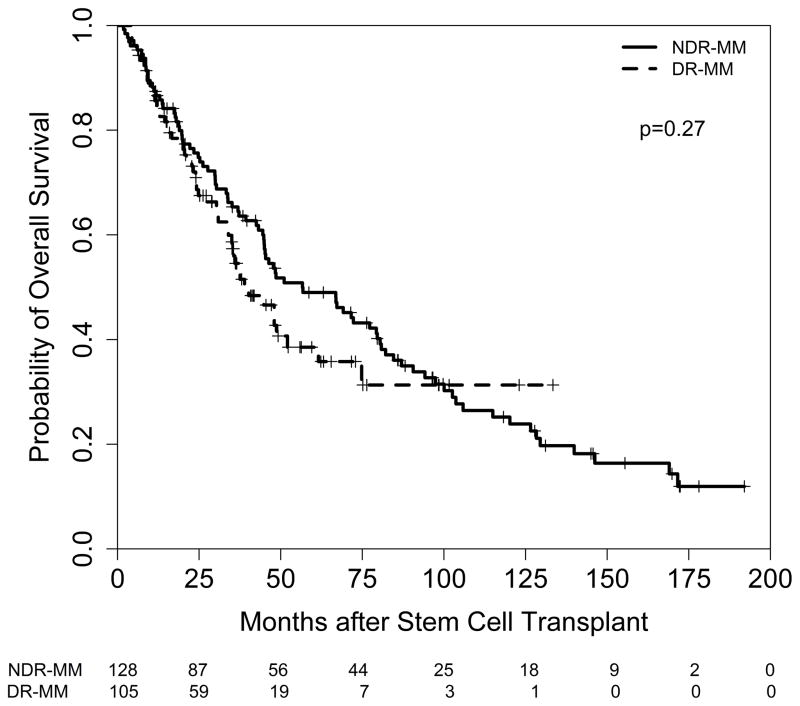
In total, 233 patients were identified, including 105 (45%) classified with DR-MM and 128 (55%) classified with nondouble-refractory myeloma (NDR-MM). At a median follow-up of 42 months for surviving patients, at least a partial response was observed in 188 patients (81%; 83 patients in the DR-MM group [79%] and 105 patients in the NDR-MM [82%]; P = .77). A near complete response or better was observed in 52 patients (22%; 25 patients in the DR-MM group [24%] and 27 patients in the NDR-MM group [21%]; P = .77). The median progression-free survival was 17.6 months (14.4 months in the DR-MM group and 18.2 months in the NDR-MM group), and the 2-year progression-free survival rate was 38% (35% in the DR-MM group and 40% in the NDR-MM group; P = .40). The median overall survival was 48 months (38.9 months in the DR-MM group and 56.6 months in the NDR-MM group), and the 2-year overall survival rate was 74% (71% in the DR-MM group and 76% in the NDR-MM group; P = .27).
The current findings indicate that auto-HCT is an effective and safe therapy in patients with refractory multiple myeloma, including those who are refractory to IMiDs and PIs. Cancer 2017;123:3568-75. © 2017 American Cancer Society.
尽管引入了有效的新型药物,但难治性多发性骨髓瘤患者的预后仍然很差,尤其是那些对蛋白酶体抑制剂(PIs)和免疫调节剂(IMiDs)均难治的患者。关于自体造血干细胞移植在该人群中的作用,可用数据有限。
对2000年3月至2015年10月期间接受首次自体造血干细胞移植(auto-HCT)的难治性骨髓瘤患者进行回顾性分析。纳入原发性难治性疾病患者以及复发难治性疾病患者。对至少1种PI和至少1种IMiD难治的疾病被分类为双难治性多发性骨髓瘤(DR-MM)。
总共确定了233例患者,其中105例(45%)被分类为DR-MM,128例(55%)被分类为非双难治性骨髓瘤(NDR-MM)。存活患者的中位随访时间为42个月,188例患者(81%)观察到至少部分缓解(DR-MM组83例[79%],NDR-MM组105例[82%];P = 0.77)。52例患者(22%)观察到接近完全缓解或更好的缓解(DR-MM组25例[24%],NDR-MM组27例[21%];P = 0.77)。中位无进展生存期为17.6个月(DR-MM组为14.4个月,NDR-MM组为18.2个月),2年无进展生存率为38%(DR-MM组为35%,NDR-MM组为40%;P = 0.40)。中位总生存期为48个月(DR-MM组为38.9个月,NDR-MM组为56.6个月),2年总生存率为74%(DR-MM组为71%,NDR-MM组为76%;P = 0.27)。
目前的研究结果表明,auto-HCT是难治性多发性骨髓瘤患者,包括对IMiDs和PIs难治的患者的一种有效且安全的治疗方法。《癌症》2017年;123:3568 - 75。©2017美国癌症协会。