Yoo Han Soo, Park Eunjeong, Rhiu Soolienah, Chang Hyuk-Jae, Kim Kyoungsub, Yoo Joonsang, Heo Ji Hoe, Nam Hyo Suk
Department of Neurology, Yonsei University College of Medicine, 50 Yonsei-ro, Seodaemoon-gu, Seoul, 03722, Korea.
Cardiovascular Research Institute, Yonsei University College of Medicine, Seoul, Korea.
BMC Ophthalmol. 2017 May 17;17(1):71. doi: 10.1186/s12886-017-0465-8.
Accurate evaluation of diplopia during bedside physical examination is challenging. We developed a new computerized red glass test (CRT) to detect, localize, and quantify diplopia and investigated whether the CRT is useful and feasible.
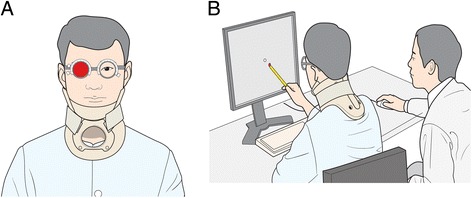
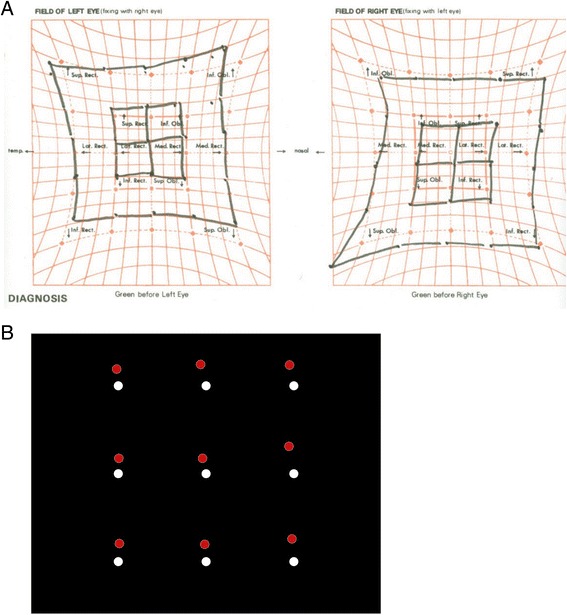
During the CRT, a white dot randomly appears on a monitor. Because a red glass is applied on the right eye, a patient can see one white dot and one red dot when diplopia is present. We defined the degree of diplopia as the direct distance of the two points with the largest deviation and compared the degree with the Hess score and Hess area ratio.
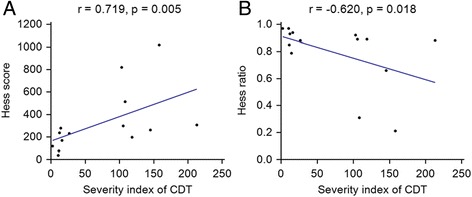
We prospectively enrolled 14 patients with binocular diplopia. Test-retest reliability of the CRT was excellent (overall intraclass correlation coefficient = 0.948, 95% CI 0.939-0.956). The degree of diplopia in the CRT was well correlated with both the Hess score (r = 0.719, p = 0.005) and the Hess area ratio (r = -0.620, p = 0.018).
The CRT can easily detect the presence of diplopia and provided the quantitative values of the degree of diplopia. The CRT was useful and feasible for improving routine bedside examination.
在床边体格检查期间准确评估复视具有挑战性。我们开发了一种新的计算机化红玻璃试验(CRT)来检测、定位和量化复视,并研究了CRT是否有用且可行。
在CRT过程中,一个白色圆点随机出现在显示器上。由于右眼佩戴红色玻璃,当存在复视时患者可以看到一个白色圆点和一个红色圆点。我们将复视程度定义为两点最大偏差的直线距离,并将该程度与Hess评分和Hess面积比进行比较。
我们前瞻性纳入了14例双眼复视患者。CRT的重测信度极佳(总体组内相关系数=0.948,95%CI 0.939-0.956)。CRT中的复视程度与Hess评分(r=0.719,p=0.005)和Hess面积比(r=-0.620,p=0.018)均具有良好的相关性。
CRT能够轻松检测复视的存在,并提供复视程度的定量值。CRT对于改进常规床边检查是有用且可行的。