Klevos Geetika A, Collado-Mesa Fernando, Net Jose M, Yepes Monica M
Department of Radiology, Sylvester Comprehensive Cancer Center, University of Miami Hospital and Clinics, Miami, Florida, USA.
Indian J Radiol Imaging. 2017 Jan-Mar;27(1):52-58. doi: 10.4103/0971-3026.202962.
To assess the results of an initial round of supplemental screening with hand-held bilateral breast ultrasound following a negative screening mammogram in asymptomatic women with dense breast tissue who are not at high risk for breast cancer.
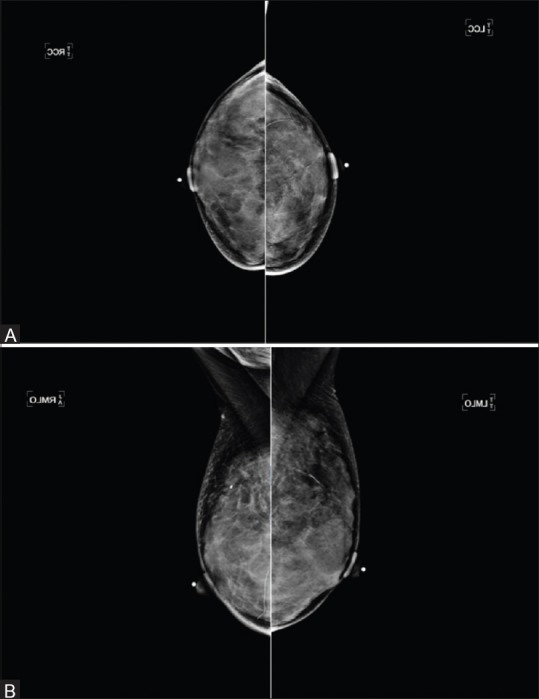
A retrospective, Health Insurance Portability and Accountability Act compliant, Institutional Research Board approved study was performed at a single academic tertiary breast center. Informed consent was waived. A systematic review of the breast imaging center database was conducted to identify and retrieve data for all asymptomatic women, who were found to have heterogeneously dense or extremely dense breast tissue on screening bilateral mammograms performed from July 1, 2010 through June 30, 2012 and who received a mammographic final assessment American College of Radiology's (ACR) Breast Imaging Reporting and Data System (BI-RADS) category 1 or BI-RADS category 2. Hand-held screening ultrasound was performed initially by a technologist followed by a radiologist. Chi-square and -test were used and statistical significance was considered at < 0.05.
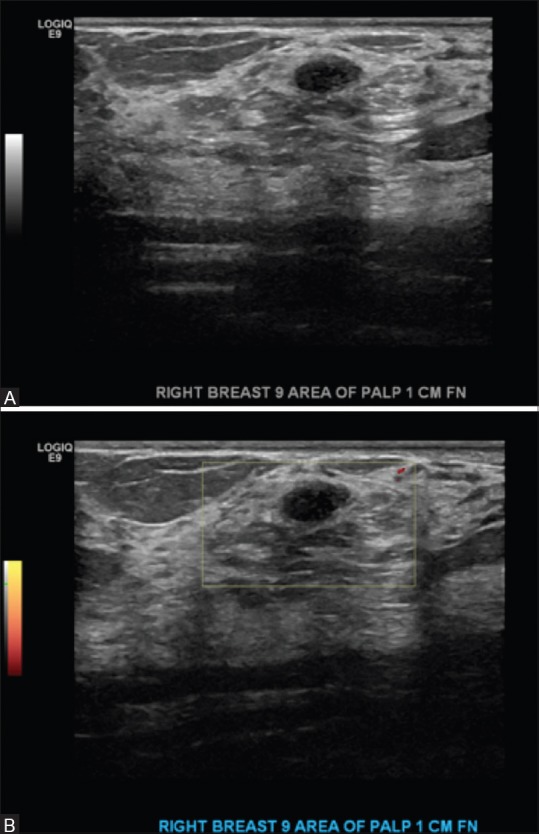
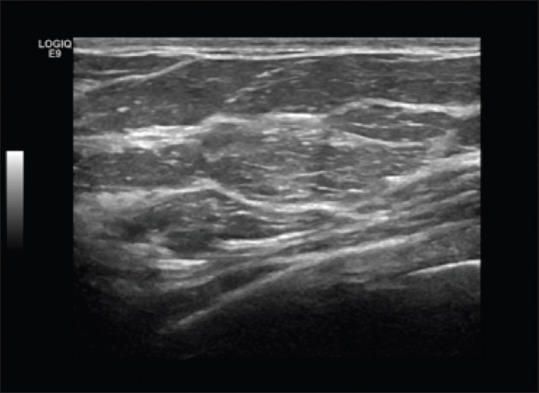
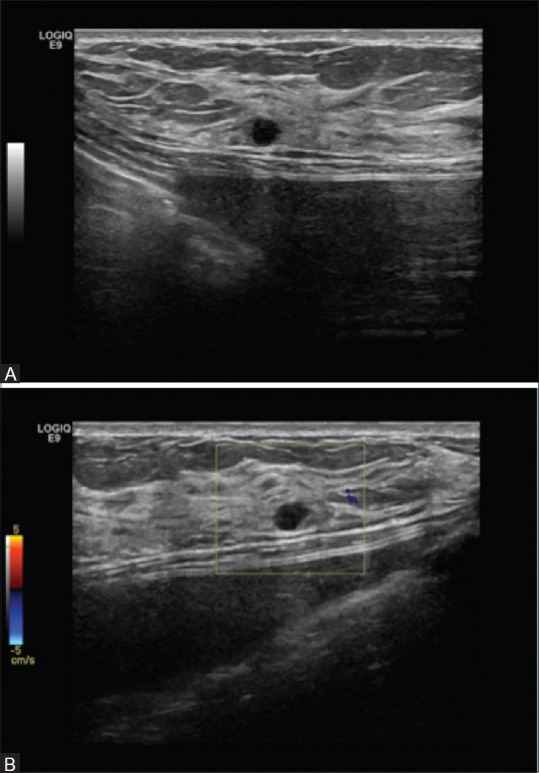
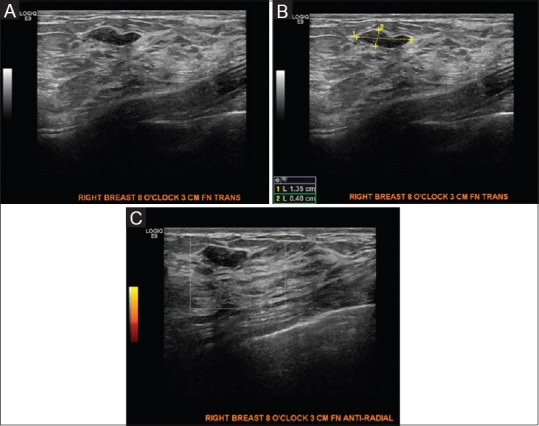
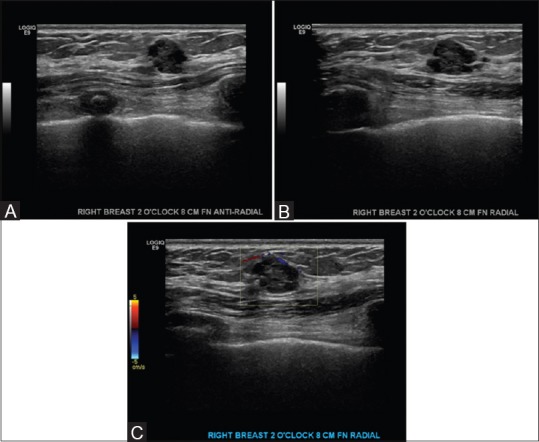
A total of 1210 women were identified. Of these, 394 underwent the offered supplemental screening ultrasound. BI-RADS category 1 or 2 was assigned to 323 women (81.9%). BI-RADS category 3 was assigned to 50 women (12.9%). A total of 26 biopsies/aspirations were recommended and performed in 26 women (6.6%). The most common finding for which biopsy was recommended was a solid mass (88.5%) with an average size of 0.9 cm (0.5-1.7 cm). Most frequent pathology result was fibroadenoma (60.8%). No carcinoma was found.
Our data support the reported occurrence of a relatively high number of false positives at supplemental screening with breast ultrasound following a negative screening mammogram in asymptomatic women with dense breast tissue, who are not at a high risk of developing breast cancer, and suggests that caution is necessary in establishing wide implementation of this type of supplemental screening for all women with dense breast tissue without considering other risk factors for breast cancer.
评估在乳腺组织致密且无乳腺癌高风险的无症状女性中,乳腺钼靶筛查结果为阴性后,首轮采用手持双侧乳腺超声进行补充筛查的效果。
在一家单一的学术性三级乳腺中心进行了一项回顾性研究,该研究符合《健康保险流通与责任法案》要求,并获得了机构研究委员会的批准。无需知情同意。对乳腺影像中心数据库进行系统回顾,以识别和检索2010年7月1日至2012年6月30日期间进行的双侧乳腺钼靶筛查中,所有被发现乳腺组织呈不均匀致密或极度致密且钼靶最终评估为美国放射学会(ACR)乳腺影像报告和数据系统(BI-RADS)1类或BI-RADS 2类的无症状女性的数据。最初由技术人员进行手持筛查超声检查,随后由放射科医生进行检查。使用卡方检验和t检验,P<0.05被认为具有统计学意义。
共识别出1210名女性。其中,394名接受了提供的补充筛查超声检查。323名女性(81.9%)被评定为BI-RADS 1类或2类。50名女性(12.9%)被评定为BI-RADS 3类。共建议并对26名女性(6.6%)进行了26次活检/抽吸。建议活检的最常见发现是实性肿块(88.5%),平均大小为0.9厘米(0.5 - 1.7厘米)。最常见的病理结果是纤维腺瘤(60.8%)。未发现癌症。
我们的数据支持了以下报道,即在乳腺组织致密且无乳腺癌高风险的无症状女性中,乳腺钼靶筛查结果为阴性后,采用乳腺超声进行补充筛查会出现相对较多的假阳性,这表明在不考虑其他乳腺癌风险因素的情况下,为所有乳腺组织致密的女性广泛实施此类补充筛查时需谨慎。