Shimizu Kazumichi, Stopfer Mark
National Institute of Child Health and Human Development, National Institutes of HealthBethesda, MD, USA.
Front Neural Circuits. 2017 May 3;11:30. doi: 10.3389/fncir.2017.00030. eCollection 2017.
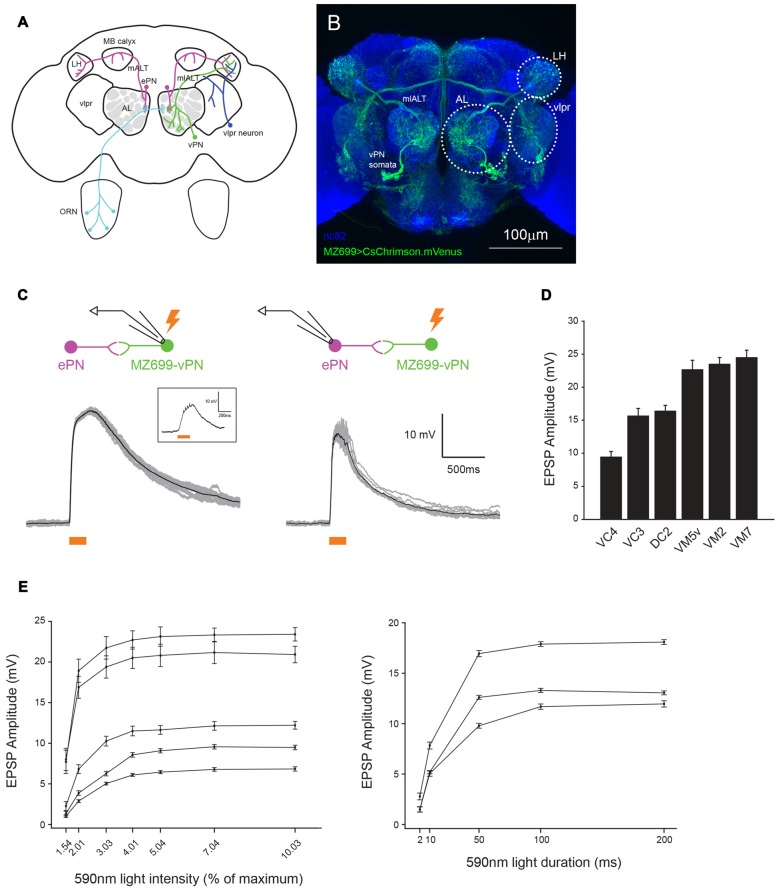
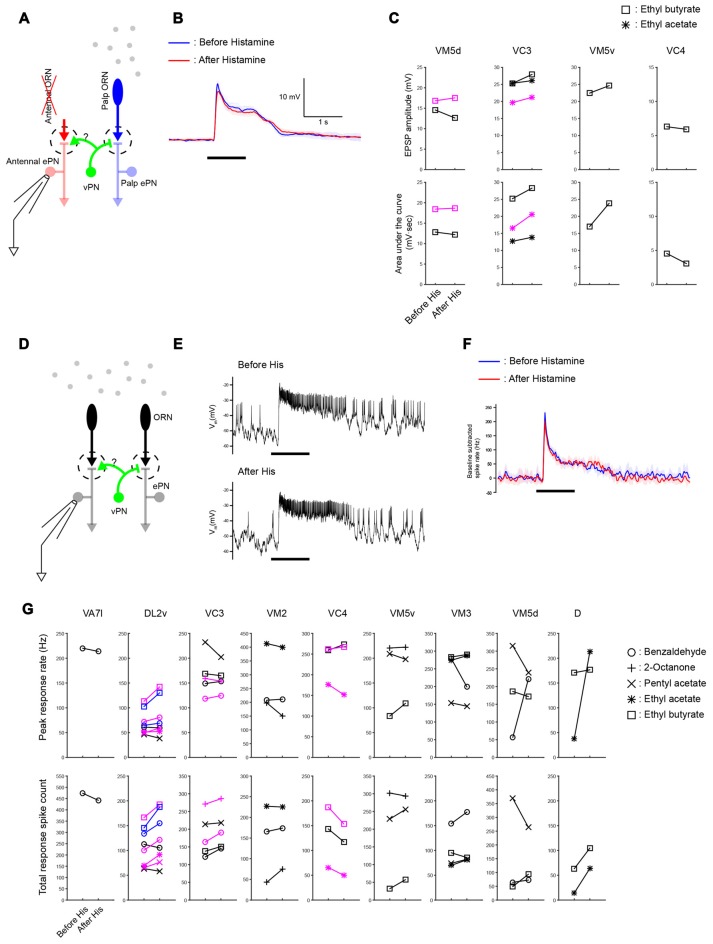
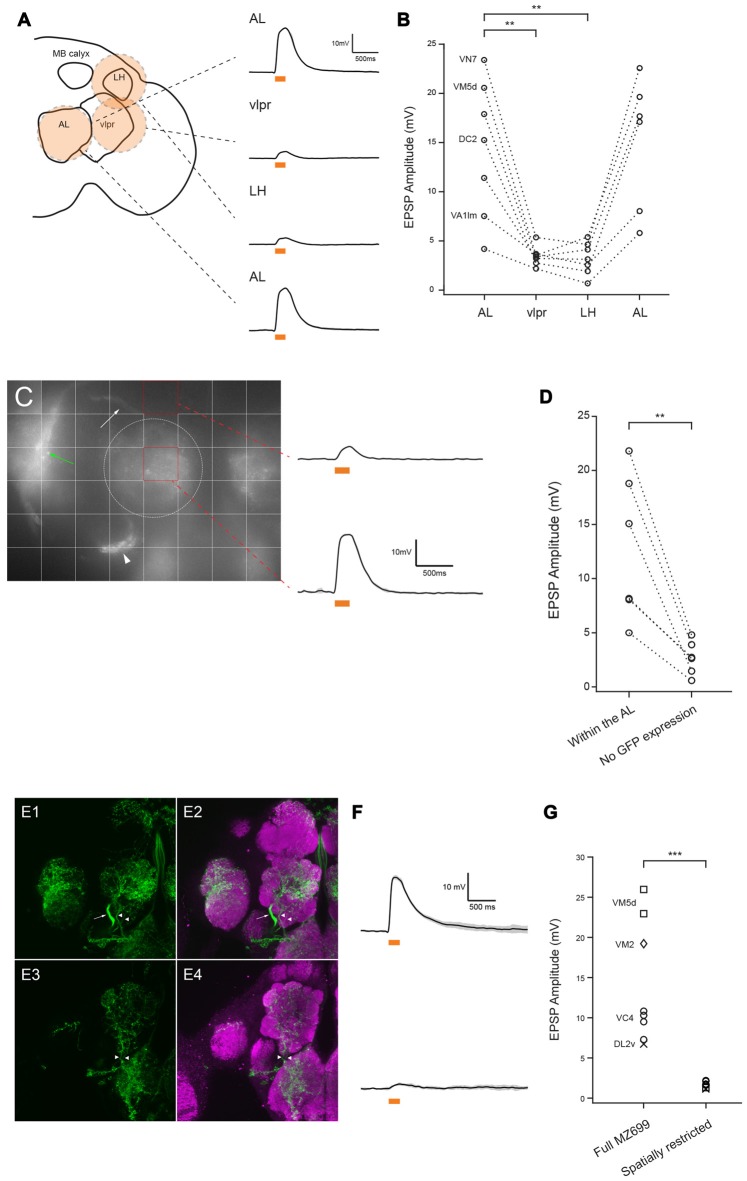
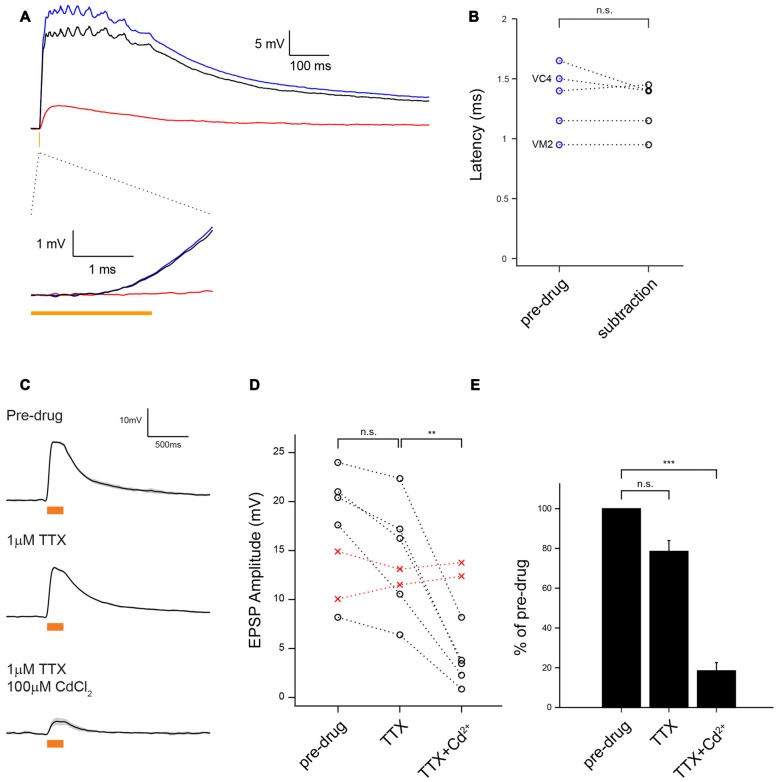
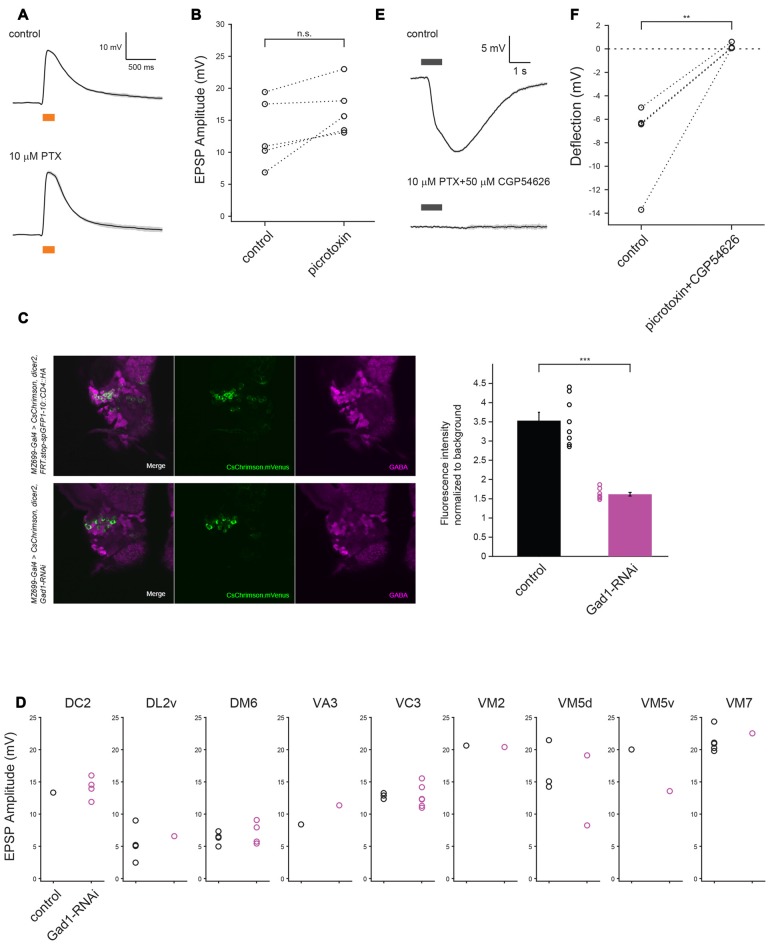
In the insect olfactory system, odor information is transferred from the antennal lobe (AL) to higher brain areas by projection neurons (PNs) in multiple AL tracts (ALTs). In several species, one of the ALTs, the mediolateral ALT (mlALT), contains some GABAergic PNs; in the brain, the great majority of ventral PNs (vPNs) are GABAergic and project through this tract to the lateral horn (LH). Most excitatory PNs (ePNs), project through the medial ALT (mALT) to the mushroom body (MB) and the LH. Recent studies have shown that GABAergic vPNs play inhibitory roles at their axon terminals in the LH. However, little is known about the properties and functions of vPNs at their dendritic branches in the AL. Here, we used optogenetic and patch clamp techniques to investigate the functional roles of vPNs in the AL. Surprisingly, our results show that specific activation of vPNs reliably elicits strong excitatory postsynaptic potentials (EPSPs) in ePNs. Moreover, the connections between vPNs and ePNs are mediated by direct chemical synapses. Neither pulses of GABA, nor pharmagological, or genetic blockade of GABAergic transmission gave results consistent with the involvement of GABA in vPN-ePN excitatory transmission. These unexpected results suggest new roles for the vPN population in olfactory information processing.
在昆虫嗅觉系统中,气味信息通过多条触角叶束(ALTs)中的投射神经元(PNs)从触角叶(AL)传递到更高的脑区。在多个物种中,其中一条ALT,即内侧外侧ALT(mlALT),包含一些γ-氨基丁酸能PNs;在大脑中,绝大多数腹侧PNs(vPNs)是γ-氨基丁酸能的,并通过这条束投射到侧角(LH)。大多数兴奋性PNs(ePNs)通过内侧ALT(mALT)投射到蘑菇体(MB)和LH。最近的研究表明,γ-氨基丁酸能vPNs在LH的轴突终末发挥抑制作用。然而,关于vPNs在AL的树突分支处的特性和功能却知之甚少。在这里,我们使用光遗传学和膜片钳技术来研究vPNs在AL中的功能作用。令人惊讶的是,我们的结果表明,vPNs的特异性激活能可靠地在ePNs中引发强烈的兴奋性突触后电位(EPSPs)。此外,vPNs和ePNs之间的连接是由直接化学突触介导的。无论是γ-氨基丁酸脉冲,还是γ-氨基丁酸能传递的药理学或遗传学阻断,都没有得到与γ-氨基丁酸参与vPN-ePN兴奋性传递一致的结果。这些意想不到的结果表明vPN群体在嗅觉信息处理中具有新的作用。