Abdulrahman Surajudeen Abiola, Rampal Lekhraj, Ibrahim Faisal, Radhakrishnan Anuradha P, Kadir Shahar Hayati, Othman Norlijah
Department of Community Health, Faculty of Medicine and Health Sciences, Universiti Putra Malaysia, UPM Serdang, Selangor Darul Ehsan, Malaysia.
Department of Public Health Medicine, Penang Medical College, George Town, Penang, Malaysia.
PLoS One. 2017 May 16;12(5):e0177698. doi: 10.1371/journal.pone.0177698. eCollection 2017.
Adherence to treatment remains the cornerstone of long term viral suppression and successful treatment outcomes among patients receiving Antiretroviral Therapy (ART).
OBJECTIVE(S): Evaluate the effectiveness of mobile phone reminders and peer counseling in improving adherence and treatment outcomes among HIV positive patients on ART in Malaysia.
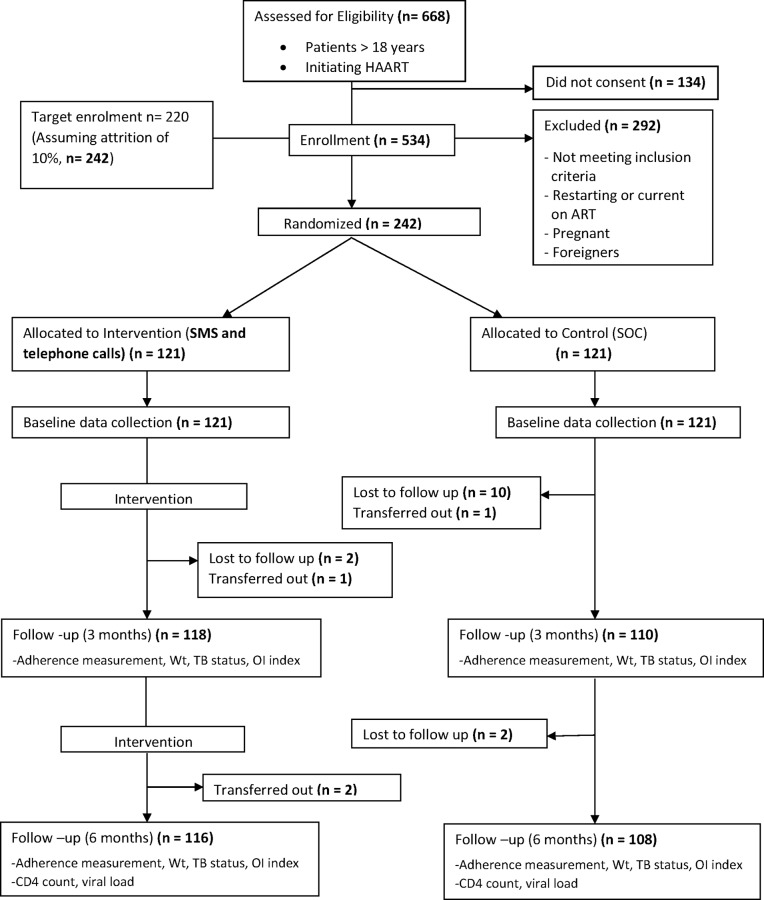
A single-blind, parallel group RCT conducted in Hospital Sungai Buloh, Malaysia in which 242 adult Malaysian patients were randomized to intervention or control groups. Intervention consisted of a reminder module delivered through SMS and telephone call reminders by trained research assistants for 24 consecutive weeks (starting from date of ART initiation), in addition to adherence counseling at every clinic visit. The length of intended follow up for each patient was 6 months. Data on adherence behavior of patients was collected using specialized, pre-validated Adult AIDS Clinical Trial Group (AACTG) adherence questionnaires. Data on weight, clinical symptoms, CD4 count and viral load tests were also collected. Data was analyzed using SPSS version 22 and R software. Repeated measures ANOVA, Friedman's ANOVA and Multivariate regression models were used to evaluate efficacy of the intervention.
The response rate after 6 months follow up was 93%. There were no significant differences at baseline in gender, employment status, income distribution and residential location of respondents between the intervention and control group. After 6 months follow up, the mean adherence was significantly higher in the intervention group (95.7; 95% CI: 94.39-96.97) as compared to the control group (87.5; 95% CI: 86.14-88.81). The proportion of respondents who had Good (>95%) adherence was significantly higher in the intervention group (92.2%) compared to the control group (54.6%). A significantly lower frequency in missed appointments (14.0% vs 35.5%) (p = 0.001), lower viral load (p = 0.001), higher rise in CD4 count (p = 0.017), lower incidence of tuberculosis (p = 0.001) and OIs (p = 0.001) at 6 months follow up, was observed among patients in the intervention group.
Mobile phone reminders (SMS and telephone call reminders) and peer counseling are effective in improving adherence and treatment outcomes among HIV positive patients on ART in Malaysia. These findings may be of potential benefit for collaborative adherence planning between patients and health care providers at ART commencement.
坚持治疗仍然是接受抗逆转录病毒疗法(ART)的患者实现长期病毒抑制和成功治疗结果的基石。
评估手机提醒和同伴咨询对提高马来西亚接受ART治疗的HIV阳性患者的依从性和治疗效果的有效性。
在马来西亚双溪毛糯医院进行了一项单盲平行组随机对照试验,将242名成年马来西亚患者随机分为干预组或对照组。干预措施包括由经过培训的研究助理通过短信和电话提醒提供的提醒模块,持续24周(从开始接受ART治疗之日起),此外每次门诊就诊时还提供依从性咨询。每位患者的预期随访时间为6个月。使用专门的、预先验证的成人艾滋病临床试验组(AACTG)依从性问卷收集患者的依从行为数据。还收集了体重、临床症状、CD4细胞计数和病毒载量检测的数据。使用SPSS 22版软件和R软件进行数据分析。采用重复测量方差分析、弗里德曼方差分析和多元回归模型评估干预效果。
随访6个月后的应答率为93%。干预组和对照组在基线时受访者的性别、就业状况、收入分布和居住地点方面无显著差异。随访6个月后,干预组的平均依从性(95.7;95%可信区间:94.39 - 96.97)显著高于对照组(87.5;95%可信区间:86.14 - 88.81)。干预组依从性良好(>95%)的受访者比例(92.2%)显著高于对照组(54.6%)。在随访6个月时,干预组患者错过预约的频率显著更低(14.0%对35.5%)(p = 0.001),病毒载量更低(p = 0.001),CD4细胞计数升高幅度更大(p = 0.017),结核病(p = 0.001)和机会性感染(p = 0.001)的发生率更低。
手机提醒(短信和电话提醒)和同伴咨询对提高马来西亚接受ART治疗的HIV阳性患者的依从性和治疗效果有效。这些发现可能对患者和医疗保健提供者在开始ART治疗时进行协作依从性规划具有潜在益处。