Bond Meaghan, Hunt Brady, Flynn Bailey, Huhtinen Petri, Ware Russell, Richards-Kortum Rebecca
Department of Bioengineering, Rice University, Houston, TX, United States of America.
PerkinElmer, Turku, Finland.
PLoS One. 2017 May 16;12(5):e0177732. doi: 10.1371/journal.pone.0177732. eCollection 2017.
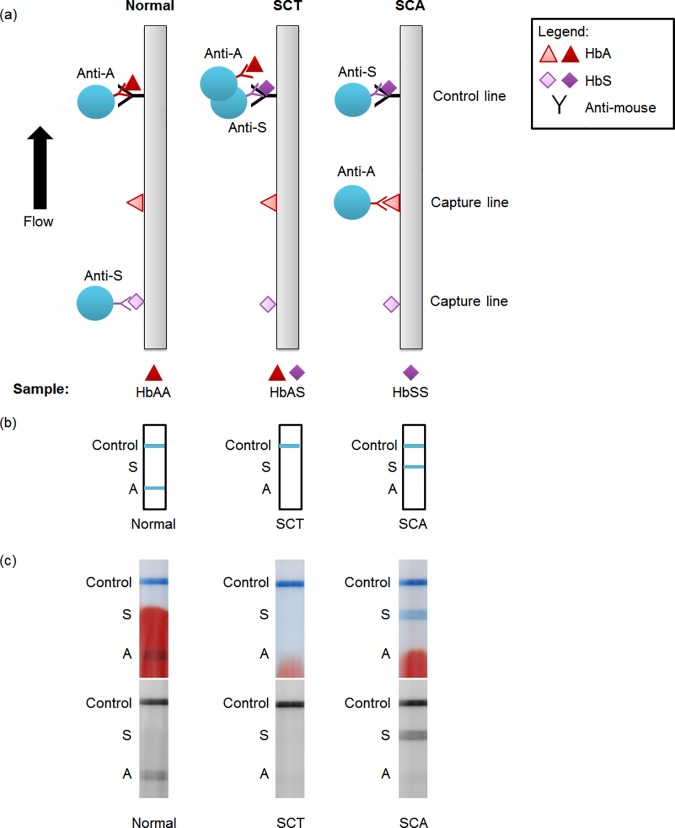
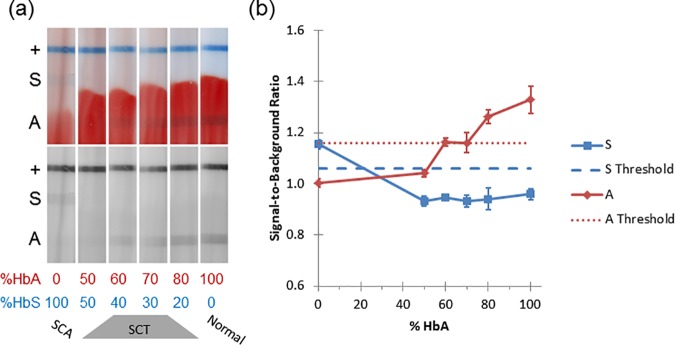
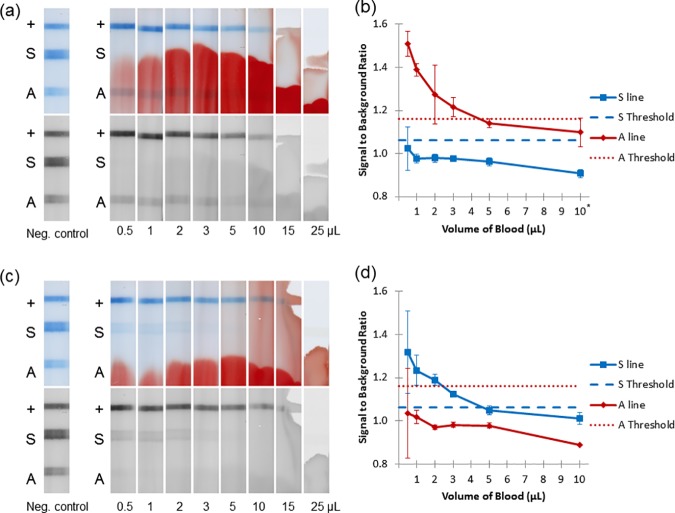
A rapid test to identify patients with sickle cell disease could have important benefits in low-resource settings. Sickle cell anemia (SCA) affects about 300,000 newborns each year, the majority of whom are born in sub-Saharan Africa. Low-cost therapies are available to treat SCA, but most countries in sub-Saharan Africa lack robust neonatal screening programs needed to identify patients in need of treatment. To address this need, we developed and evaluated a competitive lateral flow assay that identifies patients with SCA (genotype HbSS) in 15 minutes using undiluted whole blood. A small volume of blood (0.5 μL- 3 μL) is mixed with antibody-coated blue latex beads in a tube and applied to the strip. Strips are then placed in a well of running buffer and allowed to run for 10 minutes. Laboratory evaluation with samples containing different proportions of hemoglobin A (HbA) and hemoglobin S (HbS) indicated that the test should enable identification of SCA patients but not persons with sickle cell trait (SCT). We evaluated the test using 41 samples from individuals with SCA, SCT, and normal blood. With visual inspection or quantitative analysis, we found a 98% accuracy when differentiating SCA from normal and SCT samples as a group (90% sensitivity and 100% specificity for identifying SCA). This work demonstrates important steps towards making a lateral flow test for hemoglobinopathies more appropriate for point-of-care use; further work is needed before the test is appropriate for clinical use.
一种用于识别镰状细胞病患者的快速检测方法在资源匮乏地区可能具有重要益处。镰状细胞贫血(SCA)每年影响约30万新生儿,其中大多数出生在撒哈拉以南非洲。有低成本疗法可用于治疗SCA,但撒哈拉以南非洲的大多数国家缺乏识别需要治疗的患者所需的强大新生儿筛查项目。为满足这一需求,我们开发并评估了一种竞争性侧向流动检测方法,该方法使用未稀释的全血在15分钟内识别SCA(基因型HbSS)患者。将少量血液(0.5微升 - 3微升)与抗体包被的蓝色乳胶珠在试管中混合,然后应用于试纸条。然后将试纸条放入运行缓冲液的孔中,使其运行10分钟。对含有不同比例血红蛋白A(HbA)和血红蛋白S(HbS)的样本进行的实验室评估表明,该检测方法应能够识别SCA患者,但不能识别镰状细胞性状(SCT)患者。我们使用来自SCA、SCT和正常血液个体的41个样本对该检测方法进行了评估。通过目视检查或定量分析,我们发现将SCA与正常和SCT样本作为一组进行区分时,准确率为98%(识别SCA的灵敏度为90%,特异性为100%)。这项工作展示了朝着使血红蛋白病的侧向流动检测更适合即时护理使用迈出的重要一步;在该检测方法适合临床使用之前,还需要进一步开展工作。