Choi Young Wook, Kim Yang Gyun, Song Min-Young, Moon Ju-Young, Jeong Kyung-Hwan, Lee Tae-Won, Ihm Chun-Gyoo, Park Kang-Sik, Lee Sang-Ho
Division of Nephrology, Department of Internal Medicine, Kyung Hee University School of Medicine, 892 Dongnam-ro, Gangdong-gu, Seoul, Korea.
Department of Physiology, Kyung Hee University School of Medicine, 26 Kyungheedae-ro, Dongdaemun-gu, Seoul, Korea.
Clin Proteomics. 2017 May 16;14:18. doi: 10.1186/s12014-017-9153-1. eCollection 2017.
Nephrotic syndrome (NS) is a nonspecific kidney disorder, commonly caused by minimal change disease (MCD), focal segmental glomerulosclerosis (FSGS), and membranous nephropathy (MN). Here we analyzed urinary protein profiles, aiming to discover disease-specific biomarkers of these three common diseases in NS.
Sixteen urine samples were collected from patients with biopsy-proven NS and healthy controls. After removal of high-abundance proteins, the urinary protein profile was analyzed by LC-MS/MS to generate a discovery set. For validation, ELISA was used to analyze the selected proteins in 61 urine samples.
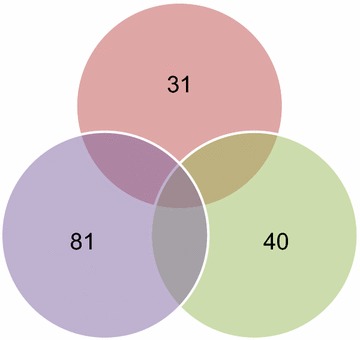
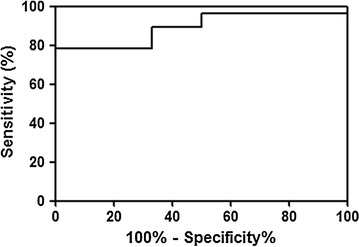
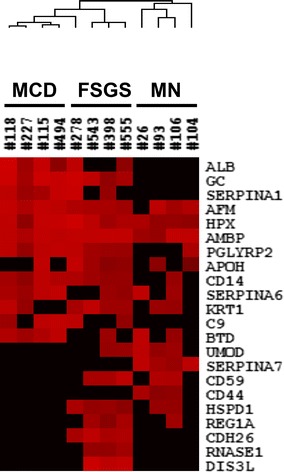
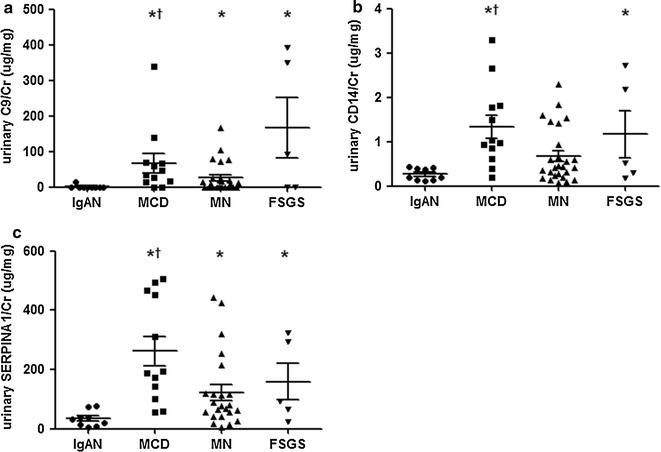
The discovery set included 228 urine proteins, of which 22 proteins were differently expressed in MCD, MN, and FSGS. Among these, C9, CD14, and SERPINA1 were validated by ELISA. All three proteins were elevated in MCD, MN, and FSGS groups compared with in IgA nephropathy and healthy controls. When a regression model was applied, receiver operating characteristic analysis clearly discriminated MCD from the other causative diseases in NS.
We developed a disease-specific protein panel that discriminated between three main causes of NS. Through this pilot study, we suggest that urine proteomics could be a non-invasive and clinically available tool to discriminate MCD from MN and FSGS.
肾病综合征(NS)是一种非特异性肾脏疾病,通常由微小病变病(MCD)、局灶节段性肾小球硬化(FSGS)和膜性肾病(MN)引起。在此,我们分析了尿蛋白谱,旨在发现NS中这三种常见疾病的疾病特异性生物标志物。
从经活检证实患有NS的患者和健康对照者中收集了16份尿液样本。去除高丰度蛋白后,通过液相色谱-串联质谱法(LC-MS/MS)分析尿蛋白谱以生成一个发现集。为进行验证,采用酶联免疫吸附测定(ELISA)法分析61份尿液样本中的选定蛋白。
发现集包括228种尿蛋白,其中22种蛋白在MCD、MN和FSGS中表达不同。其中,C9、CD14和丝氨酸蛋白酶抑制剂A1(SERPINA1)通过ELISA得到验证。与IgA肾病和健康对照相比,这三种蛋白在MCD、MN和FSGS组中均升高。应用回归模型时,受试者工作特征分析能清晰地区分NS中MCD与其他致病疾病。
我们开发了一种疾病特异性蛋白组,可区分NS的三种主要病因。通过这项初步研究,我们认为尿蛋白质组学可能是一种将MCD与MN和FSGS区分开来的非侵入性且临床可用的工具。