Lin Kuan-Yu, Lin Na-Sheng
Institute of Plant and Microbial Biology, Academia SinicaTaipei, Taiwan.
Front Microbiol. 2017 May 4;8:787. doi: 10.3389/fmicb.2017.00787. eCollection 2017.
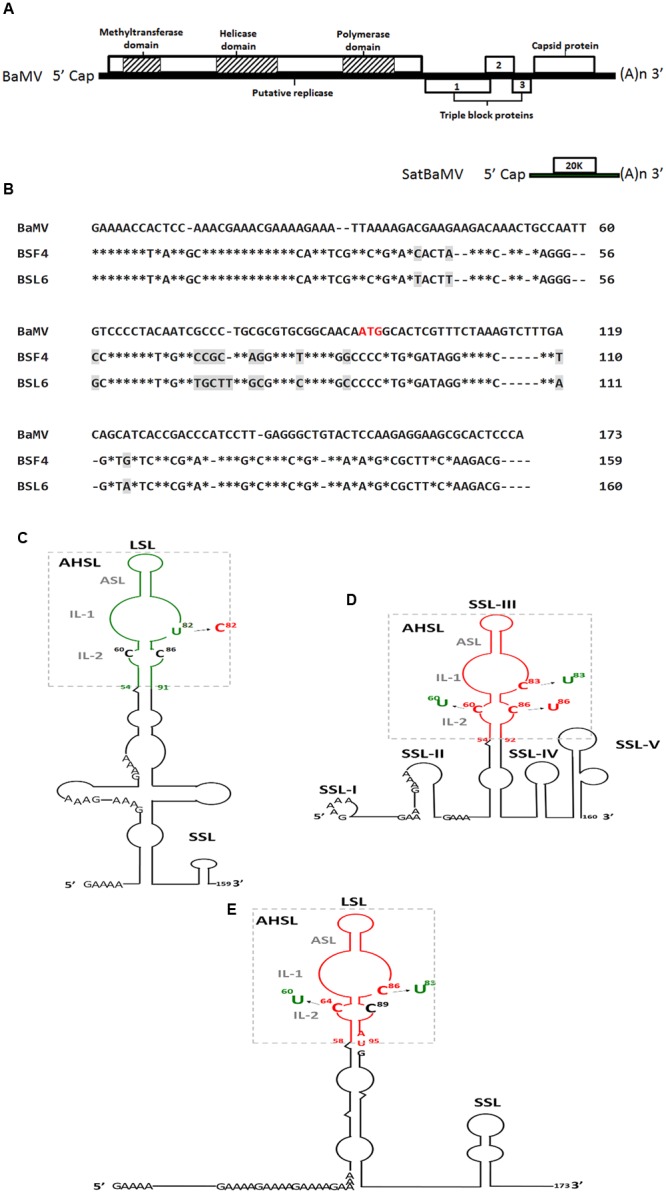
Satellite RNAs (satRNAs) are sub-viral agents that may interact with their cognate helper virus (HV) and host plant synergistically and/or antagonistically. SatRNAs totally depend on the HV for replication, so satRNAs and HV usually evolve similar secondary or tertiary RNA structures that are recognized by a replication complex, although satRNAs and HV do not share an appreciable sequence homology. The satRNAs of (satBaMV), the only satRNAs of the genus , have become one of the models of how satRNAs can modulate HV replication and virus-induced symptoms. In this review, we summarize the molecular mechanisms underlying the interaction of interfering satBaMV and BaMV. Like other satRNAs, satBaMV mimics the secondary structures of 5'- and 3'-untranslated regions (UTRs) of BaMV as a molecular pretender. However, a conserved apical hairpin stem loop (AHSL) in the 5'-UTR of satBaMV was found as the key determinant for downregulating BaMV replication. In particular, two unique nucleotides (C and C) in the AHSL of satBaMVs determine the satBaMV interference ability by competing for the replication machinery. Thus, transgenic plants expressing interfering satBaMV could confer resistance to BaMV, and interfering satBaMV could be used as biological-control agent. Unlike two major anti-viral mechanisms, RNA silencing and salicylic acid-mediated immunity, our findings in plants by competition assay and RNA deep sequencing suggested replication competition is involved in this transgenic satBaMV-mediated BaMV interference. We propose how a single nucleotide of satBaMV can make a great change in BaMV pathogenicity and the underlying mechanism.
卫星RNA(satRNAs)是亚病毒因子,可能与它们的同源辅助病毒(HV)和宿主植物发生协同和/或拮抗相互作用。SatRNAs完全依赖HV进行复制,因此satRNAs和HV通常会进化出相似的二级或三级RNA结构,这些结构可被复制复合体识别,尽管satRNAs和HV没有明显的序列同源性。烟草花叶病毒卫星RNA(satBaMV)是烟草花叶病毒属唯一的satRNAs,已成为satRNAs如何调节HV复制和病毒诱导症状的模型之一。在本综述中,我们总结了干扰性satBaMV与烟草花叶病毒(BaMV)相互作用的分子机制。与其他satRNAs一样,satBaMV模仿BaMV 5'-和3'-非翻译区(UTR)的二级结构,作为分子伪装者。然而,发现satBaMV 5'-UTR中的一个保守顶端发夹茎环(AHSL)是下调BaMV复制的关键决定因素。特别是,satBaMVs的AHSL中的两个独特核苷酸(C和C)通过竞争复制机制来决定satBaMV的干扰能力。因此,表达干扰性satBaMV的转基因植物可以赋予对BaMV的抗性,并且干扰性satBaMV可以用作生物防治剂。与两种主要的抗病毒机制——RNA沉默和水杨酸介导的免疫不同,我们通过竞争试验和RNA深度测序在植物中的发现表明,复制竞争参与了这种转基因satBaMV介导的BaMV干扰。我们提出了satBaMV的单个核苷酸如何能对BaMV致病性产生巨大变化及其潜在机制。