Chraibi Abdelmjid, Al-Herz Shoorook, Nguyen Bich Dao, Soeatmadji Djoko W, Shinde Anil, Lakshmivenkataraman Balasubramanian, Assaad-Khalil Samir H
Medical School of Agadir, Agadir, Morocco.
Ibn Zohr University, Agadir, Morocco.
Diabetes Ther. 2017 Aug;8(4):767-780. doi: 10.1007/s13300-017-0268-1. Epub 2017 May 18.
The aim of this study was to confirm the efficacy of patient-driven titration of BIAsp 30 in terms of glycemic control, by comparing it to physician-driven titration of BIAsp 30, in patients with type 2 diabetes in North Africa, the Middle East, and Asia.
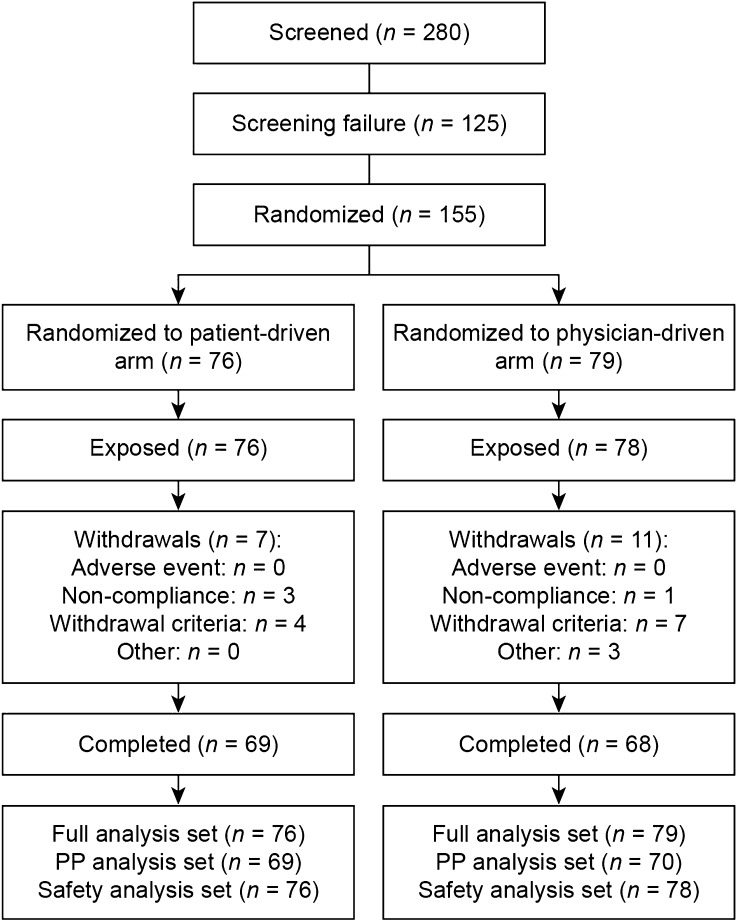
A 20-week, open-label, randomized, two-armed, parallel-group, multicenter study in Egypt, Indonesia, Morocco, Saudi Arabia, and Vietnam. Patients (n = 155) with type 2 diabetes inadequately controlled using neutral protamine Hagedorn (NPH) insulin were randomized to either patient-driven or physician-driven BIAsp 30 titration.
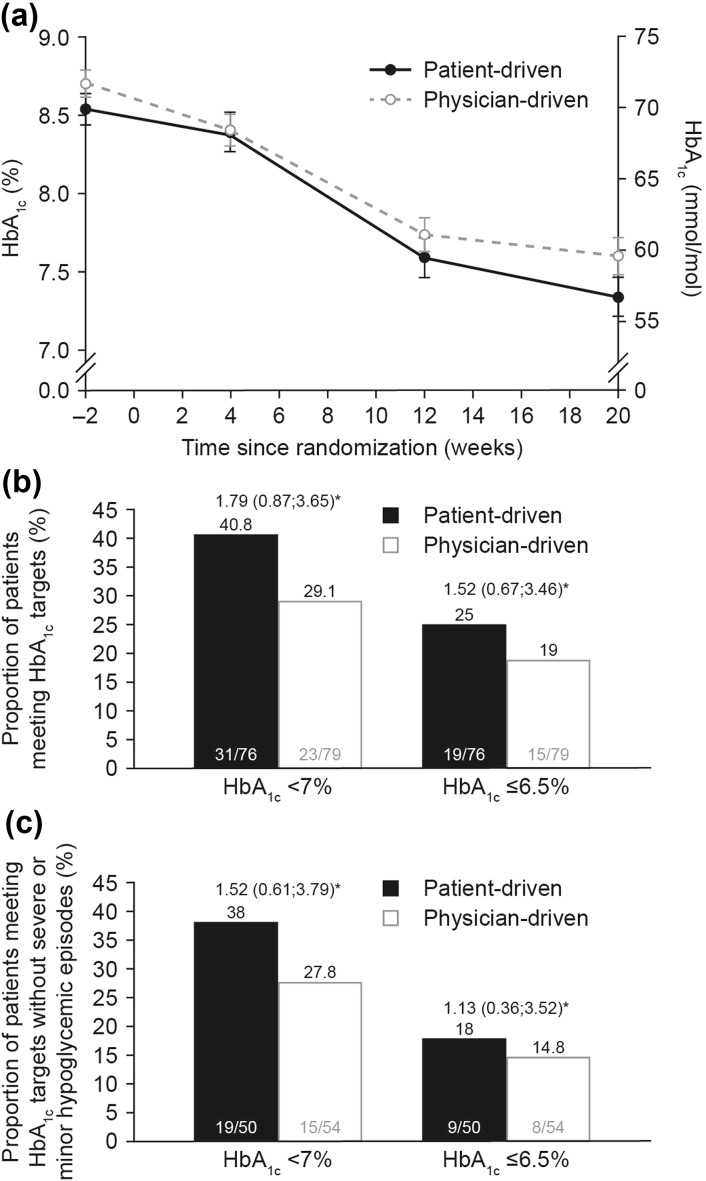
The noninferiority of patient-driven compared to physician-driven titration with respect to the reduction in HbA1c was confirmed. The estimated mean change in HbA1c from baseline to week 20 was -1.27% in the patient-driven arm and -1.04% in the physician-driven arm, with an estimated treatment difference of -0.23% (95% confidence interval: -0.54; 0.08). After 20 weeks of treatment, the proportions of patients achieving the target of HbA1c <7.5% were similar between titration arms; the proportions of patients achieving the target of ≤6.5% were also similar. Both titration algorithms were well tolerated, and hypoglycemic episode rates were similar in both arms.
Patient-driven titration of BIAsp 30 can be as effective and safe as physician-driven titration in non-Western populations. Overall, the switch from NPH insulin to BIAsp 30 was well tolerated in both titration arms and led to improved glycemic control. A limitation of the study was the relatively small number of patients recruited in each country.
ClinicalTrials.gov NCT01589653.
Novo Nordisk A/S, Denmark.
本研究的目的是通过在北非、中东和亚洲的2型糖尿病患者中,将患者驱动的门冬胰岛素30滴定法与医生驱动的门冬胰岛素30滴定法进行比较,来证实其在血糖控制方面的疗效。
在埃及、印度尼西亚、摩洛哥、沙特阿拉伯和越南进行了一项为期20周的开放标签、随机、双臂、平行组、多中心研究。使用中性鱼精蛋白锌胰岛素(NPH)胰岛素控制不佳的2型糖尿病患者(n = 155)被随机分为患者驱动或医生驱动的门冬胰岛素30滴定组。
证实了患者驱动滴定法与医生驱动滴定法相比,在降低糖化血红蛋白方面的非劣效性。从基线到第20周,患者驱动组糖化血红蛋白的估计平均变化为-1.27%,医生驱动组为-1.04%,估计治疗差异为-0.23%(95%置信区间:-0.54;0.08)。治疗20周后,达到糖化血红蛋白<7.5%目标的患者比例在滴定组之间相似;达到≤6.5%目标的患者比例也相似。两种滴定算法耐受性良好,两组低血糖发作率相似。
在非西方人群中,患者驱动的门冬胰岛素30滴定法与医生驱动的滴定法一样有效和安全。总体而言,在两个滴定组中,从NPH胰岛素转换为门冬胰岛素30耐受性良好,并改善了血糖控制。该研究的一个局限性是每个国家招募的患者数量相对较少。
ClinicalTrials.gov NCT01589653。
丹麦诺和诺德公司。