Farshchi Amir, Aghili Rokhsareh, Oskuee Maryam, Rashed Marjan, Noshad Sina, Kebriaeezadeh Abbas, Kia Maryam, Esteghamati Alireza
Department of Pharmacoeconomics and Pharmaceutical Administration, School of Pharmacy, Tehran University of Medical Sciences, Tehran, Iran.
Endocrine Research Center, Institute of Endocrinology and Metabolism, Iran University of Medical Sciences, Tehran, Iran.
BMC Endocr Disord. 2016 Jun 9;16(1):35. doi: 10.1186/s12902-016-0116-8.
The aim of this study was to compare the efficacy, safety, costs, and cost-effectiveness of biphasic insulin aspart 30 (BIAsp 30) with NPH plus regular human insulin (NPH/Reg) in patients with type 2 diabetes mellitus (T2DM).
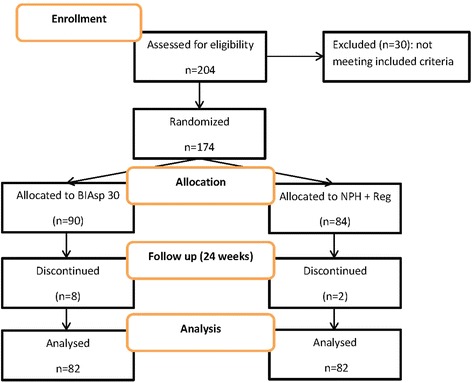
It was a Single-center, parallel-group, randomized, clinical trial (Trial Registration: NCT01889095). One hundred and seventy four T2DM patients with poorly controlled diabetes (HbA1c ≥ 8 % (63.9 mmol/mol)) were randomly assigned to trial arms (BIAsp 30 and NPH/Reg) and were followed up for 48 weeks. BIAsp 30 was started at an initial dose of 0.2-0.6 IU/Kg in two divided doses and was titrated according to the glycemic status of the patient. Similarly, NPH/Reg insulin was initiated at a dose of 0.2-0.6 IU/Kg with a 2:1 ratio and was subsequently titrated. Level of glycemic control, hypoglycemic events, direct and indirect costs, quality adjusted life year (QALY) and incremental cost-effectiveness ratio have been assessed.
HbA1c, Fasting plasma glucose (FPG), and two-hour post-prandial glucose (PPG) were improved in both groups during the study (P < 0.05 for all analyses). Lower frequencies of minor, major, and nocturnal hypoglycemic episodes were observed with BIAsp 30 (P < 0.05). Additionally, BIAsp 30 was associated with less weight gain and also higher QALYs (P < 0.05). Total medical and non-medical costs were significantly lower with BIAsp 30 as compared with NPH/Reg (930.55 ± 81.43 USD vs. 1101.24 ± 165.49 USD, P = 0.004). Moreover, BIAsp 30 showed lower ICER as a dominant alternative.
Despite being more expensive, BIAsp 30 offers the same glycemic control as to NPH/Reg dose-dependently and also appears to cause fewer hypoglycemic events and to be more cost-effective in Iranian patients with type 2 diabetes.
本研究旨在比较双相门冬胰岛素30(BIAsp 30)与中性低精蛋白锌胰岛素加正规人胰岛素(NPH/Reg)治疗2型糖尿病(T2DM)患者的疗效、安全性、成本及成本效益。
这是一项单中心、平行组、随机临床试验(试验注册号:NCT01889095)。174例糖尿病控制不佳(糖化血红蛋白[HbA1c]≥8%[63.9 mmol/mol])的T2DM患者被随机分配至试验组(BIAsp 30和NPH/Reg),并随访48周。BIAsp 30起始剂量为0.2 - 0.6 IU/Kg,分两次给药,并根据患者血糖状况进行滴定。同样,NPH/Reg胰岛素起始剂量为0.2 - 0.6 IU/Kg,比例为2:1,随后进行滴定。评估了血糖控制水平、低血糖事件、直接和间接成本、质量调整生命年(QALY)及增量成本效益比。
研究期间两组患者的HbA1c、空腹血糖(FPG)及餐后两小时血糖(PPG)均有所改善(所有分析P < 0.05)。使用BIAsp 30观察到轻度、重度及夜间低血糖事件的发生频率较低(P < 0.05)。此外,BIAsp 30与体重增加较少及更高的QALY相关(P < 0.05)。与NPH/Reg相比,BIAsp 30的总医疗和非医疗成本显著更低(930.55 ± 81.43美元 vs. 1101.24 ± 165.49美元,P = 0.004)。此外,BIAsp 30作为主要替代方案显示出更低的增量成本效益比。
尽管BIAsp 30价格更高,但在伊朗T2DM患者中,它与NPH/Reg一样能剂量依赖性地控制血糖,且似乎能减少低血糖事件,成本效益更高。