Department for Internal Medicine, Center for Diabetes and Metabolism, m&i-Fachklinik Bad Heilbrunn, Woernerweg 30, 83670, Bad Heilbrunn, Germany.
Dr. Mohan's Diabetes Specialties Centre and Madras Diabetes Research Foundation, Chennai, India.
Drugs R D. 2018 Mar;18(1):27-39. doi: 10.1007/s40268-018-0228-x.
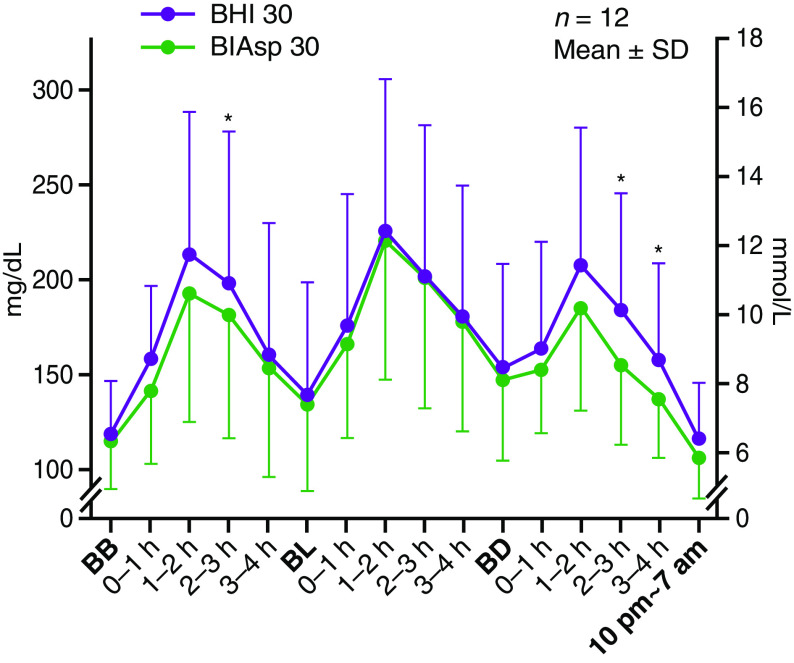
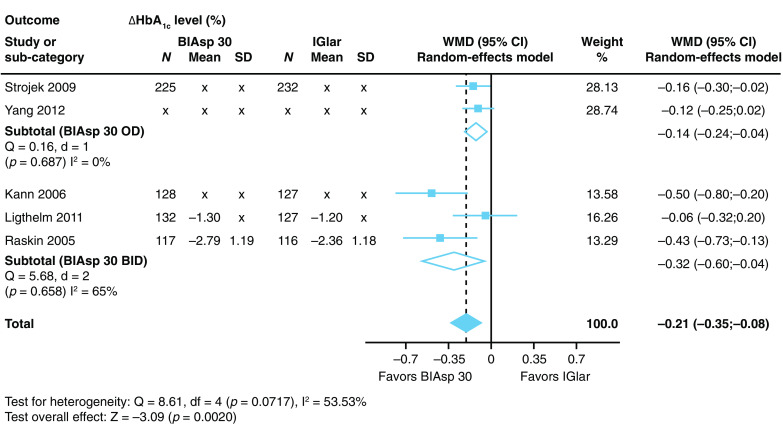
Since clinical experience with biphasic insulin aspart 30 (BIAsp 30) in type 2 diabetes mellitus (T2DM) was reviewed in 2012 after 10 years of use worldwide, additional studies have been published that highlight new aspects, including use in real-world populations. Evidence from 35 new studies confirms and builds upon previous work indicating that BIAsp 30 continues to have pharmacodynamic and clinical advantages over biphasic human insulin (BHI 30), including in real-world practice with unselected populations of patients. BIAsp 30 has also been shown to be safe and efficacious as an add-on to dipeptidyl peptidase-4 (DPP-4) inhibitors. Intensification with BIAsp 30 is a safe and effective way to improve glycemic control, and titration performed by patients can achieve results that are at least comparable to those when being guided by healthcare providers. Stepwise intensification using BIAsp 30 is comparable to intensification using a basal-bolus regimen, and twice-daily BIAsp 30 provides similar glycemic control to a basal-plus regimen. Data from large observational studies, in particular, have identified patient-related characteristics that are associated with improved clinical responses, suggesting that earlier initiation and intensification of therapy is warranted. Finally, new health-economic analyses continue to confirm that BIAsp 30 is cost effective versus other therapies such as BHI 30, neutral protamine Hagedorn (NPH), or insulin glargine in both insulin-naïve and insulin-experienced patients. After 15 years of clinical use worldwide, analysis of more recent 5-year data indicates that BIAsp 30 remains a safe, effective, and simple-to-use insulin for initiation and intensification by diabetes specialists and primary care physicians in a variety of patients with T2DM.
自 2012 年对全球使用 10 年后的双相门冬胰岛素 30(BIAsp 30)在 2 型糖尿病(T2DM)中的临床经验进行回顾以来,又发表了更多的研究,强调了新的方面,包括在真实世界人群中的应用。来自 35 项新研究的证据证实并进一步证明,BIAsp 30 在药效学和临床方面继续优于双相人胰岛素(BHI 30),包括在未选择患者人群的真实世界实践中。BIAsp 30 也已被证明作为二肽基肽酶-4(DPP-4)抑制剂的附加疗法是安全有效的。与 DPP-4 抑制剂联合使用 BIAsp 30 是改善血糖控制的安全有效方法,而且患者自行调整剂量也能达到与由医护人员指导时至少相当的效果。使用 BIAsp 30 逐步强化治疗与使用基础-餐时胰岛素方案相当,而每日两次的 BIAsp 30 与基础-预混胰岛素方案提供相似的血糖控制。特别是来自大型观察性研究的数据,确定了与改善临床反应相关的患者特征,这表明需要更早地开始和加强治疗。最后,新的健康经济学分析继续证实,与其他疗法(如 BHI 30、中性鱼精蛋白锌胰岛素[NPH]或甘精胰岛素)相比,BIAsp 30 在胰岛素初治和经治患者中均具有成本效益。在全球临床应用 15 年后,对最近 5 年数据的分析表明,BIAsp 30 仍然是一种安全、有效且易于使用的胰岛素,可供糖尿病专家和初级保健医生在各种 T2DM 患者中起始和强化治疗使用。