Usamentiaga Rubén, García Daniel Fernando
Department of Computer Science and Engineering, University of Oviedo, Campus de Viesques, 33204 Gijón, Spain.
Sensors (Basel). 2017 May 18;17(5):1157. doi: 10.3390/s17051157.
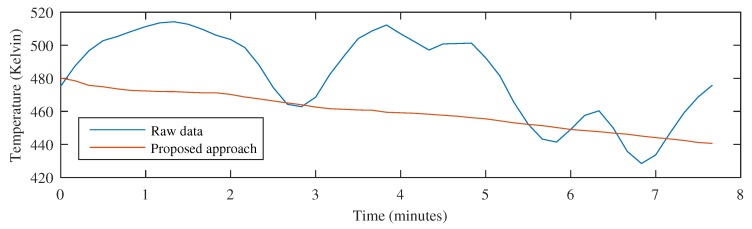
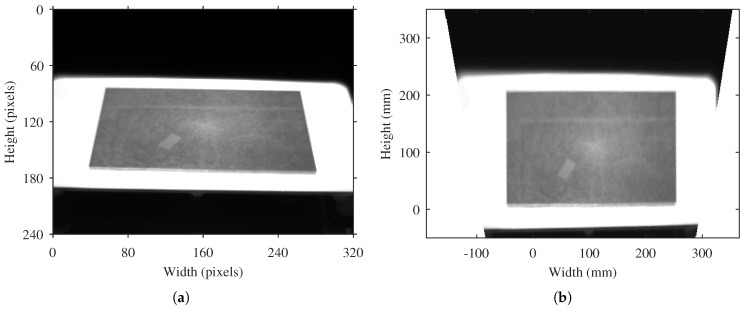
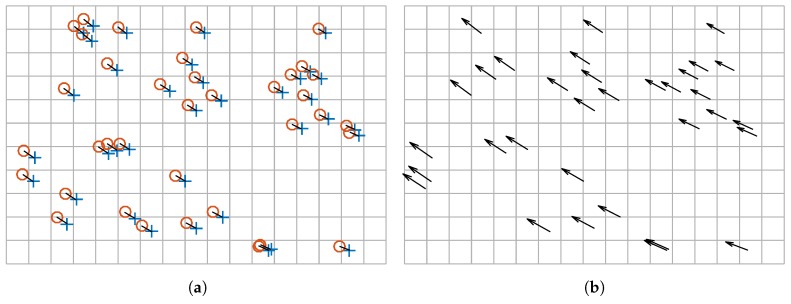
Infrared thermography offers significant advantages in monitoring the temperature of objects over time, but crucial aspects need to be addressed. Movements between the infrared camera and the inspected material seriously affect the accuracy of the calculated temperature. These movements can be the consequence of solid objects that are moved, molten metal poured, material on a conveyor belt, or just vibrations. This work proposes a solution for monitoring the temperature of material in these scenarios. In this work both real movements and vibrations are treated equally, proposing a unified solution for both problems. The three key steps of the proposed procedure are image rectification, motion estimation and motion compensation. Image rectification calculates a front-parallel projection of the image that simplifies the estimation and compensation of the movement. Motion estimation describes the movement using a mathematical model, and estimates the coefficients using robust methods adapted to infrared images. Motion is finally compensated for in order to produce the correct temperature time history of the monitored material regardless of the movement. The result is a robust sensor for temperature of moving material that can also be used to measure the speed of the material. Different experiments are carried out to validate the proposed method in laboratory and real environments. Results show excellent performance.
红外热成像技术在长期监测物体温度方面具有显著优势,但仍需解决一些关键问题。红外摄像机与被检测材料之间的移动会严重影响计算温度的准确性。这些移动可能是由被移动的固体物体、浇注的熔融金属、传送带上的材料,或者仅仅是振动引起的。这项工作提出了一种在这些场景下监测材料温度的解决方案。在这项工作中,真实移动和振动被同等对待,为这两个问题提出了统一的解决方案。所提出的程序的三个关键步骤是图像校正、运动估计和运动补偿。图像校正计算图像的前平行投影,这简化了运动的估计和补偿。运动估计使用数学模型描述运动,并使用适用于红外图像的稳健方法估计系数。最后进行运动补偿,以便无论材料如何移动,都能生成被监测材料正确的温度随时间变化的历史记录。结果是一种用于移动材料温度的稳健传感器,它还可用于测量材料的速度。在实验室和实际环境中进行了不同的实验,以验证所提出的方法。结果显示出优异的性能。