Zhang Yixiang, Yuan Yeqing, Liang Pei, Zhang Zhaoxia, Guo Xiaojing, Xia Ligang, Zhao Yingying, Shu Xing-Sheng, Sun Shengkun, Ying Ying, Cheng Yingduan
Department of Urology, The Second Affiliated Hospital of Jinan University, Shenzhen People's Hospital, Shenzhen, Guangdong, People's Republic of China.
Department of Urology, David Geffen School of Medicine, University of California Los Angeles, Los Angeles, California, USA.
Oncotarget. 2017 Jul 11;8(28):45459-45469. doi: 10.18632/oncotarget.17564.
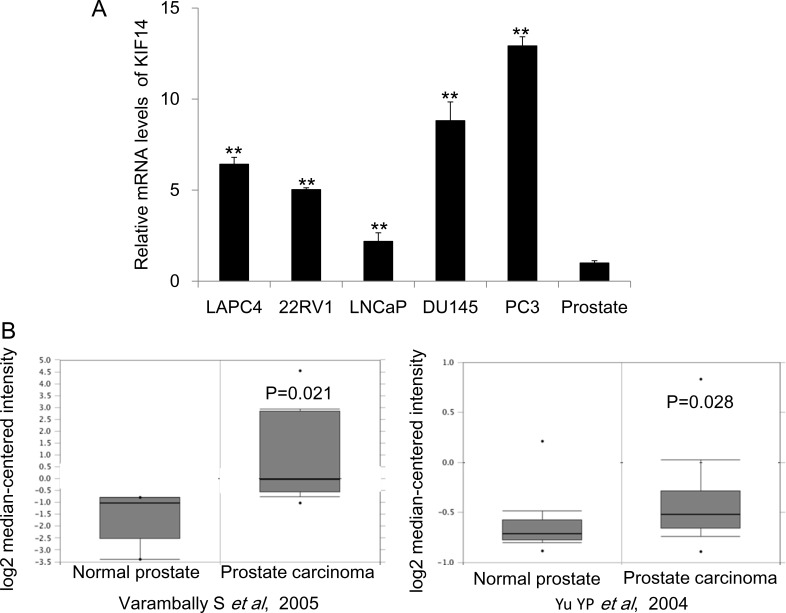
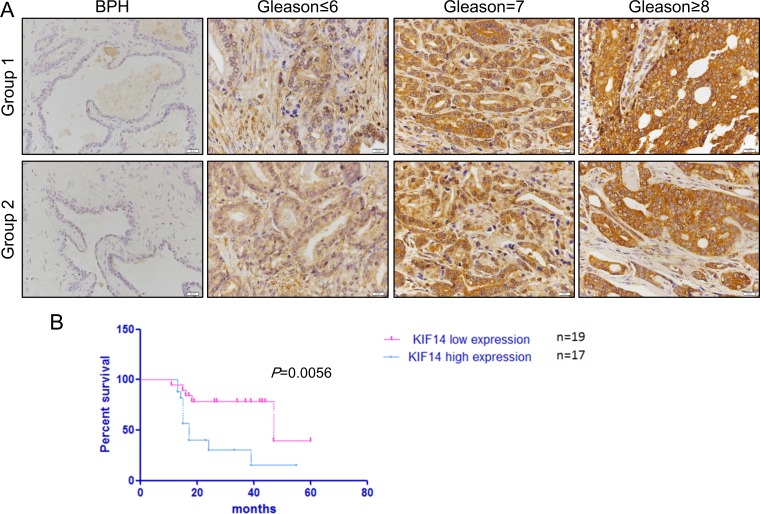
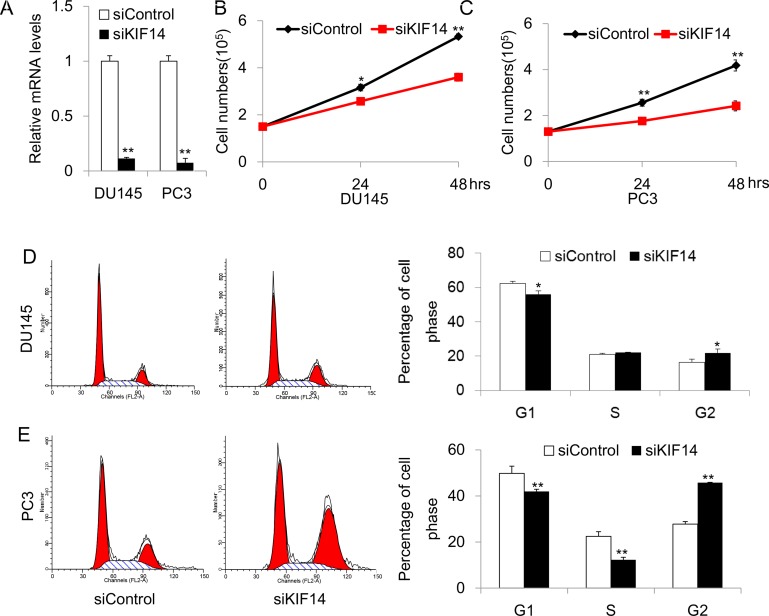
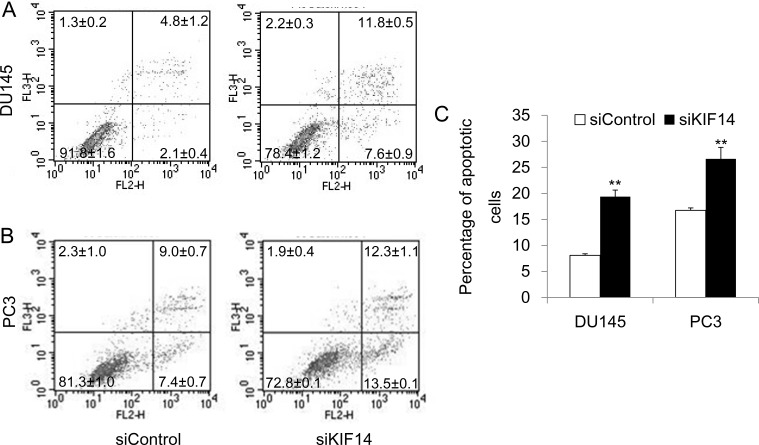
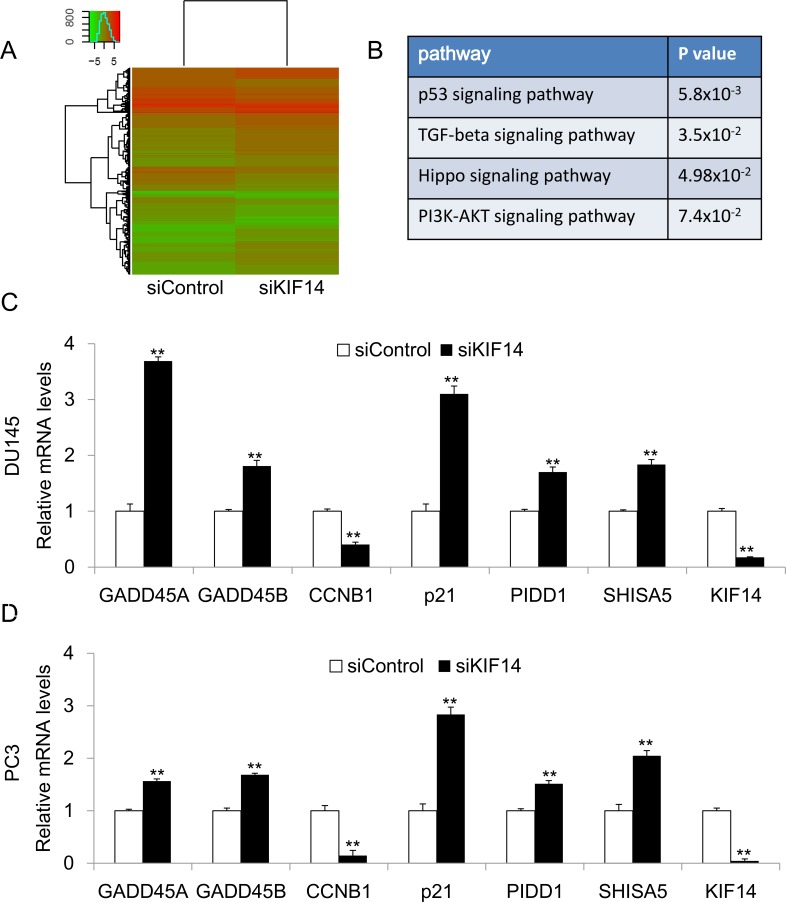
Prostate cancer (PCa) is the second leading cause of death from cancer in men. The mechanism underlying tumorigenesis and development of PCa is largely unknown. Here, we identified Kinesin family member 14 (KIF14) as a novel candidate oncogene in PCa. We found that KIF14 was overexpressed in multiple PCa cell lines and primary PCa tissues. Knockdown of KIF14 in DU145 and PC3 prostate cancer cells suppressed cell proliferation, induced cell cycle arrest and apoptosis. Transcriptome analysis by RNA-sequencing demonstrated that KIF4 suppression led to transcriptional changes of genes involved in p53 and TGF-beta signaling pathway. In addition, upregulated expression of GADD45A, GADD45B, p21, PIDD and Shisa5, which contribute to growth arrest and apoptosis induction, and downregulated CCNB1 that promotes cell cycle progression were confirmed by quantitative real-time PCR after KIF4 knockdown. We further found that KIF14 protein level was positively correlated with T stage and Gleason Score. Patients with higher KIF14 expression had shorter overall survival time than those with lower KIF14 expression. Thus, our data indicate that KIF14 could act as a potential oncogene that contributes to tumor progression and poor prognosis in PCa, which may represent a novel and useful prognostic biomarker for PCa.
前列腺癌(PCa)是男性癌症死亡的第二大主要原因。PCa发生和发展的潜在机制在很大程度上尚不清楚。在此,我们将驱动蛋白家族成员14(KIF14)鉴定为PCa中的一种新型候选癌基因。我们发现KIF14在多种PCa细胞系和原发性PCa组织中过表达。在DU145和PC3前列腺癌细胞中敲低KIF14可抑制细胞增殖,诱导细胞周期停滞和凋亡。通过RNA测序进行的转录组分析表明,KIF4抑制导致参与p53和TGF-β信号通路的基因发生转录变化。此外,在敲低KIF4后,通过定量实时PCR证实了有助于生长停滞和诱导凋亡的GADD45A、GADD45B、p21、PIDD和Shisa5的表达上调,以及促进细胞周期进程的CCNB1的表达下调。我们进一步发现KIF14蛋白水平与T分期和Gleason评分呈正相关。KIF14表达较高的患者总生存时间比KIF14表达较低的患者短。因此,我们的数据表明,KIF14可能作为一种潜在的癌基因,促进PCa的肿瘤进展和不良预后,这可能代表一种新的、有用的PCa预后生物标志物。