Chen Weena J Y, Diamant Michaela, de Boer Karin, Harms Hendrik J, Robbers Lourens F H J, van Rossum Albert C, Kramer Mark H H, Lammertsma Adriaan A, Knaapen Paul
Diabetes Center/Department of Internal Medicine, VU University Medical Center, de Boelelaan 1117, 1081 HV, Amsterdam, The Netherlands.
Department of Cardiology, VU University Medical Center, de Boelelaan 1117, 1081 HV, Amsterdam, The Netherlands.
Cardiovasc Diabetol. 2017 May 19;16(1):67. doi: 10.1186/s12933-017-0549-z.
Multiple bloodglucose-lowering agents have been linked to cardiovascular events. Preliminary studies showed improvement in left ventricular (LV) function during glucagon-like peptide-1 receptor agonist administration. Underlying mechanisms, however, are unclear. The purpose of this study was to investigate myocardial perfusion and oxidative metabolism in type 2 diabetic (T2DM) patients with LV systolic dysfunction as compared to healthy controls. Furthermore, effects of 26-weeks of exenatide versus insulin glargine administration on cardiac function, perfusion and oxidative metabolism in T2DM patients with LV dysfunction were explored.
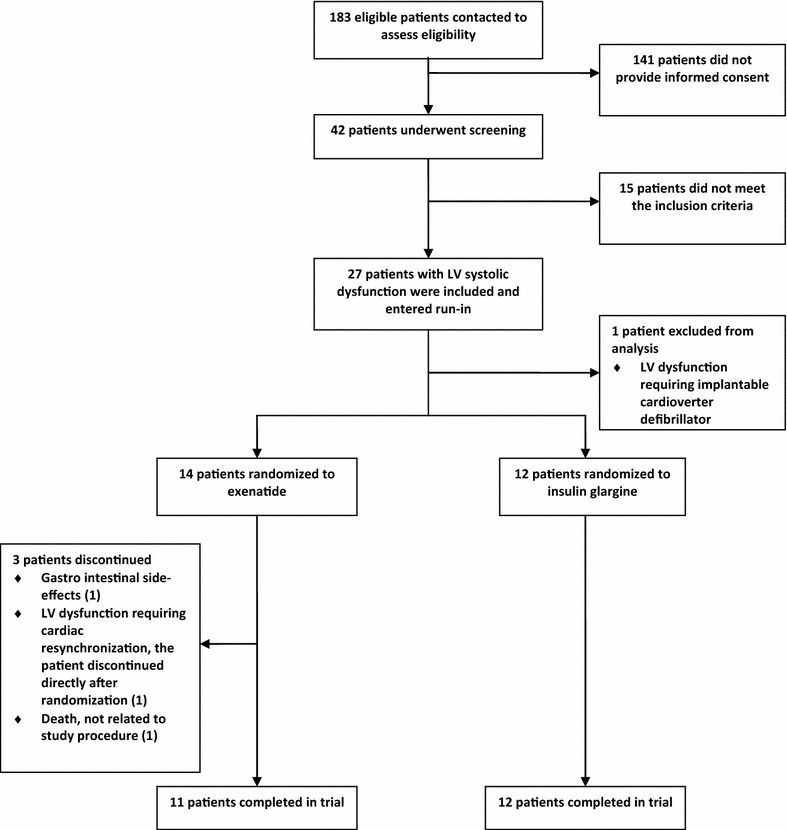
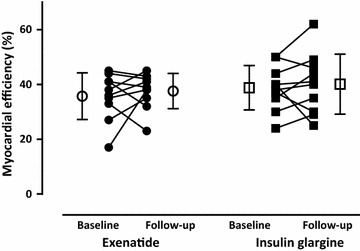
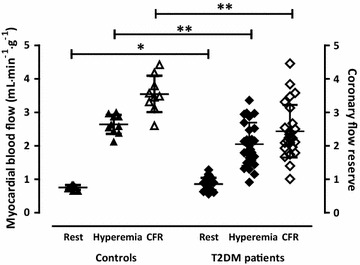
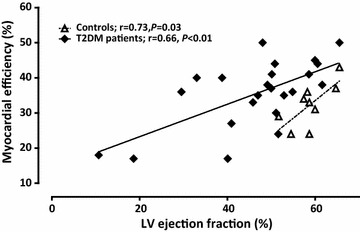
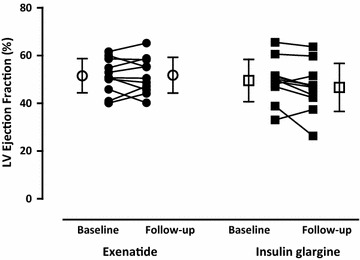
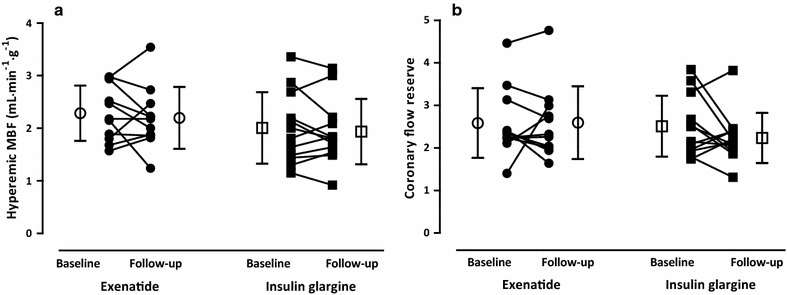
Twenty-six T2DM patients with LV systolic dysfunction (cardiac magnetic resonance (CMR) derived LV ejection fraction (LVEF) of 47 ± 13%) and 10 controls (LVEF of 59 ± 4%, P < 0.01 as compared to patients) were analyzed. Both myocardial perfusion during adenosine-induced hyperemia (P < 0.01), and coronary flow reserve (P < 0.01), measured by [O]HO positron emission tomography (PET), were impaired in T2DM patients as compared to healthy controls. Myocardial oxygen consumption and myocardial efficiency, measured using [C]acetate PET and CMR derived stroke volume, were not different between the groups. Eleven patients in the exenatide group and 12 patients in the insulin glargine group completed the trial. Systemic metabolic control was improved after both treatments, although, no changes in cardiac function, perfusion and metabolism were seen after exenatide or insulin glargine.
T2DM patients with LV systolic dysfunction did not have altered myocardial efficiency as compared to healthy controls. Exenatide or insulin glargine had no effects on cardiac function, perfusion or oxidative metabolism. Trial registration NCT00766857.
多种降糖药物与心血管事件有关。初步研究显示,在使用胰高血糖素样肽-1受体激动剂期间左心室(LV)功能有所改善。然而,其潜在机制尚不清楚。本研究的目的是调查2型糖尿病(T2DM)合并LV收缩功能障碍患者与健康对照者相比的心肌灌注和氧化代谢情况。此外,还探讨了26周的艾塞那肽与甘精胰岛素给药对LV功能障碍的T2DM患者心脏功能、灌注和氧化代谢的影响。
分析了26例LV收缩功能障碍的T2DM患者(心脏磁共振成像(CMR)得出的LV射血分数(LVEF)为47±13%)和10例对照者(LVEF为59±4%,与患者相比P<0.01)。与健康对照者相比,通过[O]HO正电子发射断层扫描(PET)测量的腺苷诱导充血期间的心肌灌注(P<0.01)和冠状动脉血流储备(P<0.01)在T2DM患者中均受损。使用[C]醋酸盐PET和CMR得出的每搏量测量的心肌氧耗量和心肌效率在两组之间没有差异。艾塞那肽组的11例患者和甘精胰岛素组的12例患者完成了试验。两种治疗后全身代谢控制均得到改善,尽管在使用艾塞那肽或甘精胰岛素后心脏功能、灌注和代谢均未见变化。
与健康对照者相比,LV收缩功能障碍的T2DM患者心肌效率未改变。艾塞那肽或甘精胰岛素对心脏功能、灌注或氧化代谢无影响。试验注册号NCT00766857。