Shao Xue, Li Bingjue, Cao Luxi, Liang Ludan, Yang Jingjuan, Wang Yucheng, Feng Shi, Wang Cuili, Weng Chunhua, Shen Xiujin, Jiang Hong, Chen Jianghua
Kidney Disease Center, The First Affiliated Hospital, College of Medicine, Zhejiang University, Hangzhou, China.
Kidney Disease Immunology Laboratory, The Third Grade Laboratory, State Administration of Traditional Chinese Medicine of China, Hangzhou, China.
Oncotarget. 2017 Jul 11;8(28):46436-46448. doi: 10.18632/oncotarget.17502.
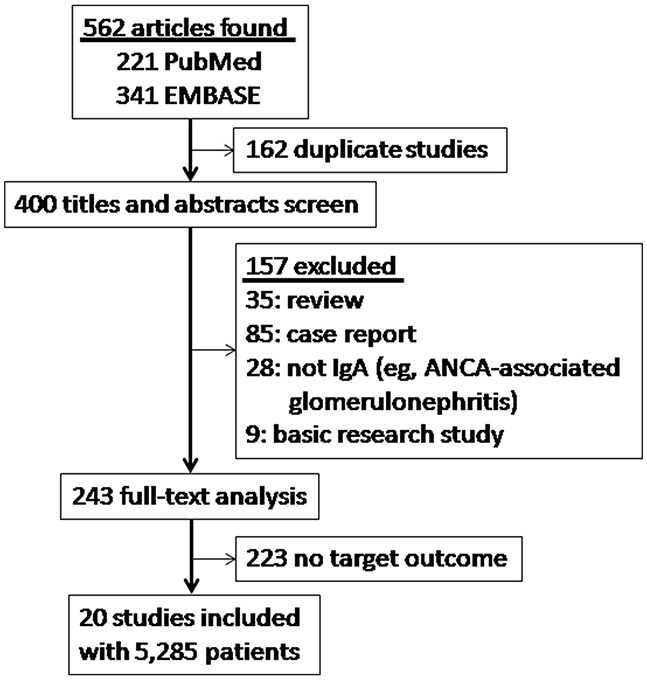
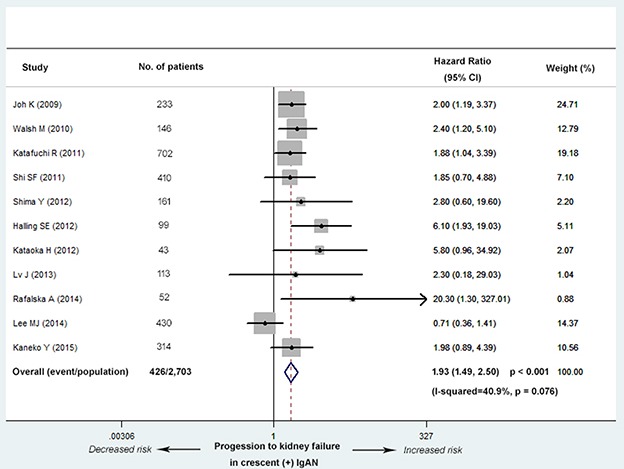
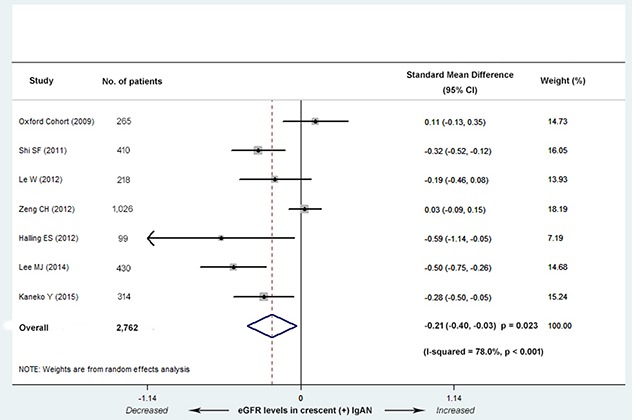
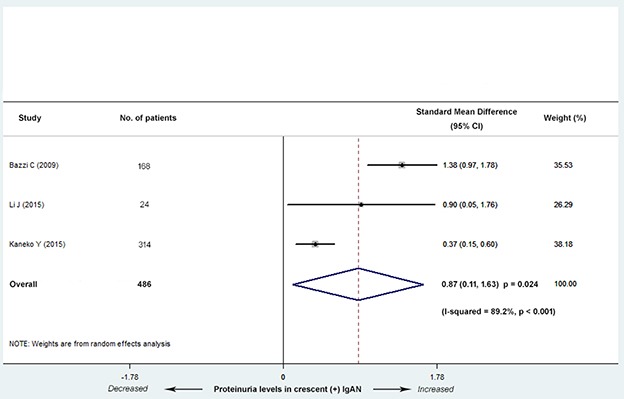
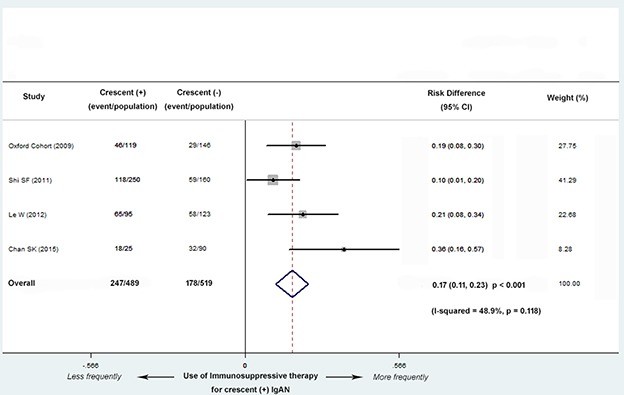
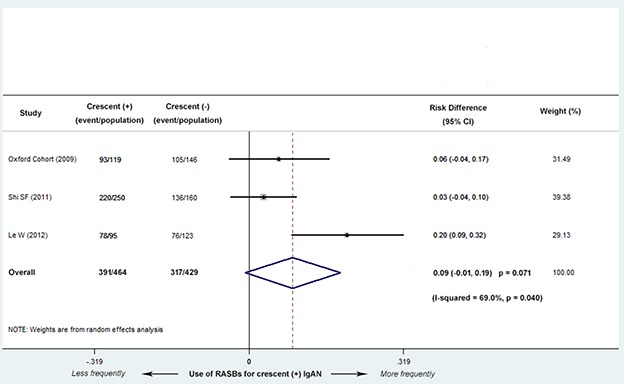
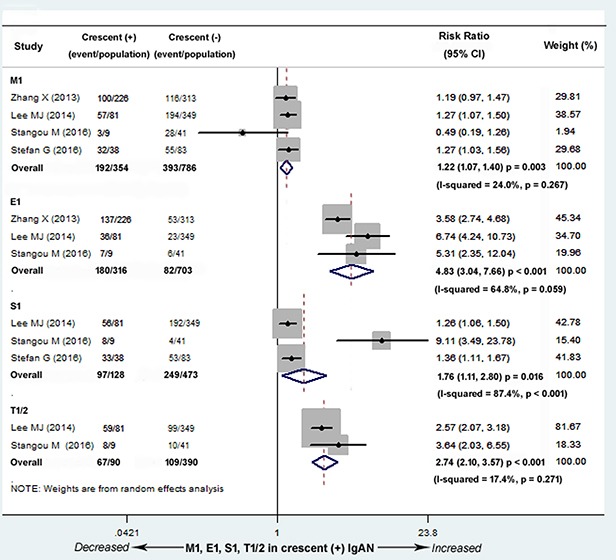
The 2009 Oxford Classification of immunoglobulin A (IgA) nephropathy (IgAN) identifies four histological features as predictors of renal prognosis: mesangial hypercellularity (M), endocapillary hypercellularity (E), segmental glomerulosclerosis (S), and tubular atrophy/interstitial fibrosis (T). However, the clinical and prognostic significance of crescent formation still remains controversial. Therefore, we performed a meta-analysis to evaluate the association between crescents and kidney outcome in IgAN. A total of 20 studies published from January 2009 to July 2016 involving 5,285 patients were included after systematic searches of PubMed and EMBASE databases. Pooled results showed that crescent lesions were associated with kidney failure (HR, 1.93; 95% CI, 1.49-2.50; P < 0.001). IgAN patients with crescents had lower eGFR levels (SMD, -0.21; 95% CI, -0.40--0.03; P = 0.023); higher proteinuria levels (SMD, 0.87; 95% CI, 0.11-1.63; P = 0.024); a larger number of patients with M1 (RR, 1.22; 95% CI, 1.07-1.40; P = 0.003), E1 (RR, 4.83; 95% CI, 3.04-7.66;P < 0.001), S1 (RR, 1.76; 95% CI, 1.11-2.80; P = 0.016) and T1/2 (RR, 2.74; 95% CI, 2.10-3.57; P < 0.001) lesions; and received immunosuppressive therapy more frequently (RD, 0.17; 95% CI, 0.11-0.23; P < 0.001). Our results suggest that crescent formation represents an efficient prognostic factor associated with progression to kidney failure and thus could be considered into the new Oxford Classification.
2009年免疫球蛋白A(IgA)肾病(IgAN)的牛津分类确定了四种组织学特征作为肾脏预后的预测指标:系膜细胞增多(M)、毛细血管内细胞增多(E)、节段性肾小球硬化(S)和肾小管萎缩/间质纤维化(T)。然而,新月体形成的临床和预后意义仍存在争议。因此,我们进行了一项荟萃分析,以评估IgAN中新月体与肾脏结局之间的关联。通过系统检索PubMed和EMBASE数据库,共纳入了2009年1月至2016年7月发表的20项研究,涉及5285例患者。汇总结果显示,新月体病变与肾衰竭相关(风险比[HR],1.93;95%置信区间[CI],1.49 - 2.50;P < 0.001)。有新月体的IgAN患者估算肾小球滤过率(eGFR)水平较低(标准化均数差[SMD],-0.21;95% CI,-0.40 - -0.03;P = 0.023);蛋白尿水平较高(SMD,0.87;95% CI,0.11 - 1.63;P = 0.024);有更多患者存在M1(相对危险度[RR],1.22;95% CI,1.07 - 1.40;P = 0.003)、E1(RR,4.83;95% CI,3.04 - 7.66;P < 0.001)、S1(RR,1.76;95% CI,1.11 - 2.80;P = 0.016)和T1/2(RR,2.74;95% CI,2.10 - 3.57;P < 0.001)病变;并且更频繁地接受免疫抑制治疗(风险差[RD],0.17;95% CI,0.11 - 0.23;P < 0.001)。我们的结果表明,新月体形成是与进展至肾衰竭相关的有效预后因素,因此可考虑纳入新的牛津分类。