Itami Shusaku, Moriyama Takahito, Miyabe Yoei, Karasawa Kazunori, Nitta Kosaku
Department of Nephrology, Tokyo Women's Medical University, Tokyo, Japan.
Kidney Int Rep. 2021 Oct 14;7(1):99-107. doi: 10.1016/j.ekir.2021.10.007. eCollection 2022 Jan.
The usefulness of the Oxford classification (MEST-C score) for deciding the management approach for IgA nephropathy (IgAN) remains unclear.
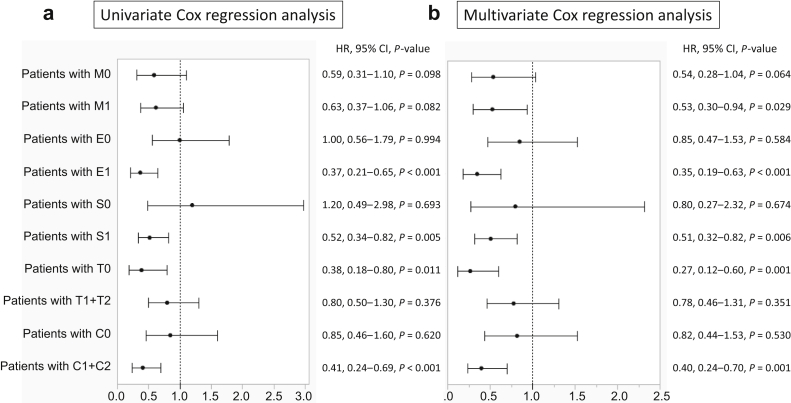
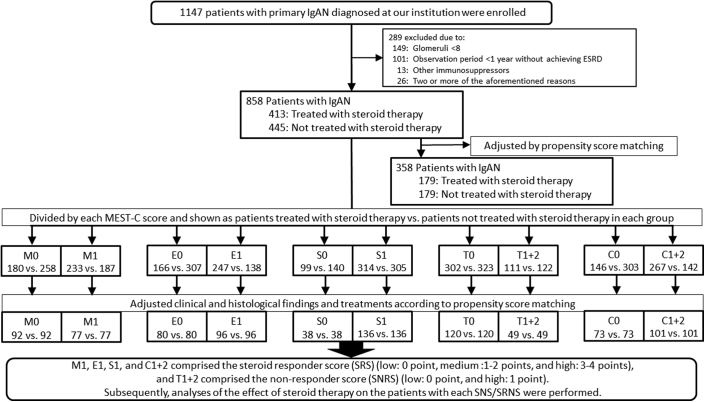
Effects of steroid therapy on the long-term prognosis for all 858 patients with IgAN and patients classified according to each MEST-C score were evaluated using Kaplan-Meier and Cox regression analyses. Steroid responder score (SRS) and steroid nonresponder score (SNRS) were determined using individual pathology scores when steroids were found to be independently associated, or not, with clinical benefits. In addition, the effects of steroid therapy according to the total SRS/SNRS were analyzed.
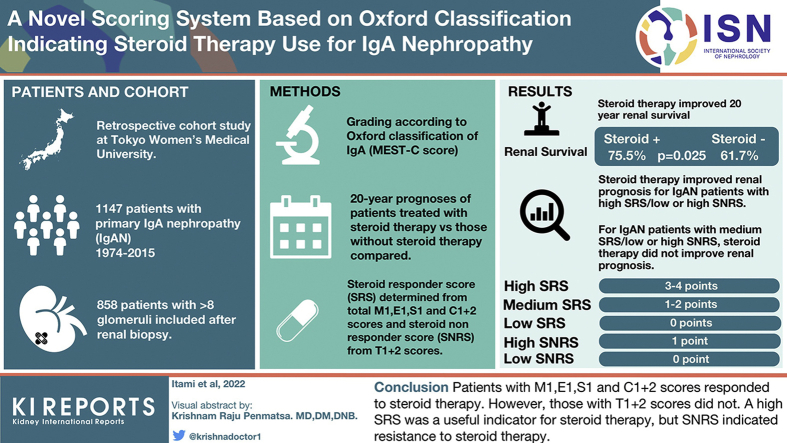
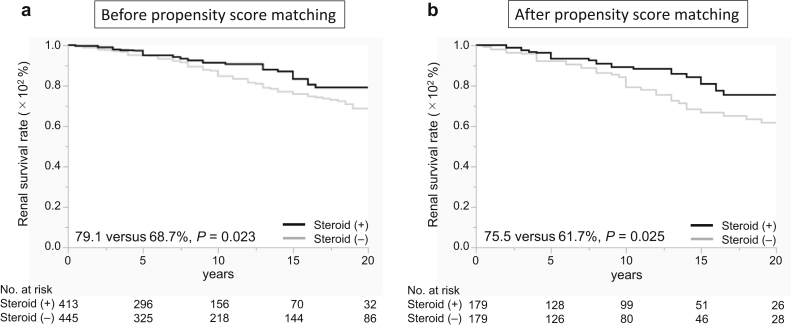
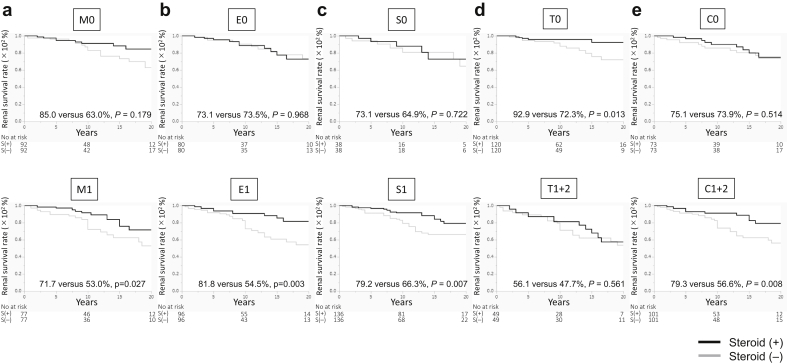
Steroid therapy improved the 20-year renal survival rates of patients with IgAN after matching (steroids[+] vs. steroids[-]; estimated glomerular filtration rate [eGFR] [ml/min per 1.73 m]: 79.4 vs. 77.0, not significant; proteinuria [g/d]: 0.80 vs. 0.62, not significant; renal survival rate: 75.5% vs. 61.7%; = 0.025) and of patients with M1, E1, S1, C1+2, and T0 scores. Therefore, we considered the total of the M1, E1, S1, and C1+2 scores (point 0: low, 1-2: medium, and 3-4: high) as the SRS and the total of the T1+2 scores (0: low and 1: high) as the SNRS. Multivariate Cox regression analyses revealed that steroid therapy improved the renal prognosis of patients with IgAN with high SRS and any SNRS, unlike patients with IgAN with medium SRS and any SNRS.
Patients with M1, E1, S1, and C1+2 scores responded to steroid therapy; however, those with T1+2 scores did not. Although a high SRS was a useful indicator for steroid therapy, SNRS indicated resistance to steroid therapy.
牛津分类法(MEST - C评分)在决定IgA肾病(IgAN)治疗方案方面的实用性仍不明确。
采用Kaplan - Meier法和Cox回归分析评估了激素治疗对858例IgAN患者及根据各MEST - C评分分类的患者长期预后的影响。当发现激素与临床获益独立相关或不相关时,使用个体病理评分确定激素反应者评分(SRS)和激素无反应者评分(SNRS)。此外,还分析了根据总SRS/SNRS进行激素治疗的效果。
匹配后,激素治疗提高了IgAN患者的20年肾脏生存率(激素治疗组[+]与未用激素治疗组[-];估计肾小球滤过率[eGFR][ml/min per 1.73 m]:79.4对77.0,无显著差异;蛋白尿[g/d]:0.80对0.62,无显著差异;肾脏生存率:75.5%对61.7%;P = 0.025)以及M1、E1、S1、C1 + 2和T0评分患者的生存率。因此,我们将M1、E1、S1和C1 + 2评分的总和(0分:低,1 - 2分:中,3 - 4分:高)视为SRS,将T1 + 2评分的总和(0分:低,1分:高)视为SNRS。多变量Cox回归分析显示,与中等SRS且任何SNRS的IgAN患者不同,激素治疗改善了高SRS且任何SNRS的IgAN患者的肾脏预后。
M1、E1、S1和C1 + 2评分的患者对激素治疗有反应;然而,T1 + 2评分的患者则无反应。虽然高SRS是激素治疗的有用指标,但SNRS表明对激素治疗有抵抗性。