SingHealth Polyclinics, Singapore.
Duke-NUS Medical School, Singapore; Department of Renal Medicine, Singapore General Hospital, Singapore.
Kidney Int. 2017 Oct;92(4):979-987. doi: 10.1016/j.kint.2017.03.019. Epub 2017 May 18.
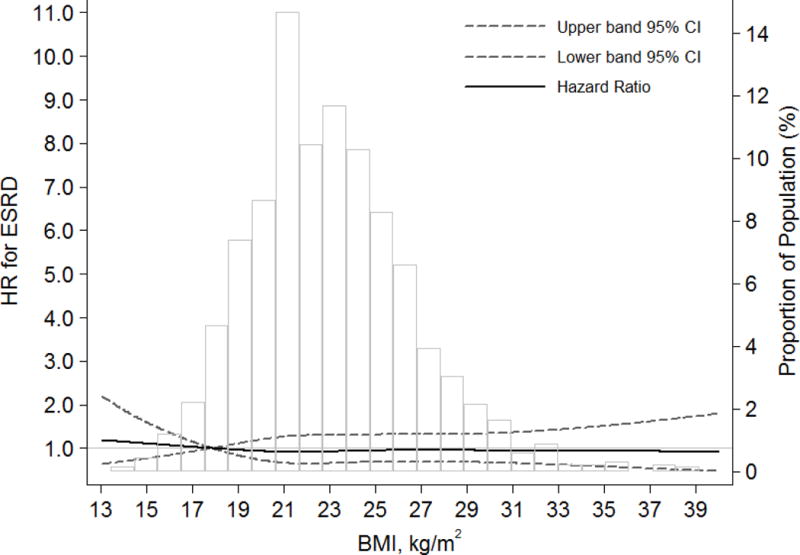
The relationship between body mass index (BMI) and end-stage renal disease (ESRD) is confounded by co-morbidities associated with both conditions. Furthermore, the association at low range BMI is controversial. We studied this association in the Singapore Chinese Health Study, a population-based prospective cohort that recruited Singaporean Chinese men and women 45-74 years of age from 1993 to 1998. Self-reported weight, height, lifestyle factors, usual diet, and medical history were collected via an interviewer-administered questionnaire. Incident ESRD cases were identified via record linkage with the nationwide ESRD registry. The computed Cox proportional hazard regression was adjusted for potential risk factors. After an average follow-up of 15.5 years, 827 incident ESRD cases were identified. Compared with a normal BMI of 18.5 to under 23 kg/m, the hazard ratios and (95% confidence intervals) of ESRD risk for BMIs under 18.5, 23 to under 27.5, and 27.5 kg/m or more were 0.54 (0.37-0.79), 1.40 (1.20-1.64) and 2.13 (1.74-2.59), respectively. This significantly trended, linear, dose-dependent association was only present among those with no history of diabetes, hypertension, coronary heart disease, and stroke at baseline, but not significantly among those with any of these co-morbidities. Thus, BMI itself is a risk factor for ESRD in the general population and this association is present in those without pre-existing diabetes, hypertension, coronary heart disease, and stroke.
体重指数(BMI)与终末期肾病(ESRD)之间的关系受到与这两种疾病都相关的合并症的影响。此外,BMI 低值范围内的相关性存在争议。我们在新加坡华人健康研究中研究了这种相关性,这是一项基于人群的前瞻性队列研究,于 1993 年至 1998 年期间招募了 45-74 岁的新加坡华人男性和女性。通过访谈员管理的问卷收集了自我报告的体重、身高、生活方式因素、常规饮食和病史。通过与全国性 ESRD 登记处的记录链接,确定了 ESRD 病例。计算的 Cox 比例风险回归调整了潜在的危险因素。经过平均 15.5 年的随访,确定了 827 例 ESRD 病例。与正常 BMI(18.5 至 23kg/m 以下)相比,BMI 低于 18.5、23 至 27.5 及 27.5kg/m 或更高的 ESRD 风险的危险比(95%置信区间)分别为 0.54(0.37-0.79)、1.40(1.20-1.64)和 2.13(1.74-2.59)。这种明显呈线性趋势、剂量依赖性的关联仅存在于基线时没有糖尿病、高血压、冠心病和中风病史的人群中,而在有这些合并症的人群中则不显著。因此,BMI 本身就是一般人群中 ESRD 的一个危险因素,这种关联存在于没有预先存在的糖尿病、高血压、冠心病和中风的人群中。