VUmc MS Center Amsterdam and Department of Rehabilitation Medicine, VU University Medical Center, Amsterdam, The Netherlands/Brain Center Rudolf Magnus and Center of Excellence for Rehabilitation Medicine, University Medical Center Utrecht and Rehabilitation Center De Hoogstraat, Utrecht, The Netherlands.
Brain Center Rudolf Magnus and Center of Excellence for Rehabilitation Medicine, University Medical Center Utrecht and Rehabilitation Center De Hoogstraat, Utrecht, The Netherlands.
Mult Scler. 2017 Oct;23(11):1517-1526. doi: 10.1177/1352458517696596. Epub 2017 May 22.
Evidence supporting the effectiveness of aerobic training, specific for fatigue, in severely fatigued patients with multiple sclerosis (MS) is lacking.
To estimate the effectiveness of aerobic training on MS-related fatigue and societal participation in ambulant patients with severe MS-related fatigue.
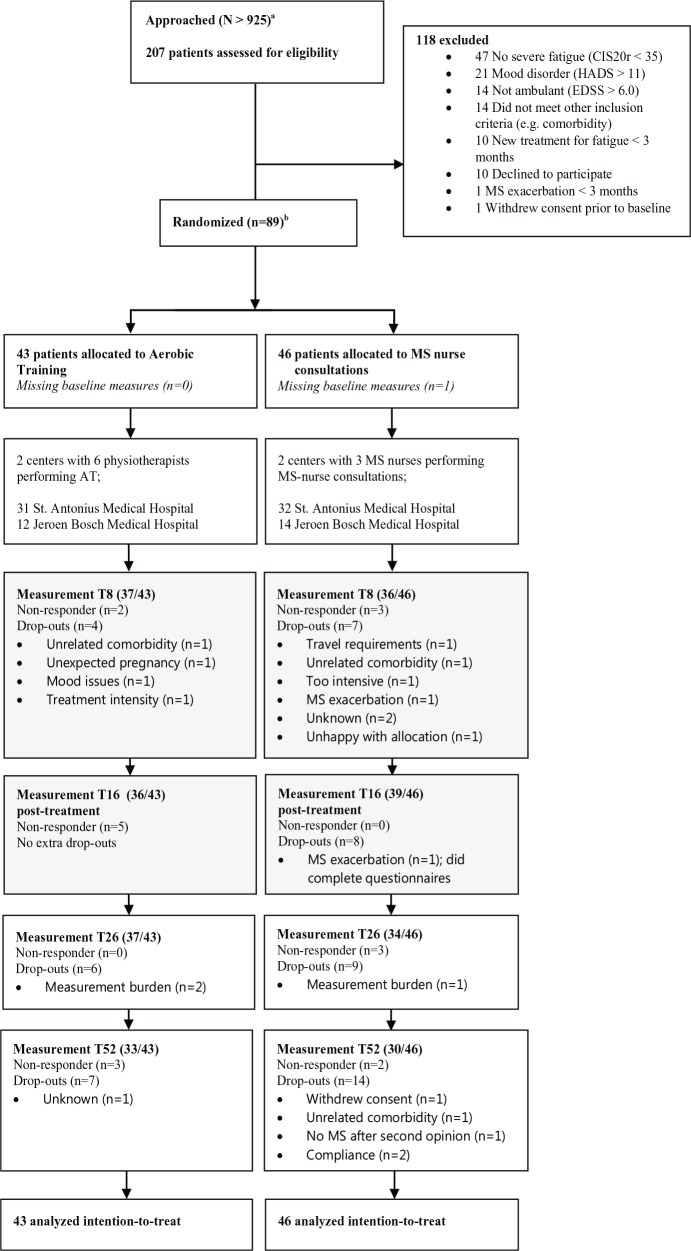
Patients ( N = 90) with severe MS-related fatigue were allocated to 16-week aerobic training or control intervention. Primary outcomes were perceived fatigue (Checklist Individual Strength (CIS20r) fatigue subscale) and societal participation. An improvement of ⩾8 points on the CIS20r fatigue subscale was considered clinically relevant. Outcomes were assessed by a blinded observer at baseline, 2, 4, 6 and 12 months.
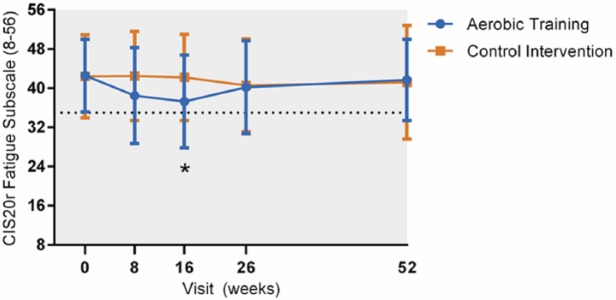
Of the 89 patients that started treatment (median Expanded Disability Status Scale (interquartile range), 3.0 (2.0-3.6); mean CIS20r fatigue subscale (standard deviation (SD)), 42.6 (8.0)), 43 received aerobic training and 46 received the control intervention. A significant post-intervention between-group mean difference (MD) on the CIS20r fatigue subscale of 4.708 (95% confidence interval (CI) = 1.003-8.412; p = 0.014) points was found in favour of aerobic training that, however, was not sustained during follow-up. No effect was found on societal participation.
Aerobic training in MS patients with severe fatigue does not lead to a clinically meaningful reduction in fatigue or societal participation when compared to a low-intensity control intervention.
缺乏针对多发性硬化症(MS)严重疲劳患者的有氧训练对疲劳的有效性的证据。
评估有氧训练对 MS 相关疲劳和社会参与在严重 MS 相关疲劳的活动患者中的作用。
将 90 名患有严重 MS 相关疲劳的患者随机分配至 16 周的有氧训练或对照组。主要结局是感知疲劳(个体强度检查表(CIS20r)疲劳子量表)和社会参与。CIS20r 疲劳子量表改善 ⩾8 分被认为具有临床意义。结果由盲法观察者在基线、2、4、6 和 12 个月时评估。
89 名开始治疗的患者中(中位数扩展残疾状态量表(四分位距),3.0(2.0-3.6);平均 CIS20r 疲劳子量表(标准差(SD)),42.6(8.0)),43 名患者接受了有氧训练,46 名患者接受了对照组。发现有氧训练在 CIS20r 疲劳子量表上的干预后组间平均差异(MD)为 4.708(95%置信区间(CI)为 1.003-8.412;p = 0.014),这有利于有氧训练,但在随访期间并未持续。对社会参与没有影响。
与低强度对照组相比,MS 严重疲劳患者的有氧训练不会导致疲劳或社会参与的临床意义上的降低。