Cao Xinchuan, Liu Yuling, Liu Zhen, Liu Fang, Wu Yalei, Zhou Zhongli, Cai Xiaoyan, Wang Xingxing, Zhang Zhenmei, Wang Yuhong, Luo Zhimin, Peng Renhai, Wang Kunbo
Tarium Universty, Alar, Xinjiang 843300 China.
State Key Laboratory of Cotton Biology/Institute of Cotton Research of Chinese Academy of Agricultural Sciences, Anyang, Henan 455000 China.
Hereditas. 2017 May 18;154:13. doi: 10.1186/s41065-017-0035-3. eCollection 2017.
Chromosome microdissection is one of the most important techniques in molecular cytogenetic research. Cotton ( Linnaeus, 1753) is the main natural fiber crop in the world. The resistance gene analog (RGA) cloning after its single chromosome microdissection can greatly promote cotton genome research and breeding.
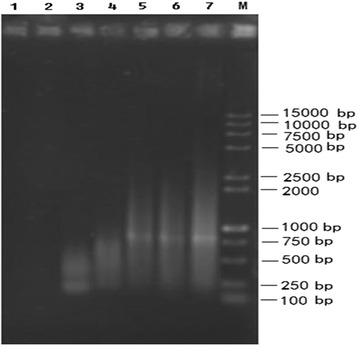
Using the linker adaptor PCR (LA-PCR) with the primers of rice disease-resistance homologues, three nucleotide sequences PS016 (KU051681), PS054 (KU051682), and PS157 (KU051680) were obtained from the chromosome A01 of upland cotton (cv. TM-1). The Blast results showed that the three sequences are the nucleotide binding site-leucine rich repeat (NBS-LRR) type RGAs. Clustering results indicated that they are homologous to these published RGAs. Thus, the three RGAs can definitely be confirmed as NBS-LRR class of RGAs in upland cotton.
Using single chromosome microdissection technique, DNA libraries containing cotton RGAs were obtained. This technique can promote cotton gene cloning, marker development and even the improvement of cotton genome research and breeding.
染色体显微切割是分子细胞遗传学研究中最重要的技术之一。棉花(林奈,1753年)是世界上主要的天然纤维作物。对其单条染色体进行显微切割后克隆抗病基因类似物(RGA)可极大地推动棉花基因组研究和育种工作。
使用水稻抗病同源物引物通过接头衔接子PCR(LA-PCR),从陆地棉(品种TM-1)的A01染色体上获得了三个核苷酸序列PS016(KU051681)、PS054(KU051682)和PS157(KU051680)。Blast结果表明这三个序列是核苷酸结合位点-富含亮氨酸重复序列(NBS-LRR)类型的RGA。聚类结果表明它们与已发表的RGA同源。因此,可以明确这三个RGA为陆地棉中NBS-LRR类RGA。
利用单条染色体显微切割技术,获得了包含棉花RGA的DNA文库。该技术可促进棉花基因克隆、标记开发,甚至推动棉花基因组研究和育种工作的改进。