Xu Ting, Kang Xiaozheng, You Xiaofang, Dai Liang, Tian Dequan, Yan Wanpu, Yang Yongbo, Xiong Hongchao, Liang Zhen, Zhao Grace Q, Lin Shengrong, Chen Ke-Neng, Xu Guobing
Key Laboratory of Carcinogenesis and Translational Research (Ministry of Education), Department of Clinical Laboratory, Peking University Cancer Hospital & Institute, Beijing, China.
Key Laboratory of Carcinogenesis and Translational Research (Ministry of Education), Department of Thoracic Surgery I, Peking University Cancer Hospital & Institute, Beijing, China.
Theranostics. 2017 Apr 2;7(6):1437-1446. doi: 10.7150/thno.16558. eCollection 2017.
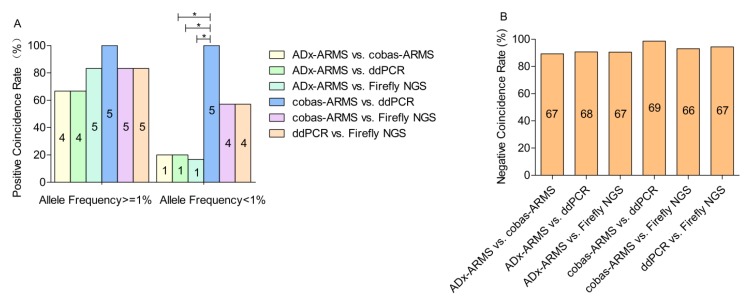
Analysis of circulating tumor DNA (ctDNA) is emerging as a powerful tool for guiding targeted therapy and monitoring tumor evolution in patients with non-small cell lung cancer (NSCLC), especially when representative tissue biopsies are not available. Here, we have compared the ability of four leading technology platforms to detect epidermal growth factor receptor ( mutations (L858R, exon 19 deletion, T790M and G719X) in ctDNA from NSCLC patients. Two amplification refractory mutation systems (cobas-ARMS and ADx-ARMS), a droplet digital polymerase chain reaction (ddPCR) and a next-generation sequencing (Firefly NGS) platform were included in the comparison. Fifteen mutations across twenty NSCLC patients were identified. Firefly NGS, cobas-ARMS and ddPCR all displayed superior sensitivity while ADx-ARMS was better suited for the qualitative detection of mutations with allele frequency higher than 1% in plasma and tissue samples. We observed high coincidence between the plasma and tissue mutational profiles for three driver mutations (L858R, exon 19 deletion and G719X) that are known targets of first generation EGFR-TKI therapies among patients who relapsed. Discrepancies between tissue and plasma mutational profiles were mainly attributable to spatial and temporal tumor heterogeneity, mutation inhibition due to therapy response and drug resistance (T790M). This study illustrates the challenges associated with selection of a technology platform for ctDNA analysis in the context of treatment evaluation and drug resistance detection.
循环肿瘤DNA(ctDNA)分析正逐渐成为指导非小细胞肺癌(NSCLC)患者靶向治疗和监测肿瘤演变的有力工具,尤其是在无法获取代表性组织活检样本时。在此,我们比较了四种领先技术平台检测NSCLC患者ctDNA中表皮生长因子受体(EGFR)突变(L858R、外显子19缺失、T790M和G719X)的能力。比较中纳入了两种扩增阻滞突变系统(cobas-ARMS和ADx-ARMS)、一种液滴数字聚合酶链反应(ddPCR)和一种二代测序(萤火虫NGS)平台。在20例NSCLC患者中鉴定出15种突变。萤火虫NGS、cobas-ARMS和ddPCR均表现出卓越的灵敏度,而ADx-ARMS更适合定性检测血浆和组织样本中等位基因频率高于1%的突变。我们观察到,在复发患者中,血浆和组织的三种驱动突变(L858R、外显子19缺失和G719X)突变谱高度一致,这三种突变是第一代EGFR-TKI疗法的已知靶点。组织和血浆突变谱之间的差异主要归因于肿瘤的空间和时间异质性、治疗反应导致的突变抑制以及耐药性(T790M)。本研究说明了在治疗评估和耐药性检测背景下选择ctDNA分析技术平台所面临的挑战。