Jilg Cordula A, Drendel Vanessa, Rischke H Christian, Beck Teresa, Vach Werner, Schaal Kathrin, Wetterauer Ulrich, Schultze-Seemann Wolfgang, Meyer Philipp T
Department of Urology, Medical Center - University of Freiburg, Faculty of Medicine, University of Freiburg, Germany.
Institute for Pathology, Faculty of Medicine, University of Freiburg, Freiburg, Germany.
Theranostics. 2017 Apr 10;7(6):1770-1780. doi: 10.7150/thno.18421. eCollection 2017.
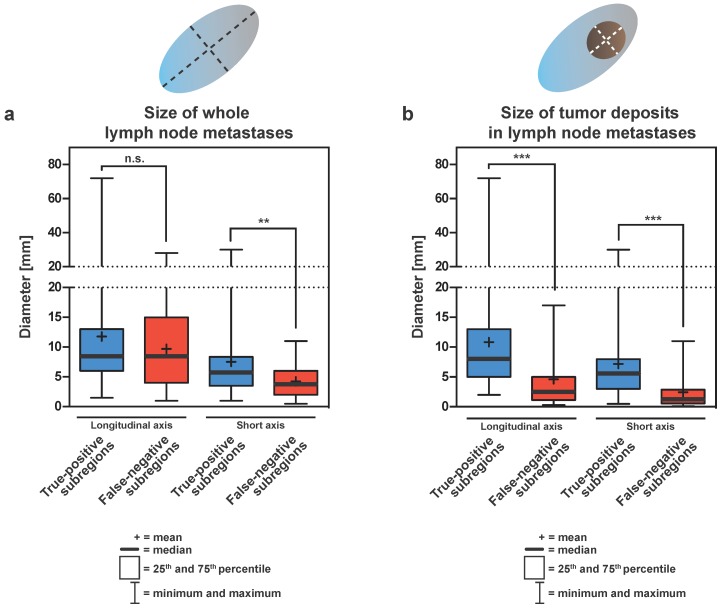
By targeting the prostate-specific membrane antigen (PSMA) on prostate cancer (PCa) cells PSMA-PET/CT shows great potential in locating the site of biochemical recurrence even at low PSA (Prostate-specific antigen)-levels. Accurate imaging of PCa recurrent lymph node metastases (LNM) is crucial for metastases directed therapies such as salvage-lymph node dissection (salvage-LND). To evaluate the diagnostic accuracy of PSMA-PET/CT for detection of affected lymph-node regions at salvage-LND for nodal recurrence of PCa. 30 patients with the suspicion of exclusively nodal PCa-relapse after primary therapy underwent a template pelvic and/or retroperitoneal salvage-LND after whole body 68-Ga-PSMA-PET/CT. The diagnostic accuracy of PET/CT was evaluated in comparison to the histopathology of 965 resected lymph nodes (LN) dissected from 68 main regions (pelvic left/right, retroperitoneal) and 289 subregions (common iliac, external iliac, obturator, internal iliac, presacral, aortic-bifurcation, aortal, caval). LNM and tumor deposits in LNM were measured bidimensionally in the histopathology. PSMA-expression was analyzed by immunohistochemistry in LNM. LNM were present in 11.4% of the resected LN (110/965) resulting in 45 positive main regions and 85 positive subregions. PET/CT was true positive in 41 main regions and 69 subregions. Three PET-negative main regions and 16 PET-negative subregions finally contained LNM, the majority of these false negative subregions (13/16) were in neighboring regions of true-positive subregions. Sensitivity, specificity, positive predictive value, negative predictive value and accuracy were: main region-based 93.2%, 100%, 100%, 88.9% and 95.6%, subregion-based 81.2%, 99.5%, 98.6%, 92.7 and 94.1%. Median short diameters of tumor deposits in LNM resected from false-negative subregions (1.3 mm) were significantly smaller than in LNM removed from true-positive subregions (5.5 mm, p<0.0001). Based on anatomical subregions containing just one LNM, the necessary short diameter of tumor deposits in LNM required to reach a detection rate of 50% and 90% was estimated to be ≥ 2.3 mm and ≥ 4.5 mm, respectively. In men with biochemical PCa-relapse and positive PSMA-PET/CT, PET/CT detects metastatic affected anatomical regions with high accuracy at a main region and at a subregion-level. If the decision for salvage-LND is prompted by a positive PSMA-PET/CT, the size of metastases is crucial for accurate detection of affected regions. All LNM showed a clear PSMA-expression in the immunohistochemistry. Further studies need to investigate how to translate the high anatomical correlation observed between PET/CT and surgical findings into optimal approaches for target salvage-LND.
通过靶向前列腺癌细胞上的前列腺特异性膜抗原(PSMA),PSMA-PET/CT在定位生化复发部位方面显示出巨大潜力,即使在低前列腺特异性抗原(PSA)水平时也是如此。前列腺癌复发性淋巴结转移(LNM)的准确成像对于诸如挽救性淋巴结清扫术(salvage-LND)等转移导向治疗至关重要。为了评估PSMA-PET/CT对前列腺癌淋巴结复发进行挽救性LND时检测受影响淋巴结区域的诊断准确性。30例怀疑原发性治疗后仅发生淋巴结前列腺癌复发的患者在全身68镓PSMA-PET/CT检查后接受了模板化盆腔和/或腹膜后挽救性LND。将PET/CT的诊断准确性与从68个主要区域(盆腔左右、腹膜后)和289个子区域(髂总、髂外、闭孔、髂内、骶前、主动脉分叉、主动脉、腔静脉)切除的965个切除淋巴结(LN)的组织病理学进行比较。在组织病理学中对LNM和LNM中的肿瘤沉积物进行二维测量。通过免疫组织化学分析LNM中的PSMA表达。11.4%的切除LN(110/965)存在LNM,导致45个主要区域和85个子区域呈阳性。PET/CT在41个主要区域和69个子区域为真阳性。三个PET阴性主要区域和16个PET阴性子区域最终含有LNM,这些假阴性子区域中的大多数(13/16)位于真阳性子区域的相邻区域。敏感性、特异性、阳性预测值、阴性预测值和准确性分别为:基于主要区域的93.2%、100%、100%、88.9%和95.6%,基于子区域的81.2%、99.5%、98.6%、92.7%和94.1%。从假阴性子区域切除的LNM中肿瘤沉积物的中位短径(1.3毫米)明显小于从真阳性子区域切除的LNM(5.5毫米,p<0.0001)。基于仅包含一个LNM的解剖子区域,估计LNM中肿瘤沉积物达到50%和90%检测率所需的短径分别≥2.3毫米和≥4.5毫米。在生化前列腺癌复发且PSMA-PET/CT阳性的男性中,PET/CT在主要区域和子区域水平上以高准确性检测转移性受影响解剖区域。如果挽救性LND的决定由阳性PSMA-PET/CT提示,转移灶的大小对于准确检测受影响区域至关重要。所有LNM在免疫组织化学中均显示出明显的PSMA表达。进一步的研究需要调查如何将PET/CT与手术结果之间观察到的高解剖相关性转化为挽救性LND的最佳靶向方法。