Department of Microbiology and Immunology, Montana State University, Bozeman, MT, USA.
J Immunol Res. 2017;2017:9361802. doi: 10.1155/2017/9361802. Epub 2017 Apr 26.
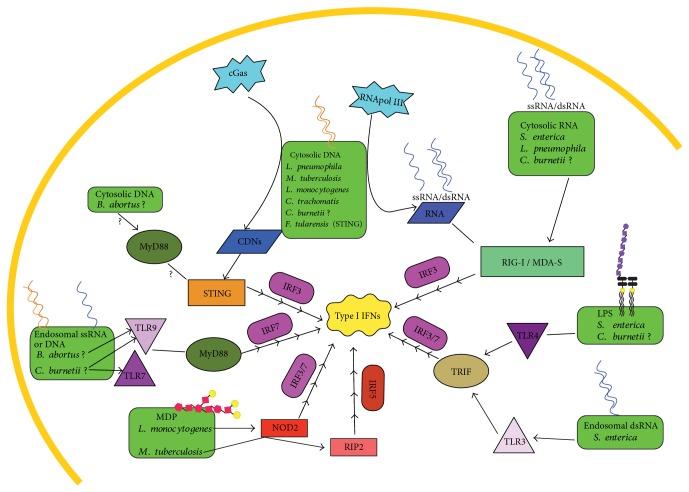
Type I interferons represent a unique and complex group of cytokines, serving many purposes during innate and adaptive immunity. Discovered in the context of viral infections, type I IFNs are now known to have myriad effects in infectious and autoimmune disease settings. Type I IFN signaling during bacterial infections is dependent on many factors including whether the infecting bacterium is intracellular or extracellular, as different signaling pathways are activated. As such, the repercussions of type I IFN induction can positively or negatively impact the disease outcome. This review focuses on type I IFN induction and downstream consequences during infection with the following intracellular bacteria: , , , serovar Typhimurium, , , , and . Intracellular bacterial infections are unique because the bacteria must avoid, circumvent, and even co-opt microbial "sensing" mechanisms in order to reside and replicate within a host cell. Furthermore, life inside a host cell makes intracellular bacteria more difficult to target with antibiotics. Because type I IFNs are important immune effectors, modulating this pathway may improve disease outcomes. But first, it is critical to understand the context-dependent effects of the type I IFN pathway in intracellular bacterial infections.
I 型干扰素是一组独特而复杂的细胞因子,在先天免疫和适应性免疫中发挥多种作用。在病毒感染的背景下发现的 I 型 IFNs 现在已知在感染和自身免疫性疾病环境中有多种作用。在细菌感染过程中,I 型 IFN 信号取决于许多因素,包括感染细菌是细胞内还是细胞外,因为不同的信号通路被激活。因此,I 型 IFN 诱导的后果可能对疾病结果产生积极或消极的影响。本综述重点介绍以下细胞内细菌感染时 I 型 IFN 的诱导和下游后果: 、 、 、 血清型 Typhimurium 、 、 、 和 。细胞内细菌感染具有独特性,因为细菌必须避免、规避甚至利用微生物“感知”机制,才能在宿主细胞内生存和复制。此外,生活在宿主细胞内使得抗生素更难以靶向细胞内细菌。由于 I 型 IFNs 是重要的免疫效应物,调节该途径可能改善疾病结果。但首先,了解细胞内细菌感染中 I 型 IFN 途径的上下文相关效应至关重要。